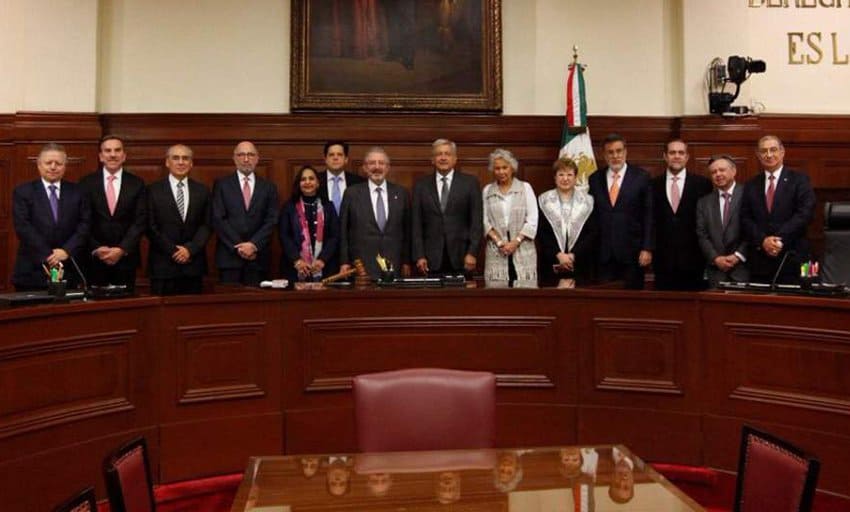
The Supreme Court (SCJN) will aim to cut its spending by 15% next year in line with austerity measures announced by the court’s president last month.
The SCJN will ask the federal government for 4.78 billion pesos (US $251.4 million) for its 2019 budget, just over 850 million pesos (US $44.7 million) less than the 5.63 billion pesos (US $296.2 million) it was allocated this year, according to a financial projection.
Cost-cutting measures proposed by court president Luis María Aguilar Morales, including reducing costs related to protocols, the organization of congresses and conventions, travel, cultural activities and vehicle purchases, are all proposed in the document, to which the newspaper El Universal had access.
No judges or court officials will travel by private plane or helicopter, severance insurance will be halved, and judges and officials will be prevented from taking their families on trips paid for by the court under the court’s financial plan.
Aguilar Morales said last month that the SCJN, the Federal Judiciary Council (CJF) and the Federal Electoral Tribunal (TEPJF) all need to implement actions that enable “greater efficiency, effectiveness, rationality and austerity” in the use of public money.
He stressed, however, that the cost-cutting strategies would not “compromise the independence and autonomy of the jurisdictional bodies.”
The financial document, which will be submitted to the Secretariat of Finance (SHCP) for analysis, said that a significant effort will be made to ensure that future funding the SCJN receives goes to the delivery of justice and the protection of human rights and guarantees enshrined in the Mexican legal system.

The document doesn’t propose any change to the monthly salary of 266,841 pesos (US $14,020) that the 11 Supreme Court judges currently receive.
By comparison, justices of the United States Supreme Court are paid a salary of US $21,275 per month.
Source: El Universal (sp)