



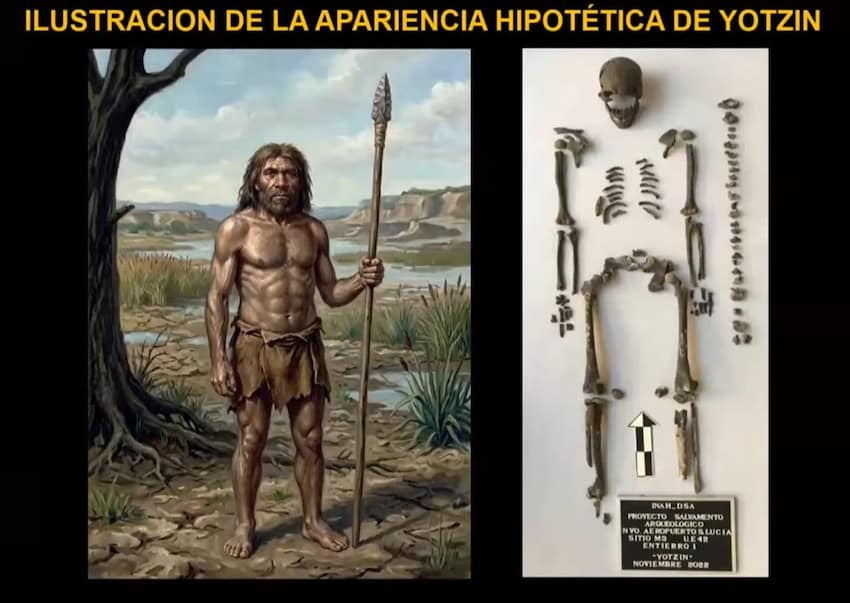
A male human skeleton unearthed in 2021 during construction of the Felipe Ángeles International Airport (AIFA) outside Mexico City has now been confirmed by the National Institute of Anthropology and History (INAH) to date back at least 11,700 years, making it one of the 23 oldest human skeletons found in the Basin of Mexico.
Foreign laboratories determined the age of the find by focusing mainly on the third molar. Isotopic Aging Inc., in Belgium, examined collagen and determined an age of between 12,987 and 13,087 years before the present. The University of Georgia, in the United States, studied bioapatite — a non-organic substance in human bones and teeth — to come up with an age of between 11,700 and 12,050 years.
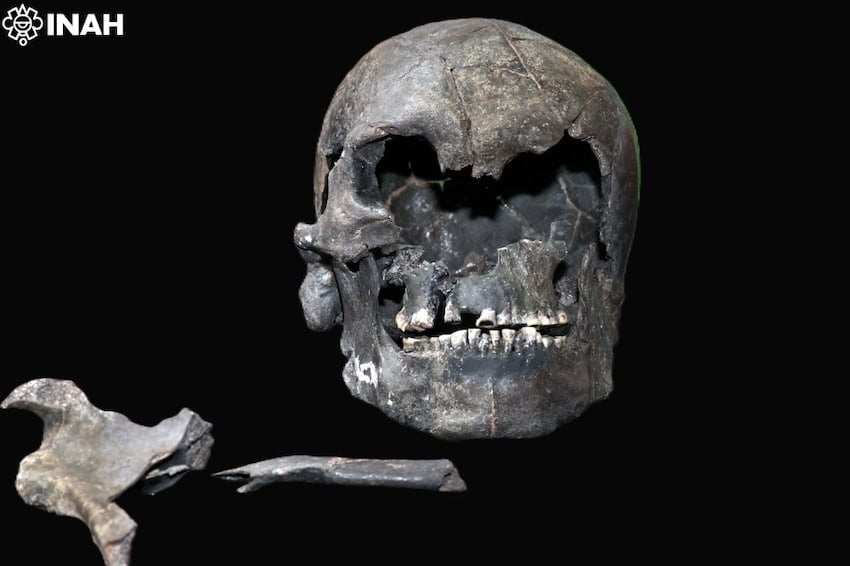
“Yotzin is one of the oldest human remains known to us from the Basin of Mexico,” said Culture Minister Claudia Curiel de Icaza, using the skeleton’s nickname from a Náhuatl word for “unique.” “Its dating brings us closer to a period in our history for which very little evidence exists, and it opens up new possibilities for investigating how those populations lived and where they came from.”
Three other human skeletons were found during AIFA’s construction work, but according to INAH anthropologist Arturo Talavera González, Yotzin’s features are unique, as his nickname implies. He measures 1.75 meters tall and features high bone mass and a “tremendously robust” skeleton, showing characteristics of a hunter used to long-distance walking and combat.
As Yotzin’s teeth were examined, tooth wear was confirmed, but there were no cavities. That absence reflects the fact that pre-ceramic hunter-gatherers did not consume sugars or simple carbohydrates. As Talavera explains it, instead they chewed many roots and tough barks, and used their teeth as a “third hand” for cutting and crushing, which accounts for the wear on its teeth.
Yotzin was discovered by archaeologist Israel Peña in the northwestern sector of AIFA, in sediments associated with ancient marshy environments and the remains of Late Pleistocene fauna – primarily mammoths and camels. Initially, Peña assumed they belonged to a camel. But as the excavation expanded, he identified them as human.
INAH expects to have the results of a genomic study from the University of Burgos, Spain, available during the first quarter of 2027. It should clarify the individual’s ancestry and provide information about the ancient populations of the Basin of Mexico, a geological region comprising four valleys, including the Valley of Mexico.

Mexico News Daily