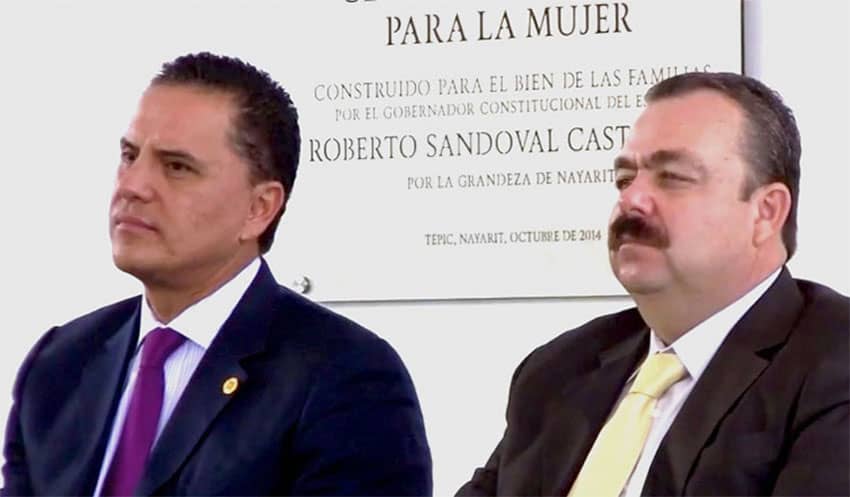
The United States government announced on Friday that former Nayarit governor Roberto Sandoval Castañeda and his immediate family members are ineligible for U.S. visas due to involvement in corruption.
Noting that the U.S. Department of the Treasury designated Sandoval in May 2019 for corruption-related conduct, Secretary of State Mike Pompeo announced the public designation of Sandoval in accordance with the Department of State, Foreign Operations, and Related Programs Appropriations Act due to “significant involvement in corruption.”
Pompeo said that the ex-governor misappropriated state assets and received bribes from drug trafficking organizations, including the Jalisco New Generation Cartel.
“In addition, Mr. Sandoval accepted bribes from the Beltrán Leyva Organization, which President George W. Bush identified as a significant foreign narcotics trafficker pursuant to the Kingpin Act in 2008,” he added.
Pompeo said that once the Secretary of State designates officials of foreign governments for their direct or indirect involvement in significant corruption, those individuals are ineligible for visas to the United States.
The law also requires the Secretary of State to publicly or privately designate the immediate family members of such officials, he said.
“In addition to Mr. Sandoval, the department is publicly designating his spouse, Ana Lilia López Torres; his daughter, Lidy Alejandra Sandoval López; and his son, Pablo Roberto Sandoval López,” Pompeo said.

“Today’s action sends a strong signal that the United States is committed to fighting systemic corruption in Mexico. The United States stands with the people of Mexico in their fight against corruption. The department will continue to use these authorities to promote accountability for corrupt actors globally and near our border, particularly when that corruption is connected to drug trafficking.”
Although Sandoval – Institutional Revolutionary Party governor between 2011 and 2017 – has now been designated by both the U.S. Treasury and Department of State, he does not currently face any criminal charges in the United States.
In Mexico, Sandoval’s bank accounts were frozen by the government’s Financial Intelligence Unit (UIF) after his U.S. Treasury designation last May.
A federal court last month rejected an application by Sandoval to have access to his bank accounts reinstated, ruling that information provided to the UIF by the U.S. Treasury about the ex-governor’s designation is sufficient grounds to keep the accounts blocked.
Sandoval, who has denied all the accusations against him, had argued that the United States does not have jurisdiction over the acts of corruption of which it accuses him because they allegedly took place in Nayarit. It consequently doesn’t have the right to advise Mexico to freeze his accounts, the ex-governor said.
The ex-governor’s attorney general, Édgar Veytia, was sentenced last September to 20 years in jail in the United States for drug trafficking.
He pleaded guilty to accepting payments from drug cartels to help them smuggle cocaine, heroin and methamphetamine into the United States from 2013 until his arrest in San Diego, California, in March 2017.
Source. Reforma (sp)