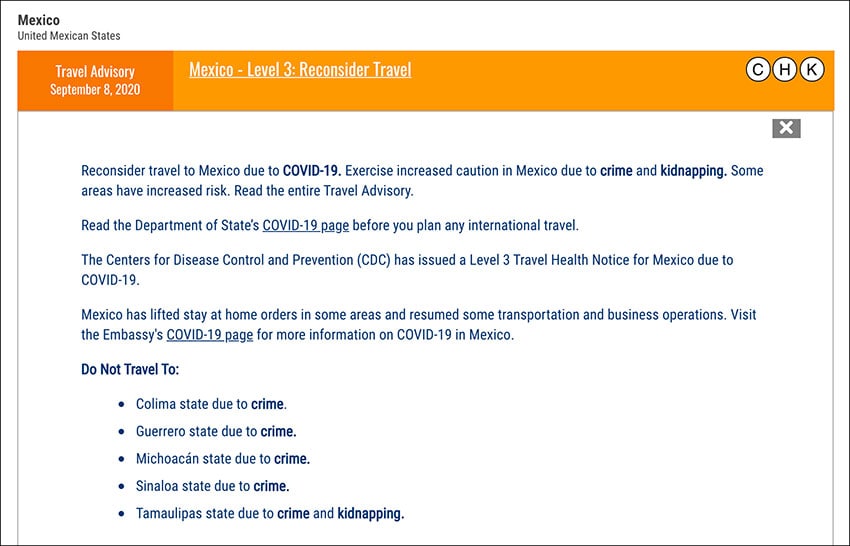
The United States has eased its travel advisory for Mexico from level 4 “Do Not Travel” level 3 “Reconsider Travel.”
Issued Tuesday, the advisory reads, “Reconsider travel to Mexico due to Covid-19. Exercise increased caution in Mexico due to crime and kidnapping. Some areas have increased risk.”
However, the U.S. advises its citizens not to travel to five Mexican states and reconsider travel to another 11 due to crime.
Colima, Guerrero, Michoacán, Tamaulipas and Sinaloa should be avoided by U.S. travelers, according to the State Department, and citizens should reconsider plans to travel to Chihuahua, Coahuila, Durango, Jalisco, México state, Morelos, Nayarit, Nuevo León, San Luis Potosí, Sonora and Zacatecas.
Travelers are advised to exercise increased caution in the rest of the country.
The State Department said homicide, kidnapping, carjacking and robbery are widespread in Mexico and cited piracy of ships and oil platforms in the Bay of Campeche as a risk factor.
It said the U.S. government has limited ability to aid its citizens in certain regions of Mexico, and has restricted or prohibited travel by government employees to several areas.

They may not travel between any city in Mexico after dark, and cannot hail taxis. They are required to use Uber or order a taxi from a taxi stand.
Driving from the border region to the interior of Mexico is also prohibited for federal workers, except for travel in Baja California and federal Highway 15D between Nogales and Hermosillo, Sonora. Government workers need to seek prior consular approval to drive between Nuevo Laredo, Tamaulipas, and Monterrey, Nuevo León, on Highway 85D.
Government employees are not permitted to visit the Copper Canyon in Chihuahua, the area south of and including Highway 45D, Celaya, Salamanca, and Irapuato in Guanajuato, and the entire state of Guerrero, including Acapulco, Zihuatanejo, Ixtapa and Taxco.
They are also forbidden from visiting Tepic and San Blas in Nayarit, the Isthmus region of Oaxaca, the border of Sonora and Chihuahua, or anywhere in Tamaulipas apart from Nuevo Laredo and Matamoros. In those cities they must remain only in areas near their homes and the U.S. consulate, while respecting a curfew between midnight and 6 a.m.
Tourists are encouraged to monitor the Centers for Disease Control and Prevention’s website for information on the coronavirus before making travel plans. The State Department also suggests that U.S. tourists keep friends apprised of travel plans, enroll in the State Department’s Smart Traveler Program, use toll roads whenever possible, avoid wearing expensive watches or jewelry and prepare a contingency plan for emergencies, among other tips.
Mexico News Daily