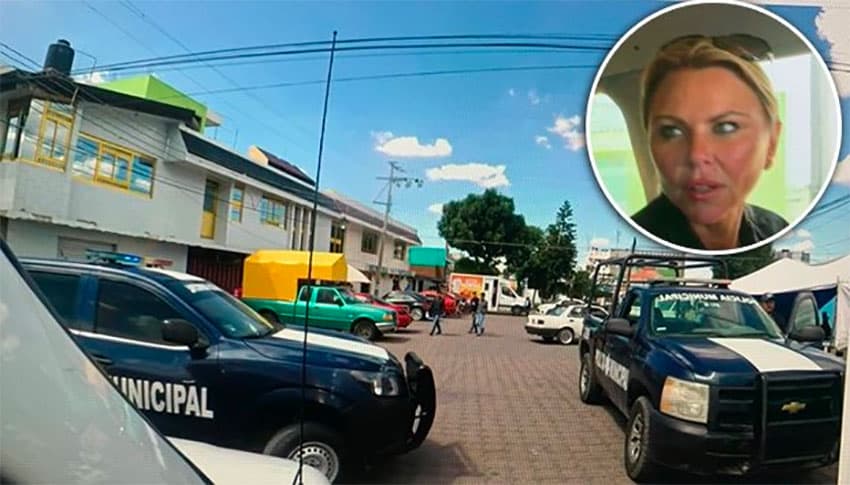
A Fox News reporter was asked by police to leave Tenancingo, Tlaxcala, while working on a sex-trafficking story “for the safety of the town.”
Veteran war correspondent Lara Logan and her team traveled to the town known as the Mecca of human trafficking with two U.S. Homeland Security Investigations (HIS) agents last October to film for a new Fox Nation series Lara Logan Has No Agenda.
While traveling through the center of Tenancingo, HSI special agent Thomas Countermine tells Logan that there is no town “quite like this” in terms of the number of sex workers sent to the United States.
“. . . Hundreds, probably thousands of women have come from Tenancingo” to New York. They sent money back and basically built this town, Countermine adds.
“So, are there scouts tracking us as we move through the town?” Logan asks the HSI agent. “That’s what it appears,” Countermine responds.
In a voiceover, Logan says that “here in Tenancingo they don’t like outsiders, what’s normal for the people who live here is unimaginable for most – an entire town built on sex trafficking.”
Later in the preview clip, a municipal police truck pulls up beside the vehicle in which the reporter and the HSI agents are traveling.

As a Mexico City-based agent identified only as Gus speaks to a police officer, Countermine warns Logan that “if they see you filming them, they’re going to get pissed off.”
Another police truck pulls up to block their path after which Logan says in a voiceover that “the police are guardians of the traffickers and their secrets, moving in to force us out; a veiled threat.”
Gus then reports that “we’ve been asked to depart the area,” adding that “about a week ago they did lynch a couple of people that were here just asking around about the town.”
He also says the police officer told him that there are people “down the street and up the street . . . wondering why we’re here.”
“The policeman told you they lynched some people here?” Logan asks. “Yes, and he’s asked me to calmly leave the area,” Gus responds.
“For our own safety?” probes the South African reporter. “For the safety of the town, he said,” the HSI agent replies.
Fox News reported that Tenancingo police escorted Logan and her team to the outskirts of the town located 15 kilometers north of Puebla city “where the situation escalated further, requiring Gus to immediately get them far away from Tenancingo.”
In a Fox News television interview, Logan said that speaking to the media can even be dangerous for people involved in the sex-trafficking trade.
“One of the pimps from Tenancingo who we interviewed, he had to meet us in a nearby town because he was afraid that his family would kill him if he was talking to us. So that’s the kind of people you’re talking about,” she said.
Sex trafficking began in Tenancingo around the middle of the last century after working age-men returned to the town from neighboring states to find few opportunities beyond badly paid factory jobs, the newspaper The Guardian reported.
“Pimping and trafficking, which they had seen while working away, was a way to get ahead, and many set up small, family-run sexual exploitation rings.”
Source: Fox News (en)