US State Dep’t announces efforts to reduce wait times for visitor visas

The U.S. State Department has reduced wait times for visitor visas, officials announced during a press briefing Thursday.

The agency doubled the number of U.S. Foreign Service personnel to meet the backlog of visa applications and conduct in-person interviews. 

“We’ve seen a tremendous drop in wait times today. We have a median global wait time of seven weeks for visitor visa interviews and only seven days for students and temporary workers. That’s down significantly from just a few months ago,” said Julie Stufft, an official from the State Department’s Bureau of Consular Affairs. 

The press release also notes that the State Department is waiving in-person interviews where possible, processing more visas with smaller staffs, processing visas remotely and providing greater transparency in the visa application process. 
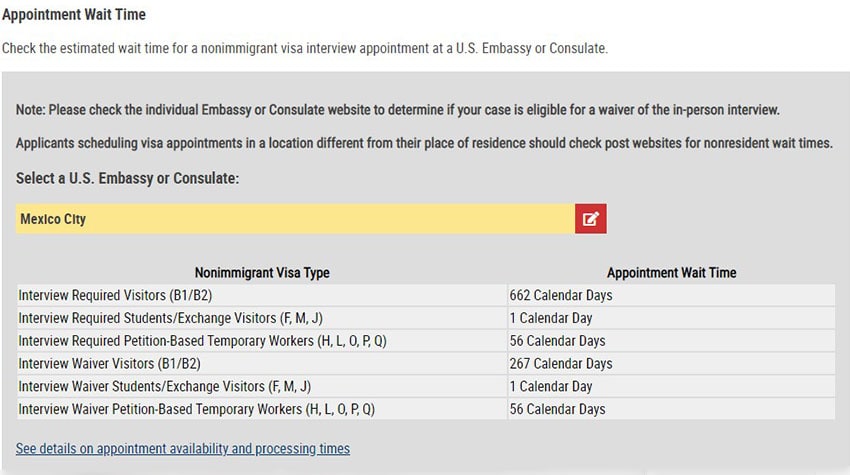
US Consulate appointment screenshot
The Mexico City consulate’s wait time for student visa interviews is better than the current global average, but other types still take weeks to years to schedule, as this screenshot taken Friday afternoon shows. travel.state.gov

The processing of visa requests faced extensive delays during the COVID-19 pandemic due to health restrictions preventing in-person interviews. 

While the U.S. government states that the median global wait time for a tourist visa is seven weeks, and that it expects to return to pre-pandemic processing numbers in 2023, wait times for a U.S. visa vary significantly throughout the world, with several countries still facing delays.

As recently as last month, the wait to schedule an interview at a U.S. consulate in Mexico reached up to 746 days, depending on the city in which it was scheduled. The wait time for an appointment in Mexico City was 647 days. 

According to the U.S. Travel Association, visa processing delays were on track to cause the loss of 6.6 million international travelers, amounting to an economic cost of $11.6 billion by 2023. 

Mexico is among the three largest U.S. tourist markets in the world. 

With reports from La Jornada, El Heraldo, and VOA News

Have something to say? Paid Subscribers get all access to make & read comments.
Manzanillo, Colima, México, 13 de marzo de 2026. La doctora Claudia Sheinbaum Pardo, presidenta Constitucional de los Estados Unidos Mexicanos en conferencia de prensa matutina, “Conferencia del Pueblo” desde Colima. La acompañan Indira Vizcaíno Silva, gobernadora Constitucional del Estado de Colima; Omar García Harfuch, secretario de Seguridad y Protección Ciudadana (SSPC); Raymundo Pedro Morales Ángeles, secretario de Marina (Semar); Bulmaro Juárez Pérez, divulgador de lenguas originarias, presentador de la sección “Suave Patria”; Ricardo Trevilla Trejo, secretario de la Defensa Nacional (Sedena); Jesús Antonio Esteva Medina, secretario de Infraestructura, Comunicaciones y Transportes; Bryant Alejandro García Ramírez, fiscal general del Estado de Colima; Fabián Ricardo Gómez Calcáneo; Rocío Bárcena Molina, subsecretaria de Desarrollo Democrático, Participación Social y Asuntos Religiosos de la Secretaría de Gobernación; Efraín Morales López, director general de la Comisión Nacional del Agua (Conagua); Marcela Figueroa Franco, secretaria ejecutiva del Sistema Nacional de Seguridad Pública (SESNSP) y Guillermo Briseño Lobera, comandante de la Guardia Nacional (GN). Foto: Saúl López / Presidencia

Mexico’s week in review: Congress deals Sheinbaum her first legislative defeat

1
The week of March 9 in Mexico was marked by standoffs between allies in Congress and adversaries at the airport. Here's what you missed.
A soldier displays seized handguns

The US and Mexico, growing together and growing apart: A perspective from our CEO

1
From a historic drop in homicides to opposite bets on electric vehicles, Mexico News Daily's CEO breaks down where the U.S. and Mexico are converging — and where they're not.
Veracruz Gov.

Veracruz governor blames private vessel for 200-kilometer Gulf Coast oil spill

1
The spill, which has spread to over 200 kilometers of Mexico's Gulf Coast beaches, has been traced to a private oil tanker off the coast of Tabasco.
BETA Version - Powered by Perplexity