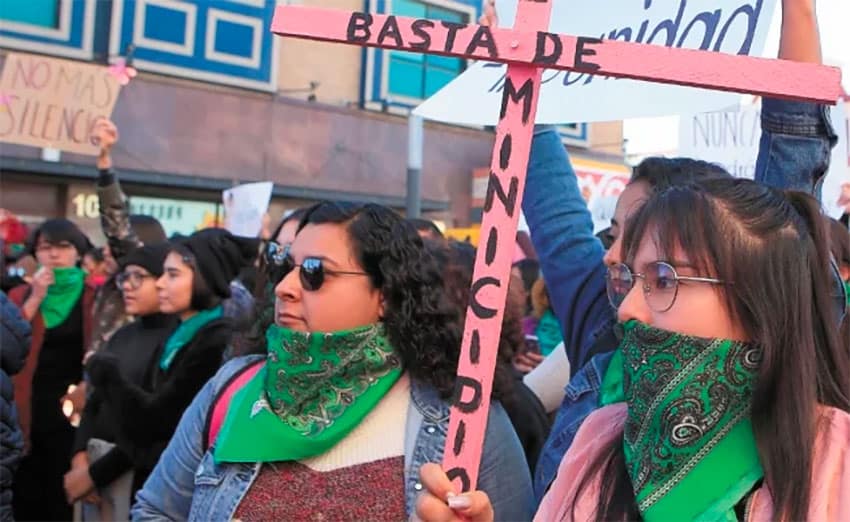
Mexico is set to record its worst ever year for femicides, statistics show, while several other crimes against women have trended upwards in recent months.
There were 809 victims of femicide – a hate crime involving the violent and deliberate killing of a woman or girl – between January and October, according to the National Public Security System (SNSP).
The figure is almost double the number recorded in all of 2015 and just 82 fewer than the 891 cases in 2018, the worst year ever for the crime.
Veracruz led the way with 147 victims, followed by 95 in México state, 58 in Nuevo León and 50 in both Puebla and Mexico City. The combined number of victims in the four states and the capital represents 49.5% of all femicides in the country this year.
Another 2,309 women were killed between January and October in crimes classified as murders rather than femicides.
If the same rate continues for the last two months of the year, the number of murders of women in 2019 will be virtually the same as 2018, a record 2,773.
The combined statistics for femicide and murder in the first 10 months of this year – which show that an average of 10 women were killed every day – indicate that 2019 is likely to go down as the most violent year ever for women in Mexico.

Four other crimes against females – malicious injury, kidnapping, trafficking of girls and extortion – all increased in the three-month period between August and October compared to the same period last year.
Once data for three other crimes – femicide, murder and trafficking of women – is added, statistics show that a total of 18,616 females were victims of the seven offenses in the three-month period.
Malicious injury was by the far the most common crime, accounting for 89% of victims.
Ana Yeli Pérez, a legal adviser at the National Citizens’ Observatory on Femicide, told the newspaper El Universal that the number of malicious injury cases tends to be high because authorities often place other crimes (such as rape) in the category.
“Malicious injury cases . . . make other kinds of violence [against women] invisible,” she said, adding that the incorrect reporting of crimes makes preventing aggression towards women more difficult.
Pérez said that recent women’s protests against violence are “an expression from the female population of being fed up” with the situation in the country.
She expressed confidence that the protests will help to reduce gender-based violence in the long run but added that President López Obrador also has an important role to play by ensuring that agencies such as the National Commission to Prevent and Eradicate Violence against Women are functioning as they should.
Sandy Muñoz Miranda, a researcher at the National Autonomous University who specializes in gender issues, said that violence against women remains high because even though Mexico has robust laws in the area, in many cases they are not correctly applied.
“We have new laws that are in force, what’s lacking is the awareness of public officials, they have an important role [in the justice system] . . .” she said.
Muñoz described the situation of violence against women in Mexico as “grave,” adding that “the reduction of crimes like harassment and rape has been very slow due to a lot of factors, among which is a lack of education.”
Source: El Universal (sp)