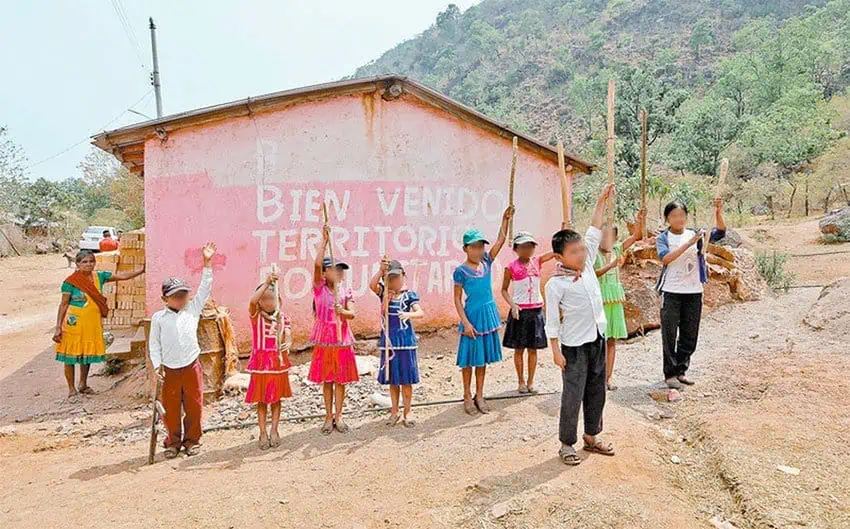
In an indigenous mountain village in Guerrero, located in the middle of territory disputed by rival drug gangs, security is the responsibility of all – even the women and children have taken up arms.
The residents of Rincón de Chautla are determined to defend their town in the case of an attack by Los Ardillos or their rivals, Los Rojos.
“We’re organizing because we want to defend our town with sticks and stones . . . and guns,” Angélica, a girl aged about 12, told the newspaper Milenio.
Adán, an eight-year-old boy, explained that he was the “commander” of a group of children in training to join the community police force.
In a video published by Milenio, the boy barks orders at his junior comrades as they raise and lower large sticks. One boy wields a rifle although it is unclear whether it is real or fake.
Despite calls from the state government and the Guerrero Human Rights Commission not to allow children to participate in practices that violate their rights, parents say that the military-style training will continue.
The Nahua village of just over 100 people, located 15 kilometers from Chilapa, has already experienced bloody violence firsthand.

On January 27, members of a self-defense group believed to be connected to the Ardillos crime gang arrived at the entrance of the town and began making threats against residents, according to David Sánchez Luna, a coordinator of the community police network known as CRAC-PF.
“That day there was only a group of 30 community police in the town. There were about 200 sicarios [hitmen] and their boss shouted that they were coming to massacre us. They tried to break the chain at the entrance [to the town] with gunfire but they couldn’t, and that failure allowed us to organize the defense,” he said.
A confrontation ensued during which hundreds of shots were fired but only one Rincón de Chautla community police member was wounded. Two aggressors from the group known as Communities for Peace and Justice (CPJ) were killed.
The same day, another clash in the municipality of Chilapa between Paraíso Tepila community police – who are also affiliated with CRAC-PF – and CPJ left 10 people dead.
“We’re all tired of the deaths caused by Los Rojos and Los Ardillos,” Sánchez Luna said.
“The CRAC-PF arose with the intention of making them see that we don’t want to be subjected to their interests, that we don’t want to be on either of their sides and that we only want them to let us work in the fields,” he added.
The women of Rincón de Chautla are adamant that they won’t be defenseless in the face of another attack.
“They say that they’re going to kill our husbands and come into our houses, where us [women] and our children are. That’s why we’ve decided that we’re going to defend ourselves,” one woman said.
Holding a rifle and with her infant daughter on her back, Adela Virgilio said that “a real mother does anything for her children, for her family.”
She added: “To this day, we haven’t received any support from the municipal, state or federal governments, they’ve abandoned us . . .”
Another gun-toting woman, Sara Flores, staunchly declared: “If we die, we’ll die standing, not on our knees.”
Source: Milenio (sp)