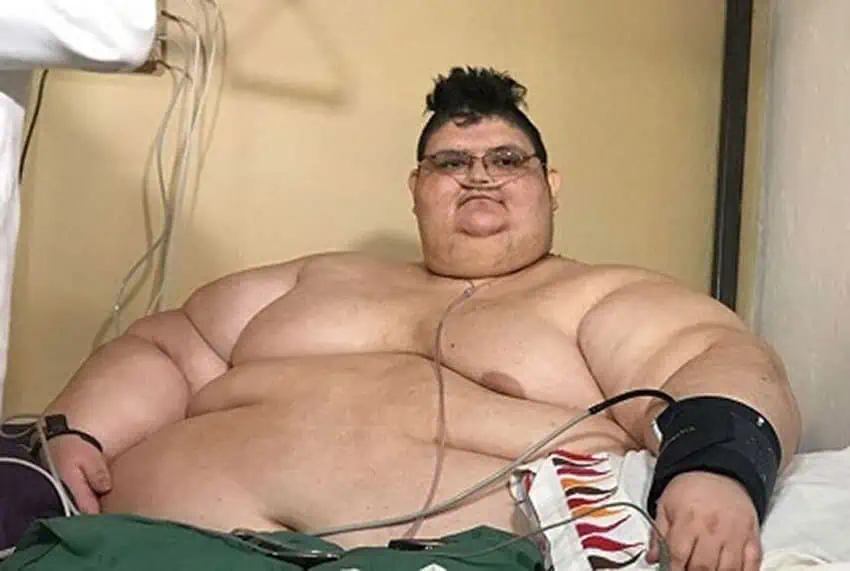
He was the world’s heaviest man for a while but today, 34-year-old Aguascalientes native Juan Pedro Franco falls well short of the unenviable title.
Two years ago, Franco left his home state weighing 595 kilograms to travel to Guadalajara, Jalisco, to undergo surgery at a specialized clinic.
After two operations – a sleeve gastrectomy and a gastric bypass – he shed about half his body weight to reach 304 kilograms. And thanks to a third surgical procedure he could lose another 140 kilos.
For the first time in years, Franco was able to get out of bed, walk and wash and dress himself.
Yesterday, a medical team led by bariatric surgeon José Antonio Castañeda placed a gastric band in the top portion of the man’s stomach, meaning that his daily food intake will be limited to what can fit in just two shot glasses, or a maximum of about 80 grams.
In the future, the band will likely be adjusted to restrict even further the amount of food that Franco can eat.
“We decided to carry out this surgery because he didn’t achieve his ideal weight,” Castañeda said.

The inflatable silicone device, commonly called a lap-band, is expected to help Franco to lose around 150 kilograms in a period of between six months and a year.
If that goal is achieved, Franco will weigh 154 kilograms or just 26% of his peak weight. However, he is already feeling the benefits of his remarkable weight loss.
“Before I took around six to 10 steps and then I had to sit down . . . Now I can walk more than 100 steps, even 10 laps of 40 steps. It’s a breakthrough . . .” Franco told the newspaper Milenio.
He also said that his blood-sugar levels have decreased significantly and that he has been able to stop taking a lot the medications he previously used to control his diabetes, high blood pressure and obstructive pulmonary disease.
“Now I’m taking 12 pills in the morning and 12 at night. I used to inject a lot of insulin but now it’s just 20 units,” Franco said.
He is also lifting light weights and doing at least 21 squats a day and no longer depends on an oxygen tank.
“We’re making progress. It’s two years already [since the first surgery] but we’re talking about almost 300 kilograms [that I’ve lost], half my body weight . . .” Franco said.
“Yes I think about death and I’m afraid but we’ll make it through.”
In December 2016 he was certified by Guinness World Records as the world’s fattest man at 595 kilos.
Source: Milenio (sp)