A rail blockade in Sonora by indigenous people demanding the government fulfill social development commitments has delayed the delivery of more than 1,000 shipping containers, according to the president of a transport association.
Yaqui indigenous people have blocked the tracks in Vícam, a town in the municipality of Guaymas, for the past 10 days, said Humberto Vargas García of the Mexican Association of Intermodal Transport.
He said companies seeking to move supplies and final products from central Mexico and the Bajío region to the northwest of the country have spent more than 20 million pesos (US $895,000) to have their goods offloaded from trains and transported to their final destination on trucks.
Vargas said the blockade is causing “significant repercussions” for both companies and consumers because goods, including food, beverages, health products and auto parts, “are not arriving on time.”
Ford México said Wednesday that the blockade was affecting operations at its plant in Hermosillo, Sonora, as well as imports from and exports to the United States.
“The recent blockade of the rail network … has affected operations at our Hermosillo plant,” the company said in a statement sent to the Reuters news agency.
“Currently, we are facing a situation unrelated to us, wherein imports and exports have been affected.”

According to the Mexican Railway Association (AMF), the blockade has prevented some 150,000 tonnes of cargo from reaching the Mexico-United States border crossings at Mexicali, Baja California, and Nogales, Sonora.
AMF President José Zozaya estimated that the Yaqui people’s protest had caused losses of more than 75 million pesos (US $3.35 million) over the past 10 days.
He said Wednesday that the rail association had engaged in discussions with both the government and protesters and expressed confidence that the blockade would soon be lifted.
Yaqui protesters also stopped traffic Monday and Tuesday on Highway 15, which runs through several states including Sonora to the border at Nogales.
Tractors and pickup trucks blocked the highway from 6:00 a.m. to 6:00 p.m Tuesday in the community of Loma de Guamúchil, located 30 kilometers east of Vícam in the municipality of Cajeme.
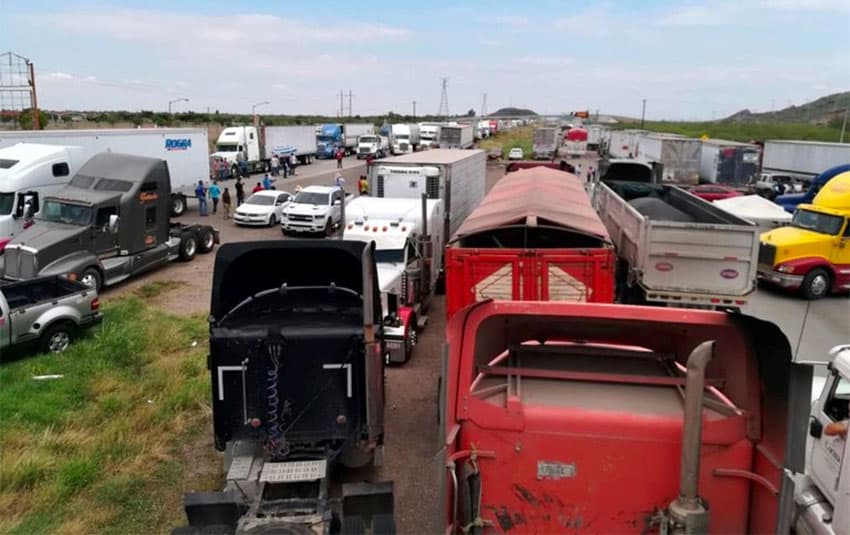
The blockade caused northbound and southbound traffic, including cargo trucks and passenger buses, to back up for several kilometers, the news agency EFE reported.
The protesters are demanding that the federal government fulfill commitments to carry out social development programs and projects in eight Yaqui towns: Cócorit, Bácum, Vícam, Pótam, Tórim, Huírivis, Ráhum and Belem.
Sergio Estrella, a local official from Cócorit, read out a manifesto during Tuesday’s highway protest that said the Yaqui people have reached several agreements with federal authorities to allow the construction of a range of infrastructure projects on their land.
In exchange for granting the government permission to carry out highway, telecommunications, electricity, gas, oil and water projects, federal authorities made commitments to compensate the Yaquis through social programs and projects, he said.
However, they failed to keep their word, Estrella said, adding that the protesters are willing to enter into dialogue with the government to reach an agreement that respects the law as well as “our traditions and customs.”