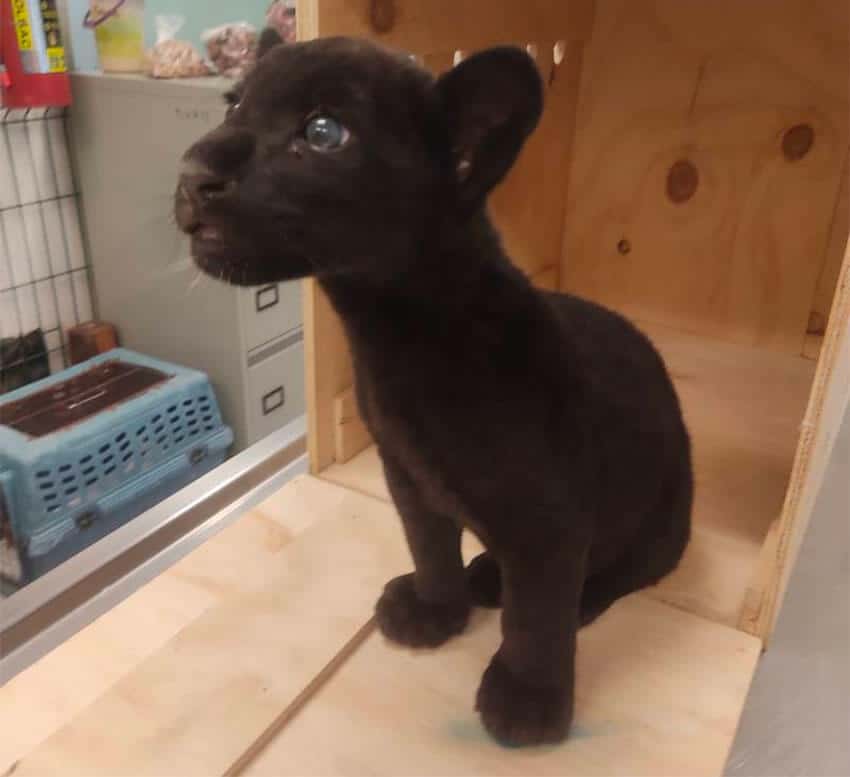
A three-month-old baby jaguar was seized at Mérida airport, the environmental protection agency Profepa said on Monday.
The male cub was discovered during a National Guard operation to combat the illegal trafficking of animals.
The feline was found thanks to the detection of a microchip that it was wearing, aided by the discovery of irregularities in documents that were presented.
Profepa wrote on Twitter to confirm the seizure and said the jaguar would be handed over to a Wildlife Management Unit (UMA).
Jaguars are listed as near threatened on the International Union for Conservation of Nature (IUCN) Red List as the population has probably declined by 20–25% since the 1990s. In Mexico, the jaguar is primarily threatened by poaching. Its habitat, in the north, the Gulf of Mexico and the Yucatán Peninsula, is threatened by changes in land use, construction of roads and the construction of tourism infrastructure.
Bengal tigers have also become a challenge for authorities.
Three Bengal tigers under the responsibility of federal and state authorities died of starvation in a cage in Guerrero in February. In March, a Bengal tiger was captured in a house in Chimalhuacán, México state, and a cub was rescued in Celaya, Guanajuato. A large white tiger was killed by authorities in Querétaro later that month and a tiger has been on the loose in Guanajuato, killing livestock, since December.

Meanwhile, tropical birds have also been appearing outside of their habitat.
A pelican whose wings had been hurt was seized by authorities in the center of the borough of Tláhuac in Mexico City. Officials said it would be taken to a reserve belonging to the National Autonomous University (UNAM) for observation, to be freed later by Profepa.
With reports from El Financiero