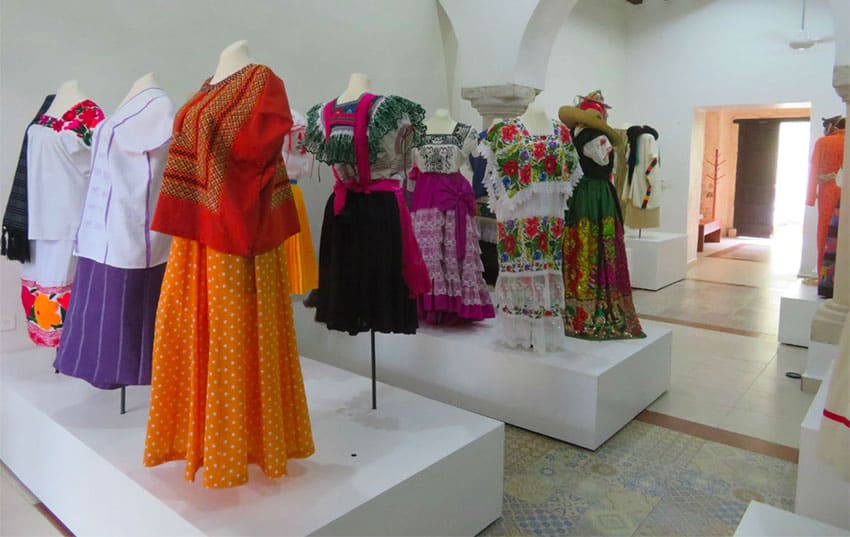
Thanks to the efforts of an American woman with Mexican roots, the city of Valladolid, Yucatán, has a museum exclusively dedicated to the traditional clothing of the entire country, the Museo de Ropa Étnica de México (the Ethnic Clothing Museum of Mexico, or Murem).
The museum is the work of Tey Mariana Stiteler, who decided to retire in Mexico after a career at the Carnegie Museum of Art, and moved to Valladolid in 2009, wrote Necee Regis last week in The Washington Post.
Like so many foreigners living in Mexico, she was bitten by the handcrafts collecting bug, with a particular interest in traditional attire of all types. She began traveling all over Mexico to meet and talk to clothing makers.
Stiteler admits that when she started she bought items because she thought they were pretty. This changed on a trip to Chiapas where she bought some white-on-white embroidery and brocade weaving which is traditional in mountain villages. But she also noticed that it was not visible in all towns in the area. Here she realized that clothing preferences change, even in Mexico’s most traditional states, and concluded there was a need to preserve and document clothing styles.
The purpose of Stiteler’s museum is to highlight Mexico’s many cultures through their dress, along with preserving and documenting clothing styles in danger of being lost. Generally, creating a museum with its accompanying non-profit organization is a very slow process, but Stiteler managed to do it in six months, officially opening the doors in April of 2018.

Creating a museum was not in her plans when she moved to Valladolid. “I was planning a one-time exhibition,” she said.
With such a large collection herself, someone commented that she should start a museum and she decided to take the plunge. The museum’s collection includes more than 90 complete outfits representing 25 ethnic groups from 16 states. It includes three types of garments: traditional (mestizo), indigenous and contemporary, organized by region. Only 65 are on view, along with individual hats, shoes, aprons and more.

When possible, similar garments from different time periods are displayed to show how elements remain or change over time such as neck openings, embroidery styles and the like. One change was the introduction of machine embroidery to the Yucatán peninsula. An antique foot-pedal Singer machine references its introduction to the area in the 1950s. Stiteler says that while most tourists are turned off by the idea of machine embroidery, well done pieces are truly works of art.
Even though there is still work to do with the collection, Murem has begun other activities. One is an educational program with public schools from preschool to secondary.
The documentation and promotion of the stories and culture behind the garments is seen as important. According to Stiteler, “It’s important to catalogue. I give it one or two generations until the daily use attached to traditions and rituals is gone. It will become a modernized version of something. The truth of it will be lost.”
Stiteler has supported the museum so far with her own funds, but the next goal is to become self-sustaining so government authorization to accept donations is expected soon. She does not want to take government money, but rather work with NGOs and other private entities.
In the next three years, Stiteler hopes to move the museum to a larger space. She says it needs at least four exhibition halls, along with storage areas and an office.
Source: The Washington Post (sp)