Home Blog Page 1236

Artist’s catrinas, coyotes and serpent gods explore issues of social justice

0
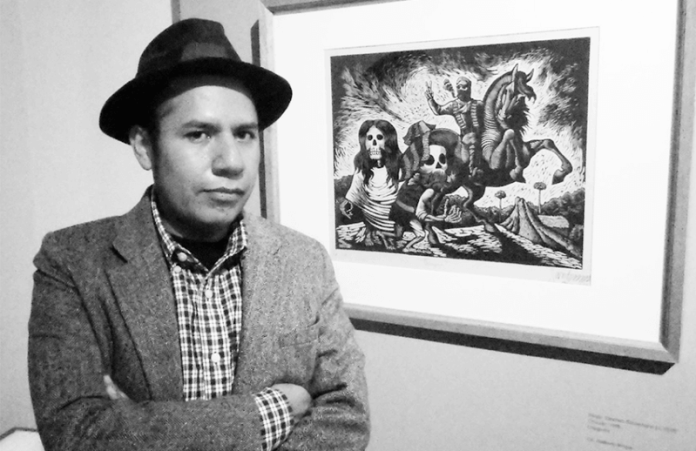
Mexican artist Sergio Sánchez Santamaría.
Mexican artist Sergio Sánchez Santamaría. photos courtesy of Sergio Sánchez Santamaría and Artist Studio Project Publishing

A catrina holding a scythe hovers over a Mexican municipality. In the background, the stars in the night sky form the shape of a skull. The skeletal figure in the foreground wears 21st-century attire — a backward ballcap, sunglasses and sneakers. And on the catrina’s jersey is a decidedly contemporary phrase: Covid-19.

This black-and-white image is among the many selections from acclaimed Mexican printmaker Sergio Sánchez Santamaría in the new book, Graphic in Transit, launched in March over Zoom.

“The opportunity to look at the work of an artist as prolific as Sergio is a very good problem,” said Miguel Rojas Sotelo, one of the book’s editors, along with Rafael A. Osuba.

Rojas Sotelo, an art scholar, is the program coordinator for the Center for Latin American and Caribbean Studies at Duke University in Durham, North Carolina. “In a sense, we tried to do some curatorial renderings of some of the themes that are very present in the work of Sergio,” he said.

The idea for the book was sparked by one of the major collectors of the artist’s work — Duke emeritus professor Robert Healy — who is also based in North Carolina and has known the artist since the late 1990s. About six years ago, Rojas Sotelo and Healy were discussing the Taller de Grafica Popular or TGP, a Mexican art collective first founded in the 1930s concerned with using art to advance revolutionary social causes. The subject of Sánchez Santamaría came up.
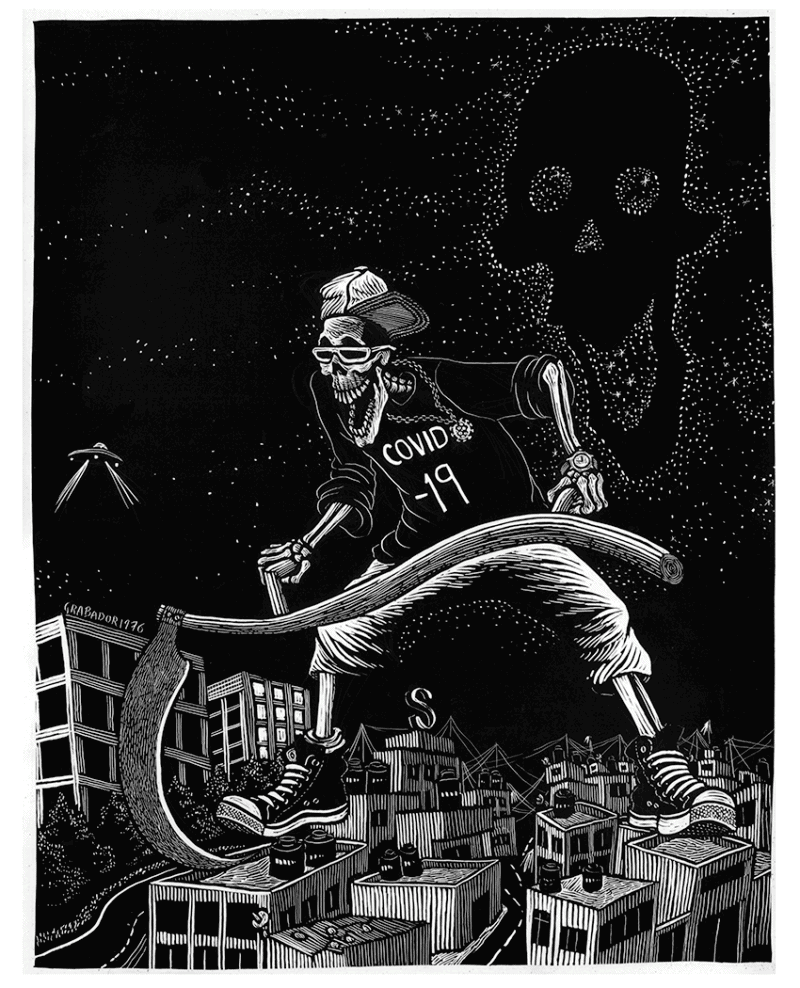
"Scratchboard," by Sergio Sánchez Santamaría.
“Scratchboard,” by Sergio Sánchez Santamaría.

“Bob said, ‘I do have this impressive art from someone who started very young and [who] is not that well-known,’” Rojas Sotelo recalled. “We started working on a way to bring Sergio to the U.S.”

Sánchez Santamaría has since come to Duke several times, interacting with young American art students and having his work exhibited. Now it is the subject of a book.

He sees connections between his art and the TGP — “probably the second-most well-known and important art movement from Mexico after the muralists,” according to Rojas Sotelo. That’s true not only due to the themes of social justice that resonate in Sánchez Santamaría’s work but also through his possession of the printing press of one of the TGP’s co-founders and best-known artists, Leopoldo Méndez.

A native of Tlayacapan in Morelos, Sánchez Santamaría still makes his home there, where roosters could be heard crowing in the background as he was interviewed over video conferencing software along with Rojas Sotelo from a separate location. Sánchez Santamaría describes himself as growing up in an artistic family with indigenous roots, as well as possible Black slave ancestry.

“My original intention was to become a sculptor, working with stone like Michelangelo,” he said. Yet he became curious upon seeing lithographs at a museum, including ones by artist José Jorge Chávez Morales.

“This style left an impact,” he recalled. Eventually, he got into printmaking after being introduced to the work of masters like Méndez.
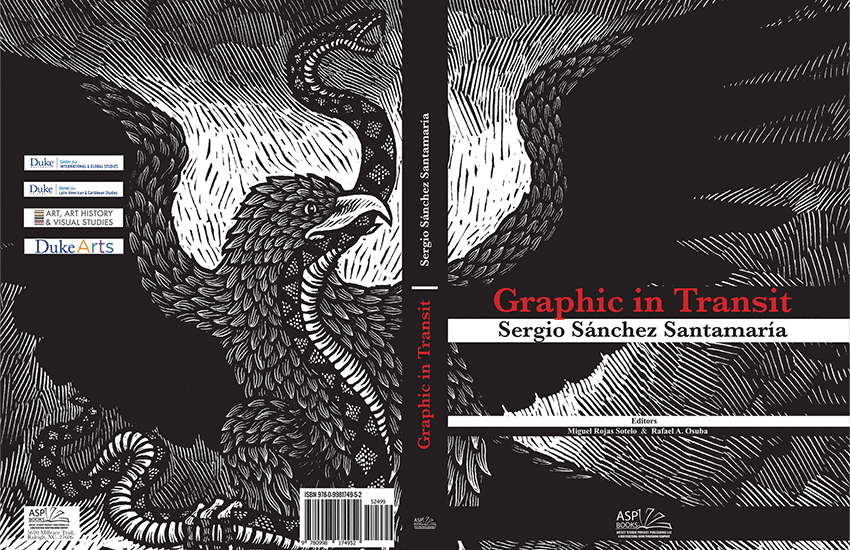
Sergio Sánchez Santamaría's book Graphic in Transit
Sergio Sánchez Santamaría’s book Graphic in Transit came out in March of this year.

Like the TGP artists in 20th-century Mexico, Sánchez Santamaría’s art reflects a concern with contemporary issues of social justice.

“Discovering his story, we were thinking it was … very powerful …” Rojas Sotelo said. “Not only because he’s an incredible, very talented graphic artist — he is an artist with a capital ‘A’ in all respects — [but] because of [his] lines of connection to history with revolutionary art in Mexico.”

Rojas Sotelo cites a print that Sánchez Santamaría made while a visiting artist at Duke University. It depicts a real-life incident in which ICE agents arrested a young asylum-seeker from Honduras who was eventually deported.

“There’s a very direct link with the history of the TGP” and Sánchez Santamaría’s work, Rojas Sotelo said.

Another image, entitled Viva Mexico, is a complex depiction of the Mexico-U.S. border through such images as that of the Virgin of Guadalupe, a mulatto woman, the Aztec serpent god Quetzalcoatl and the skyscrapers of the United States.

On one side is a Mexico troubled by unemployment and starvation; on the other side is the American Dream, represented by skyscrapers. The two countries are separated by the dangers of the desert and the Río Grande. “It’s very interesting, the kind of work he does,” Rojas Sotelo said. “There’s a documentary journalistic aspect.”

Artist Sergio Sanchez Santamaria self-portrait
A self-portrait of the artist, circa 2016.

Another way Sánchez Santamaría addresses Mexico-U.S. border issues is by a depiction of an indigenous nahual as a modern-day coyote leading migrants north.

“He does research on indigenous traditions that still play a role in many of the little towns of deep Mexico,” Rojas Sotelo said. “He loves the idea of el coyote as an owl nahua. The magical, mystical garb at the same time represents an animal moving across a territory. It doesn’t have a border. A nahual or spirit man moves across another [territory]. It’s what a coyote does. It’s very powerful, these visual representations of Mexican traditions.”

More recently, Sánchez Santamaría addressed the Covid-19 pandemic with an updated version of the Mexican Revolution-era catrinas of Jorge Guadalupe Posada. This was done on scratchboard in a style that resembles a print.

It depicts “my new catrina, a character from this era,” the artist said, yet he sees many parallels with history, including with Posada’s catrinas. He also finds a connection with the medieval woodcuts of the victims of death by Hans Holbein the Younger.

Sánchez Santamaría cites one such Holbein woodcut of a monk:

“In this example, the dead wears a monk’s habit. The monks are the most impressive people; they speak the word of God.” Yet this cannot stop them from dying, he notes.

Illustration from Graphic in Transit
An illustration from the new book on Sergio Sánchez Santamaría’s work.

Unlike in Holbein’s work, Sánchez Santamaría’s catrinas are “not monks, they are more like reggaeton [singers],” dressed in Bermuda shorts and tennis shoes.

In addition to his political themes, some of his other prints show images of nature in Mexico, as well as depictions of the Mexican gallo, or rooster, and even of traditional maize.

“I am particularly interested in his work on representing nature,” Rojas Sotelo said. “His work is full of references to Mexico’s geography, to plants, to trees, to locations.”

Sánchez Santamaría also does works related to his interest in tattoos, as well as to his love of music — he wore a Pink Floyd hoodie during the interview.

“His work is multifaceted,” Rojas Sotelo said.

Indeed, he noted, “[Sánchez Santamaría’s] work has a lot to do with reacting to the times. It’s reflective of kind of what we have with issues of identity, what constitutes being a subject in today’s Mexico, identity constraints on Mexicans, a presence of this hybridizing mix of what Mexican culture is. He reflects on that.”

Rich Tenorio is a frequent contributor to Mexico News Daily.

Makeshift hospital offers hope to people of limited means

0
The idea for the 'covitario' occurred to Martha Alicia Torres last year when she saw that city workers without social security were being turned away from the public hospitals.

In Culiacán, Sinaloa, a makeshift hospital is offering Covid-19 patients oxygen and medical treatment.

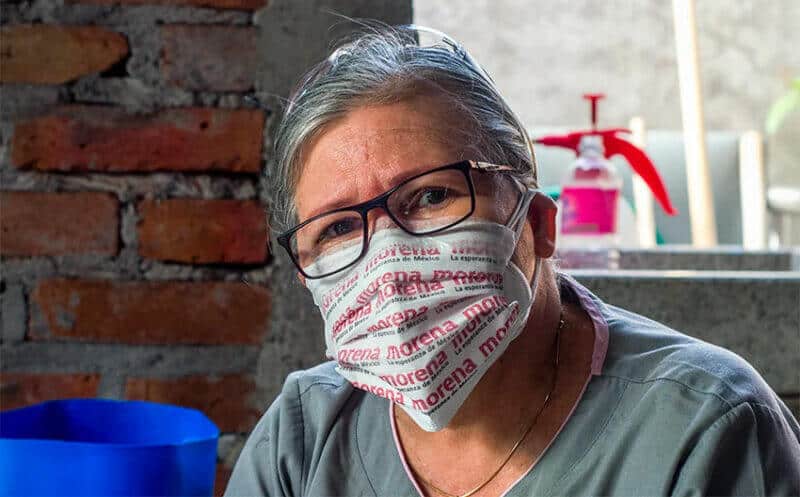
Head of municipal health, Martha Alicia Torres, runs the covitario, which still has a dirt floor and no roof.

Torres, who wears three face masks, said the idea was born of necessity. “The idea came up a year ago when local government workers who didn’t have social security were being turned away from public hospitals and didn’t know how to take care of themselves … Months later we started receiving people without any means and that’s when the consultations rose to 90 per day.” she said.

She estimates about 5,000 patients have passed the covitario, arriving as early as 4:00 a.m. to ensure they get an appointment.

However, the hospital is running on lean resources, Torres said. “There are so many patients who attend the covitario that there is not enough medicine. Today is when you need the help of the politicians who were promising everything in the campaign … Where else are people going to go if the hospitals in Culiacán are full?” she said.

Dr. Torres of Culiacán's community Covid hospital.
Dr. Torres of Culiacán’s community Covid hospital.

The community hospital survives by the support of other medical professionals, like nurse Rocío Gastelum, who helps out on her days off at the General Hospital. Gastelum said she owed a debt to Torres. “Two of my relatives got sick and Dr. Torres saved them, that’s why I’m here,” she said.

Other volunteers that collect Covid-19 medicines in the city center have also been central to the operation. Activist Martha Camacho said she wanted to give back. “I found out about the covitario because a daughter contracted Covid-19 and that’s where she received all the help to recover.”

Gabriel, 27, is a current patient at the covitario after he couldn’t get treatment in a public hospital, and maintains he has been well assisted by Torres and company. “I have been ill for seven days and I have not stopped attending my appointments with Dr. Torres,” he said.

Sinaloa is one of seven states that are red on the coronavirus stoplight map, according to federal data.

It has been the fifth worst state in terms of deaths per 100,000 inhabitants over the course of the pandemic.

With reports from Milenio

Conquest was ‘a disaster,’ says AMLO; asks indigenous for forgiveness

0
President López Obrador at the Zócalo, Mexico City's central square
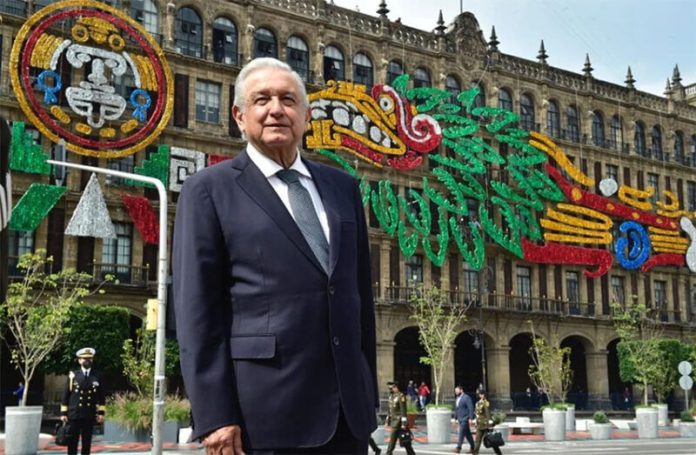
President López Obrador at the zócalo, Mexico City's central square.

President López Obrador asked indigenous people for forgiveness for the fall of Tenochtitlán and called the ensuing domination of Spanish conquistadors “a disaster” at events commemorating the 500th anniversary of the collapse of the Aztec — or Mexica — Empire.

Tenochtitlán was the forbear to Mexico City and the capital of the Mexicas, the dominant ethnic group before the Conquest. After the military defeat on August 13, 1521 the city was looted and razed.

AMLO, as the president is commonly known, spoke on Friday in front of a replica of the Templo Mayor, a temple of spiritual importance destroyed in the Conquest, which was erected in Mexico City’s central square, the zócalo, for the event called 500 years of Indigenous Resistance.

“August 13 is a funeral date …  we remember the fall of the great Tenochtitlán and we apologize to the victims of the disaster caused by the Spanish military occupation of Mesoamerica and the territory of the current Mexican republic,” he said.

“The Conquest was a resounding fiasco. How can we call it a civilization if the lives of millions of human beings are lost and the nation, the empire, the dominant monarchy does not even manage to recover the population that existed before the military occupation in three centuries of colonization … The Conquest and colonization are signs of backwardness, not of civilization, less of justice,” he said.

AMLO added that conqueror Hernán Cortes had achieved victory by deception. “A soulless soldier, a bold and ambitious politician … who skillfully took advantage of the divisions and weaknesses of the Mexicas to impose himself with … tricks, terror and violence until he succeeded in seizing the longed-for treasure: the gold and silver of Tenochtitlán.”

Without mentioning his name, the president criticized writer Marcelo Gullo for being a “pro-monarchist,” and resisted the idea that other indigenous populations had been enslaved before the Conquest. Gullo had written: “Spain did not conquer America; Spain liberated America. Asking forgiveness for freeing Mexicans from the Aztecs is like asking forgiveness for having defeated the Nazis.”

The crimes of the Conquest have been a frequently revisited theme during AMLO’s time in office.

In 2019, he requested an apology from the Spanish monarchy and the Vatican for human rights abuses committed, a request which the government of Spain “vigorously rejected.”

In 2020, the president’s wife, Beatriz Gutiérrez Müller, traveled to Vienna to pressure a museum into lending the country a headdress said to have been worn by the Moctezuma, the Aztec Emperor toppled on August 13, 1521. That request was also rebuffed.

With reports from El Universal and Reuters

Archers bring home gold medals from world youth championships

0
archer selene rodriguez
Rodríguez: 'I've never been a world champion.'

Mexico shone at this year’s World Youth Archery Championship in Wroclaw, Poland, bringing home three gold medals.

Selene Rodríguez claimed first place in the under-18 compound category, attending her first international competition. She beat Priya Gurjar of India 139-136.

“[I’m] very excited, it’s something I’ve never felt before. I’ve never been a world champion,” Rodríguez said.

In the final against Gurjar, each archer scored 28 points before Rodríguez took a three-point lead over her opponent in the second final. All of her arrows except one landed in the yellow bullseye.

Mexico’s under-21 compound women’s team, composed of Dafne Quintero, Mariana Bernal and Astrid Alanis, also took home gold after beating the Russian team.

On the men’s side, Mexico racked up another win thanks to the under-21 men’s team, made up of Rodrigo Olvera, Sebastián García y Luis Lezama, who won 230-229 against Turkey.

With reports from El Universal

Body devoured by sharks off Yucatán presumed to be fisherman

0
Sharks attack a body floating 124 kilometers north of Progreso, Yucatán.
Sharks attack a body floating 124 kilometers north of Progreso.

A body was sighted Friday floating in the ocean 124 kilometers north of Progreso, Yucatán, near Isla Pérez. But before officials could recover the cadaver, it was devoured by sharks.

The body, which was in a state of decomposition and missing its legs, was first spotted by fishermen, who reported the finding to the Yucalpetén naval base. The navy informed the state Ministry of Public Security, which dispatched a team to recover the body.

However, before the team could do so, sharks attacked it and pulled it under the water, which SSP officials recorded on video. They were able to recover some body parts, giving them hints to the man’s identity.

From what officials could see, the body was that of a bearded man with tattoos. Though no fishermen have been reported missing in the area, the body was presumed to belong to a fisherman who fell overboard three days ago, according to rumor.

With reports from La Verdad Noticias, El Universal

Law-breaking motorists get sensitivity training at Mexico City’s ‘bikeschool’

0
Violators of traffic laws learn about traffic safety.

The Mexico City Ministry of Transportation (Semovi) had a record-setting attendance at its “bikeschool” in July with 1,278 participants, motorists who had been sanctioned for violating traffic laws.

The bicycle education program is part of the city’s system of consequences for drivers who break the rules of the road. It seeks to raise awareness of the needs of cyclists and pedestrians, and provide information regarding the responsibilities of drivers.

Vehicles begin with 10 points (associated with the license plate number) which they can lose by breaking the speed limit, driving the wrong way down one-way streets, venturing into areas designated for bicyclists and motorcycles, or using cellphones while driving, among other infractions. A vehicle owner who loses five points gets two warnings then must take online safety courses.

If they continue to lose points, the driver then has to attend the one-hour “bikeschool” course. There, students learn about transit rules and put themselves in the place of cyclists, learning about the risks of the road, bicycle hand signals, and more.

“They explain to us the importance of driving and how to coexist with cyclists. They really do teach us. You always have to try to respect everyone … It’s time to be more careful with the speed limit and be more observant of the car’s surroundings,” Leonardo Rivera said of his experience in the class.

The class seems to have the desired effect: the course has reduced repeat law-breaking by 24%, according to course director Fernanda Rivera.

“The ‘bikeschool’ seeks to create sensitivity, above all in the people who have committed an infraction. We teach them about the rights that cyclists have but most importantly, about the way they must drive to guarantee our safety,” she said.

However, the school hasn’t yet managed to change a dangerous trend in transit deaths. According to Semovi, there was an 80% increase in the number of cyclists killed on the road in 2020. And in the first trimester of this year, deaths have doubled.

One “bikeschool” participant suggest that drivers should take the class before they commit an infraction, rather than after.

“It’s very useful,” Ricardo Orozco said. “I think the majority of drivers should take it.”

With reports from Reforma and El Debate

Daily audio-visual show tells of rise and fall of Tenochtitlán

0
A large crowd was in the zócalo Friday
A large crowd was in the zócalo Friday evening to watch the new multimedia show.

Mexico City’s central square was the scene Friday of the first showings of “Luminous Memory,” a multimedia show celebrating the history of Tenochtitlán on the 500th anniversary of its fall, in a ceremony led by President López Obrador and Mayor Claudia Sheinbaum.

Thousands of people attended the opening night and again on Saturday, but few paid any regard to social distancing measures being promoted to curb the third wave of the coronavirus. Mayor Sheinbaum confirmed that there was an overflow crowd but observed it was fortunate that the event was held outdoors where there was a reduced risk of contagion.

The show, which is part of the government-organized commemoration “500 years of indigenous resistance,” will be shown nightly at 8:30, 9 and 9:30 p.m. until September 1.

A replica of the Templo Mayor serves as the backdrop for the 15-minute show, with images projected on the pyramid’s four sides. The show recounts the legend of the founding of Tenochtitlán, capital of the Aztec empire and precursor to Mexico City, including how the god Huitzilopochtli ordered the Aztecs to build a city in the place where they found an eagle eating a serpent atop a cactus. It goes on to depict the cultural and economic development of the war-like Aztecs, the arrival of Hernán Cortés and his Spanish soldiers, and the eventual fall of the Aztec capital.

To see the show, spectators can enter via the avenues 20 de Noviembre, 6 de Septiembre, Francisco I. Madero and 5 de Mayo. The exits are via Pino Suárez, 5 de Febrero and Tacuba.

The spectacle can also be seen on the city’s Capital 21 television station at 3 p.m. and 7:30 p.m., or online.

The city government has also installed dramatic decorative lighting on the buildings of zócalo, as well as displays in Paseo de la Reforma and three screens on the street 16 de Septiembre, the Plaza del Empedradillo and the intersection of Paseo de la Reforma and Insurgentes. The lights show the glowing image of Quetzalcóatl, the feathered serpent god, as well as other figures from Aztec mythology and Mexican history.

The city government asked that spectators wear a face mask covering both the nose and mouth, use hand gel frequently and bring a raincoat rather than an umbrella, so as to not block the view.

With reports from Milenio

Excessive speed likely cause of accidents that killed 7 on Mexico-Cuernavaca

0
One of the motorcycles after Sunday's series of accidents.

A series of four related accidents that left seven people dead and at least 15 injured on the Mexico-Cuernavaca toll highway Sunday were likely caused by extreme speeding, the federal highways agency (Capufe) said.

In total 13 motorcycles, two tractor-trailers, a white pickup truck and at least 12 other vehicles were involved in the crashes which closed the highway for five hours in the direction of Morelos.

The first crash occurred when a motorcycle crashed at full speed into the back of a pickup truck that had stopped in the middle of the highway after traffic had backed up and come to a halt.

That caused the second accident: another motorcyclist tried to brake about 500 meters farther up the highway so he and his passenger could help their fellow riders. The rider lost control and crashed into a vehicle, flying five meters before hitting the ground.

Moments later, another couple on a motorcycle lost control and were trapped under a tractor-trailer that could not brake in time. They were crushed by the trailer’s rear tires.

The crashes caused a pileup which left another15 people injured. Seven were taken to hospitals in Cuernavaca and were reported as stable in the latest medical reports, according to the newspaper El Universal.

A motorist driving a sports car, Carlos Rosete, admitted in an interview with television channel Foro TV that he had been racing one of the motorcyclists shortly before a crash. “We came through the toll plaza and I came through next to the motorbike … we were traveling at 250 [kilometers per hour], we were running races … I lost sight of them and they crashed behind the white pickup truck,” he said.

Numerous comments on Twitter revealed that racing motorcycles are common on the highway on weekends yet there is no enforcement of speed limits. The limit where the accidents took place is 110 kph.

With reports from El Universal

AMLO blames ‘rotten, conservative judicial system’ for halt to Laguna water project

0
The president met Sunday with Durango Governor Aispuro, left, and Coahuila Governor Riquelme.

President López Obrador blamed corruption in the judicial system for a delay in a water project in Durango and Coahuila while speaking Sunday in Lerdo, Durango.

Pro Defensa del Nazas, an environmental group, filed a suspension order against construction of the project in the natural protected area of Canyon de Fernández State Park. A district judge gave temporary approval to the suspension on May 27 and a final decision on the project’s cancellation will be delivered by the court on August 23, according to the newspaper Milenio.

The judge’s action triggered a new attack on the judiciary by the president, who said the judicial system could not be trusted. “Do you think I’m going to trust in the judiciary? I’m not sucking my thumb,” said the president, meaning he wasn’t born yesterday. “Disgracefully the judiciary is rotten, there are honorable exceptions but judges, magistrates and ministers are serving groups with vested interests, which have a very conservative, ultraconservative mentality,” he said.

“If we had a reliable judiciary, I would say ‘no problem, we’ll go to litigation, we are going to show that there is no damage’ [from the water project] but … [litigation] is a delaying tactic and the work is not getting done,” he added.

Pro Defensa del Nazas member Rodrigo Meza said the law should be respected. “The president must be the example that the laws are complied with. The case is being filed because they violated some laws and regulations,” he said.

At the Sunday event, the president argued the project’s completion was a matter of public health. “It is harmful, it is very irresponsible to continue over-exploiting the aquifers and extracting water with arsenic, which causes cancer and takes the lives of children and adults. It is one of the areas of the country with more diseases of this type,” he said, adding that he didn’t want to leave any projects unfinished for the next administration.

The Clean Water for the Laguna project seeks to supply drinking water from the Nazas River and the Lázaro Cárdenas and Francisco Zarco dams to 1.6 million people in the Durango municipalities of Gómez Palacio, Lerdo, Mapimí and Tlahualio, and the Coahuila municipalities of Francisco I Madero, Matamoros, San Pedro, Torreón and Viesca. The National Water Commission (Conagua) predicts the investment will cost over 10 billion pesos (about US $503 million.)

The project could be completed by the end of 2023, according to projections, and involves building a pumping station, a water treatment plant, 35 kilometers of gravity-fed lines and 11 kilometers of pressure lines, among other infrastructure.

Durango Governor José Rosas Aispuro Torres and Coahuila Governor Miguel Ángel Riquelme Solís both signaled at the conference that the availability of clean water was a priority for the region.

With reports from Milenio and El Economista

In this Puebla town, intricate mosaics entice visitors to explore

0
two mosaic murals in Zacatlán de las Manzanas, Puebla
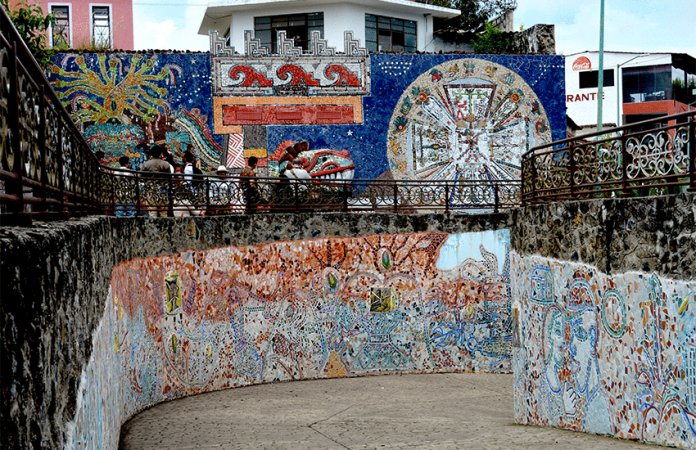
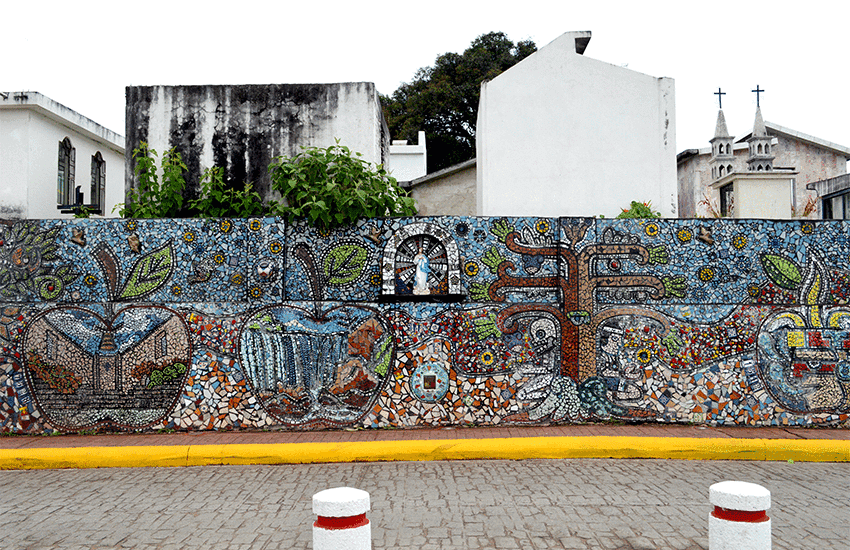
View of sections of two murals: Vivir en el Universo Náhuatl (above) and Homenaje al Maíz (below) near the lookout point of the Los Jilgueros Ravine. Alejandero Linares García

Mexico’s Pueblos Mágicos (Magical Towns) tourism promotion program has been a phenomenal success, introducing city dwellers to small rural towns. However, too often those same visitors don’t make it out of the town’s historic center.

Mary Carmen Olvera Trejo has found one way to entice them out and spread the tourism money around a little better.

Zacatlán de las Manzanas, in the north of Puebla, has been a Pueblo Mágico since 2011. Like many others, it is home to quaint houses and a massive church and monastery complex.

One thing that sets it apart is that it is home to a monumental clock industry, epitomized by the main square’s “garden clock.” But there is more to see on the outskirts of town, such as the spectacular Jilgueros Ravine with its waterfall.

Olvera is a member of a prominent local family and involved in many civic affairs. In 2014, she organized Zacatlán’s first Corn Fair.

Volunteer at Casa del Vitro Muralistas in Zacatlán de las Manzanas
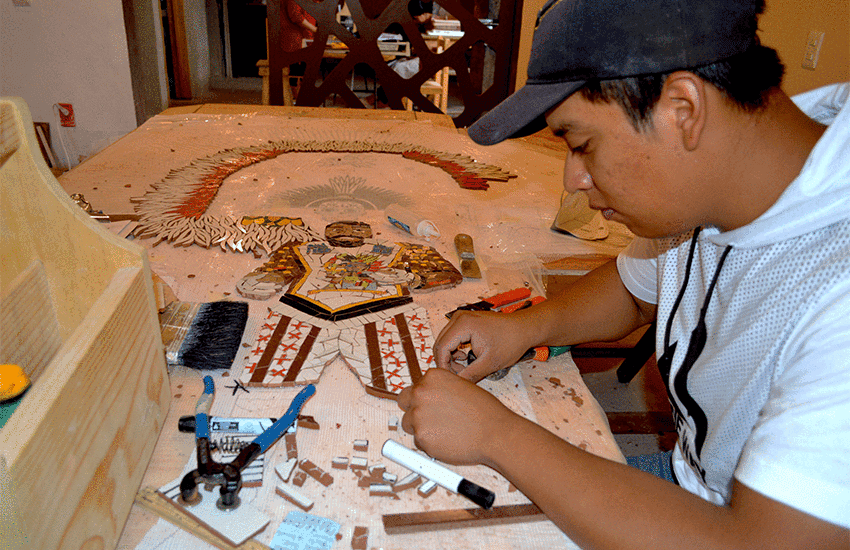
Volunteer working on a mural panel. Small pieces of the image are laid out and temporarily fastened onto a mesh. Alejandro Linares García

Her friend, American writer and philanthropist Dick W. Davis, suggested a commemorative mural for the event. Olvera agreed, and the two arranged for American tile artist Isaiah Zagar and local volunteers to work together to create Homenaje al Maíz (Homage to Corn) in the tunnel that links the ravine’s lookout point to the road leading to the town center.

Olvera was nervous when the images made from broken pieces of tile, plates, glass and mirrors started going up on the walls, but it soon became apparent that the result would be anything but graffiti. The mural, featuring an image of the god Quetzalcóatl, was an immediate success.

Only two months later, Olvera recruited another artist from the United States, Trish Metzner, to help design and direct a new mosaic mural dedicated to the area’s apple farming.

The work is titled Los 300 Años de Ser Zacatlán de las Manzanas (300 Years of Being Zacatlán of the Apples), referring to the first recorded reference of the town having the appended “de las Manzanas.” Finished in May 2015, the mural contains eight apples, each with a natural, architectural or cultural element related to Zacatlán. It was placed on the outer cemetery wall by both the tunnel and the lookout point.

By now, Olvera was completely hooked on the potential of community-assisted mural art. She continued by commissioning the mural Vivir en el Universo Náhuatl (Living in the Náhuatl Universe) for the back cemetery wall.

The front walls next to the main entrance were treated to a series of biblical scenes, a suggestion from the local priest. Olvera says these projects have been “… like hugs from the artists to give warmth, color, love and life to our ancestors …”

mosaic mural in Zacatlán de las Manzanas, Puebla
Portion of 300 Años de Ser Zacatlán de las Manzanas mural. Alejandro Linares García

These projects also had technical issues that led to an innovation I have not seen anywhere else: the biblical faces required a certain level of realism, and the haphazard pieces that result in smashing tile and glass could not provide sufficient detail.

They found that by using end nipper pliers, they could snap off very small and exact cuts.

This technique has since been refined, and its possibilities are strongly seen in the series of murals that followed. After the cemetery, Olvera turned her attention to a small winding alley called the Callejón de Hueso (Bone Alley).

Believe it or not, even small towns like Zacatlán have their seedy sections, and this was it, despite it being between the historic center and the Jilgueros Ravine. The alley is bordered on both sides by two- and three-story houses with few windows, perfect for murals.

These walls have become a winding photo album, recreations of faded black-and-white photographs of Zacatlán in the past, with the title Zacatlán de Mis Recuerdos (The Zacatlán of My Memories). The change in the neighborhood is phenomenal. It is hard to believe that people once did drugs here late at night.

The murals have been extremely effective in leading foot traffic along the residential streets in town between the main plaza and the ravine. Because of this, small businesses such as restaurants and handcraft shops are opening in this area.

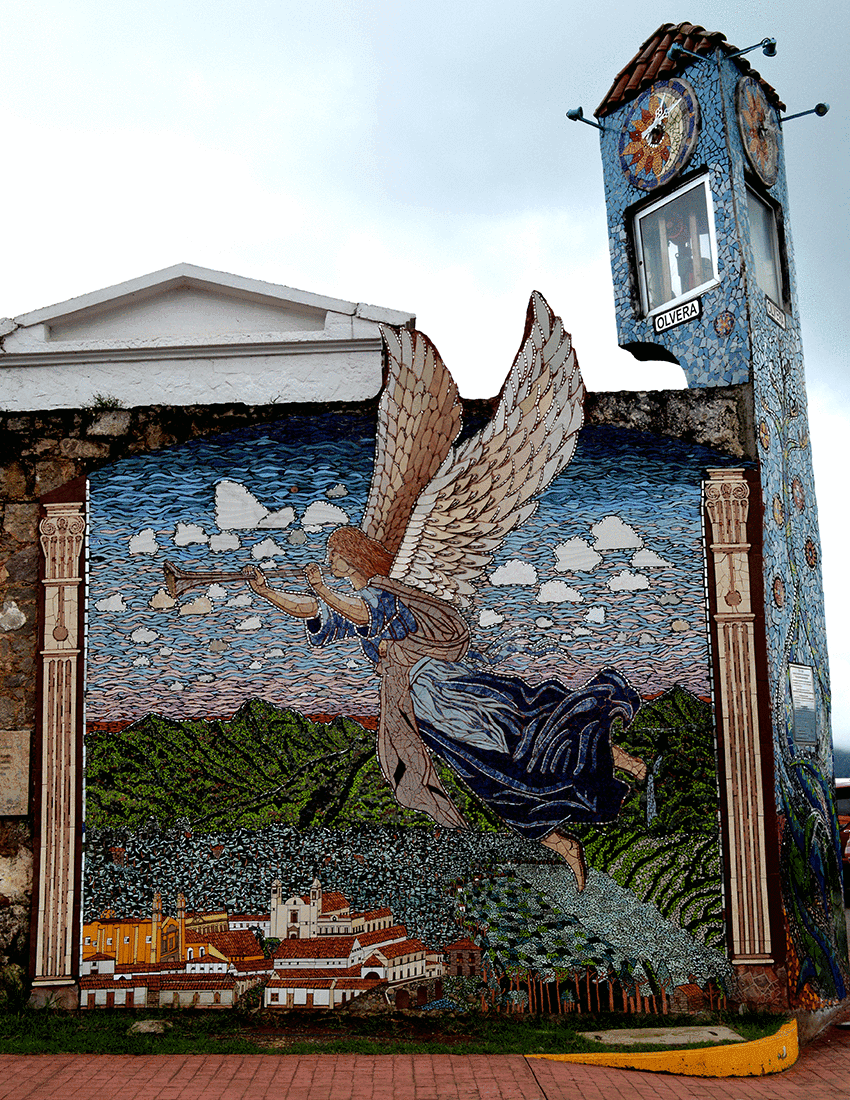
Heralding Angel from Vida Eterna mural in Zacatlán de las Manzanas, Puebla
Heralding Angel from Vida Eterna mural and clock tower containing locally made clock. Alejandro Linares García

The old cemetery, which was all but ignored, has become another attraction. People have become interested in the old abandoned tombs.

The murals give residents pride because they now live among something truly special — something they themselves helped to create. Littering, vandalism and crime have gone down, and in more than seven years of community murals, not a single one has been vandalized.

Olvera shows absolutely no signs of slowing down. This year, she established the Casa de Vitralmuralista, an art gallery and workshop dedicated to this craft in support of current and future projects. Located on Callejón Linda Vista (near Porfirio Díaz), it is where the next mural project, México Lindo y Querido (Mexico Beautiful and Loved), is in progress.

This mural will highlight the regional dress of Mexico’s states, using even more refined techniques than what was used in the Callejón del Hueso project.

Olvera’s main role is logistics — recruiting people and fundraising. Donations are from private sources, mostly from Olvera’s very wide circle of contacts in Mexico and the United States.

The donations they receive include money, of course, but also tile and cement from both companies and individuals, often leftovers from other projects.

[wpgmza id=”339″]

When Olvera started, it was just her and some of her family and friends. Today, mural-making is part of Zacatlán’s culture, with residents and other participants showing off their handiwork to friends, family and the world, both in person and through social media.

• If you are interested in knowing more about or even participating in one of the mural projects, you can contact Olvera on Facebook or on WhatsApp at 797-976-0018.

Leigh Thelmadatter arrived in Mexico 18 years ago and fell in love with the land and the culture in particular its handcrafts and art. She is the author of Mexican Cartonería: Paper, Paste and Fiesta (Schiffer 2019). Her culture column appears regularly on Mexico News Daily.