The federal Environment Secretariat (Semarnat) has acquired special machinery to remove sargassum seaweed in the Caribbean Sea, but it won’t be delivered until November.
Environment Secretary Rafael Pacchiano said his department had researched what was available in other countries, but the reality was that the technology is limited.
The few vessels that can be used to clean up the seaweed before it hits the beaches are very expensive and their capacity is limited, he said, making the process a slow one.
But collecting it before it lands on the shore is preferable to gathering it with heavy machinery on the beach due to the environmental damage that would result, Pacchiano said.
Other options that have been explored by Semarnat are methods of diverting the weed while it is still in the water and analyzing its possible use for food, pharmaceutical or energy purposes.
The federal government has allocated 70 million pesos (US $3.7 million) to address the sargassum problem.
A 200-million-peso project to divert the sargassum on the open sea is already under way with the installation of containment booms set to begin this week, a project being undertaken by the state of Quintana Roo with federal authorization.

The booms consist of 50-centimeter-deep plastic barriers hanging from buoys. With the help of wind and ocean currents, the plastic fence will divert the seaweed away from the beaches and then gathered for disposal on dry land.
The first barrier is being installed as a pilot project at Punta Nizuc, near Cancún.
“It won’t solve the problem because it depends on the currents and the wind,” said state Environment Secretary Alfredo Arellano Guillermo, “but it can reduce the quantity that arrives on the beaches.”
Federal and state officials are scheduled to meet today with academics from the National Autonomous University to look for alternatives for dealing with the seaweed.
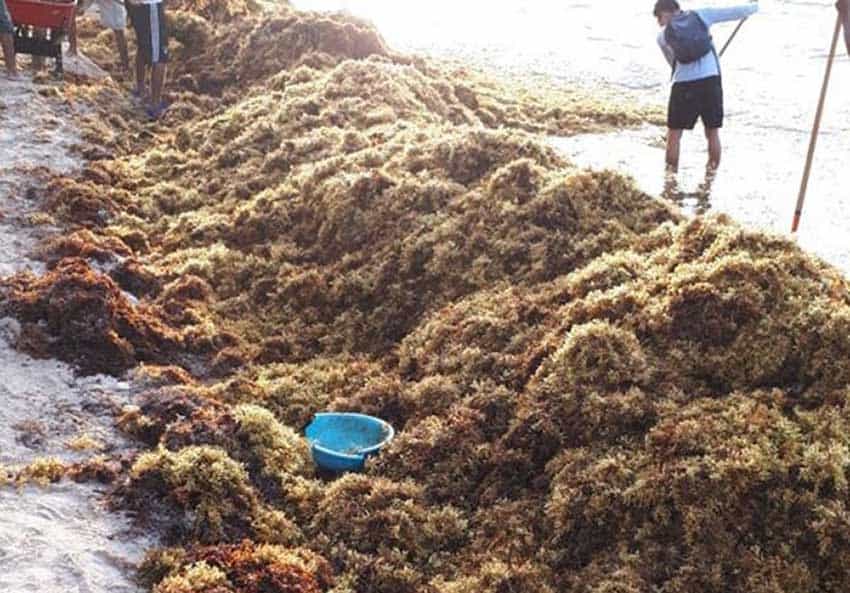
Record amounts of sargassum have been piling up on Caribbean beaches this year, and more is forecast to come. Academics have warned of a potential environmental disaster while the tourist industry is worried about a disaster in economic terms.
Source: Milenio (sp), El Universal (sp)