A judge in Acapulco has issued an arrest warrant for the head of the Mexico office of the United States investment bank JPMorgan Chase in a decade-old fraud case.
Eduardo Cepeda Fernández, who has been with the company for 30 years, and former managing director Miguel Ángel Barbosa Machado have been accused by the Mexican real estate developer BVG World of fraud in connection with a 2007 credit line for US $87 million.
As a guarantee for the loan, BVG World agreed to put properties into a trust controlled by JPMorgan. It was to sell the properties to recoup the money owed and pay the rest to BVG World.
The lawyer representing the real estate company said in a statement that an investigation started two years ago found that JPMorgan had intended all along to keep the real estate.
Javier Guerra González said the complaint against JPMorgan and Cepeda was filed in Acapulco because a significant number of properties in the trust are located there.
JPMorgan said Cepeda had the bank’s full confidence. “The accusations have no merit. We are working with our lawyers to respond to this demand and for justice to be served.” It said it also supported Barbosa.
The bank also said that BVG World is overdue on its loan payments and was attempting to exert pressure on JPMorgan with “baseless accusations” and trying to avoid its legal obligations by starting the criminal process.
Yesterday, BVG World and its owner, Elías Sacal Cababie, filed a US $1.2-billion lawsuit in New York against the bank, accusing it of fraud, unjust enrichment, defamation, civil racketeering and other crimes.
A computer rendering of Mexico City’s new Norman Foster-designed airport.
Mexico City long ago outgrew the two-terminal Benito Juárez International Airport, which is notorious for delays, overcrowding and canceled flights.
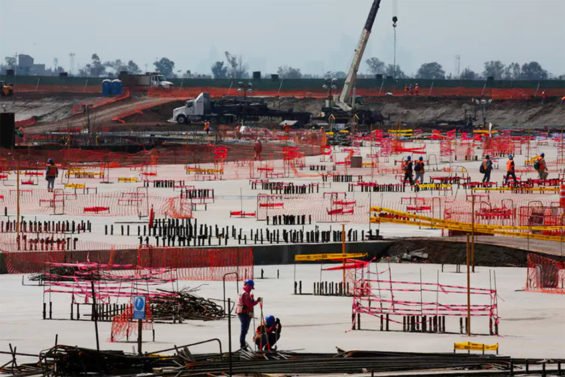
Construction is now under way on a striking new international airport east of this metropolis of 20 million. When it opens in late 2020, the LEED-certified new airport – whose terminal building was designed by renowned British architect Norman Foster in collaboration with the well-known Mexican architect Fernando Romero – is expected to eventually serve 125 million passengers. That’s more than Chicago O’Hare and Los Angeles’ LAX.
But environmentalists are concerned. The new airport is located on a semi-dry lake bed that provides water for Mexico City and prevents flooding. It also hosts migrating flocks and is home to rare native species like the Mexican duck and Kentish plover. But after three years of construction and US $1.3 billion, costs are ballooning and corruption allegations have dogged both the funding and contracting process.
According to the federal government’s environmental impact assessment, 12 threatened species and one endangered species live in the area.
The airport project is now so divisive that Andrés Manuel López Obrador, the populist front-runner in the country’s 2018 presidential election campaign, has suggested scrapping it entirely.
I’m an expert in landscape architecture who studies the ecological adaption of urban environments. I think there’s a way to save Mexico’s new airport and make it better in the process: create a nature reserve around it.
Five hundred years ago, lakes covered roughly 20% of the Valle de Mexico, a 3,500-square-mile valley in the country’s south-central region. Slowly, over centuries, local residents – first the Aztecs, then the Spanish colonizers and then the Mexican government – built cities, irrigation systems and plumbing systems that sucked the region dry.
By the mid-20th century, the lakes had been almost entirely drained. In 1971, President Luís Echeverría decreed the area a federal reserve, citing the region’s critical ecological role for Mexico City. The smattering of small lakes and reforested land there now catch and store runoff rainwater and prevent dust storms.
The new airport will occupy 17 square miles of the 46-square-mile former Lake Texcoco. To ensure effective water management for Mexico City, the airport master plan proposes creating new permanent water bodies to offset the lakes lost to the airport and cleaning up and restoring nine rivers east of the airport. It also proposes planting some 250,000 trees.
The government’s environmental assessment determined that the impacts of the new airport, while significant, are acceptable because Lake Texcoco is already “an altered ecosystem that lost the majority of its original environmental importance due to desiccation and urban expansion.” Today, the report continues, “it is now only a desolate and abandoned area.”
Environmentalists loudly disagree.
Construction progresses at new airport. Reuters/Carlos Jasso
I see this environmental controversy as an opportunity to give Mexico City something way more transformative than a shiny new airport.
Nobody can entirely turn back the clock on Lake Texcoco. But the 27 square miles of lake bed not occupied by the airport could be regenerated, its original habitat partially revitalized and environmental functions recovered in a process known as restoration ecology.
I envision a huge natural park consisting of sports fields, forests, green glades and a diverse array of water bodies – both permanent and seasonal – punctuated by bike paths, walking trails and access roads.
The airport will come equipped with new ground transportation to Mexico City, making the park easily accessible to residents. Extensions from the surrounding neighborhood streets and highways could connect people in poor neighborhoods abutting the airport – dense concrete jungles like Ecatepec, Ciudad Nezahualcoyotl and Chimalhuacan – to green space for the first time.
The nine rivers that empty into Lake Texcoco from the east could be turned into greenways to connect people from further out in México state to what would become the area’s largest public park.
Space could also be reserved for cultural attractions such as museums, open and accessible to passengers in transit.
This idea is not as crazy as it sounds.
As early as 1998, Mexican architects Alberto Kalach and the late Teodoro González de León proposed rehabilitating the lakes of the Valley of Mexico. Their book, The City and its Lakes, even envisaged a revenue-generating island airport as part of this environmentally revitalized Lake Texcoco.
Under president Felipe Calderón, Mexico’s National Water Commission also proposed building an ecological park in Lake Texcoco, which was to include an island museum and restore long-degraded nearby agricultural land. But the project never gained traction.
Granted, turning a large, half-constructed airport into a national park would require an ambitious new master plan and a budget reallocation.
But in my opinion, evolution and change should be part of ambitious public designs. And this one is already expected to cost an additional $7.7 billion to complete anyway.
In Canada, Toronto’s Downsview Park – a 291-acre former air force base turned green space – has transformed so much since its conception in 1995 that its declared mission is now to “constantly develop, change and mature to reflect the surrounding community with each generation.”
Local communities neighboring Mexico City’s new airport were not adequately consulted about their needs, environmental concerns and their current stakes in the Lake Texcoco area. A revamped park plan could be truly inclusive, designed to provide recreation and urban infrastructure – and maybe even permanent jobs – for these underserved populations.
Three of the four candidates in Mexico’s July 1 presidential election want to finish Mexico City’s new airport. But López Obrador, who for months has had an unbeatable lead in the polls, is not so sure.
Early in his campaign he said he would cancel it if elected. Instead, López Obrador suggested, a former air force base could become the new international terminal. It would be connected to Benito Juárez airport, 22 miles south, by train.
López Obrador has since said he would support completing construction of the new airport if the remaining financing came from the private sector, not the Mexican government. Currently, some two-thirds of the project is funded by future airport taxes.
López Obrador’s promise to review and likely upend the airport plan could open the door to its wholesale transformation, putting people and nature at the core of a plan ostensibly designed for the public good.
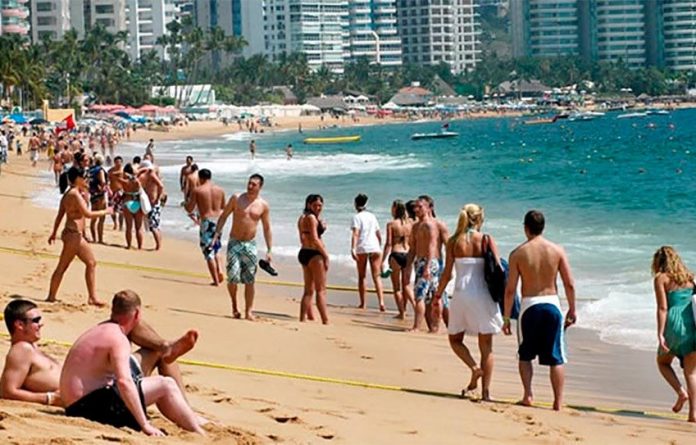
Tourists on an Acapulco beach: their numbers continue to rise.
A record number of international tourists visited Mexico in the first quarter of 2018, the federal Tourism Secretariat (Sectur) has announced.
Sectur said in a statement that 10.6 million people came to the country in the first three months of the year, 12.6% more than the 9.4 million tourists who visited in the same period last year.
The amount of money those tourists spent while they were here increased by 7.2% in the first quarter to just over US $6.2 billion compared to just over US $5.8 billion in the same period of 2017.
However, the average expenditure per tourist dropped by 4.4% to US $533.40 compared to US $558 last year.
March was a particularly good month for tourism, with four million international visitors, 14.6% more than the same month last year, and their spending was up more than in the previous two months.
They spent US $2.36 billion in March, 13.8% more than the US $2.07 billion spent in March 2017. Average spending was also up but only by the slimmest of margins, increasing by US $0.20 or 0.04% to US $539.60.
Tourism Secretary Enrique de la Madrid said last week that Mexico is now the sixth most visited country in the world and explained that an upsurge in violent crime had not had an impact on visitor numbers.
He also said that international tourism is growing at 12% annually compared to 7% in the rest of the world and that the tourism industry contributes to 8.8% of gross domestic product (GDP).
Just over 39 million international visitors came to Mexico last year but if the number of visitors recorded in the first quarter is maintained, this year will see the 40-million barrier broken for the first time.
De la Madrid said in February that the number of international tourists visiting Mexico annually could reach 50 million by 2021, which would likely make the country the world’s fifth most visited.
Despite the strong growth, one challenge that the government continues to face despite efforts to overcome it is diversification of the tourism sector.
Sectur data showed that 92.1% of all international tourist arrivals by air in January were at just seven airports.
A researcher from Guadalajara, Jalisco, has created a biodegradable, natural plastic that could be used to make eco-friendly shopping bags. Its source? The juice of the nopal cactus.
Sandra Pascoe of the University of the Valley of Atemajac (Univa) told the news agency EFE that she has used both the most common variety of edible nopal — the opuntia ficus-indica — and the opuntia megacantha, which is known for its fruit called tuna, to make her innovative product.
“The plastic is basically made out of the sugars of nopal juice, the monosaccharides and polysaccharides it contains,” she said.
Pascoe explained that the sugars, pectin and organic acids in the juice give it a very viscous consistency, adding “that viscosity is what we’re taking advantage of so that a solid material can be produced.”
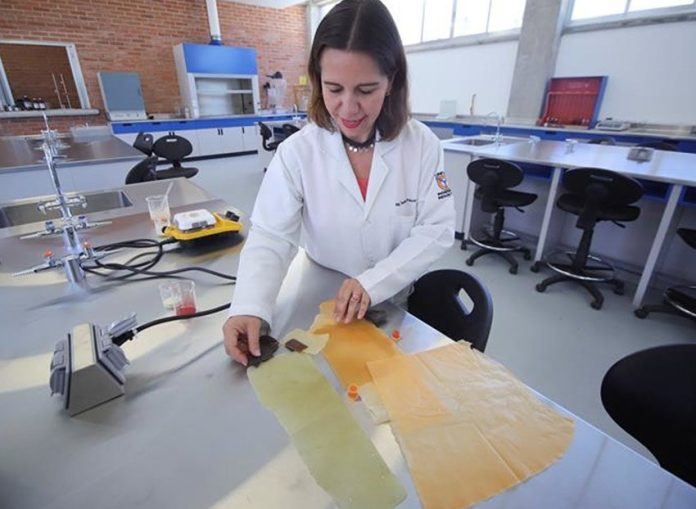
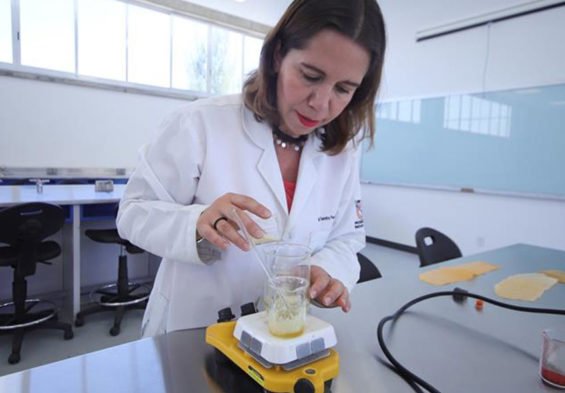
Glycerol, natural waxes, proteins and colorants are mixed with the juice after it has been decanted to remove its fiber, creating a formula that is then dried on a hot plate to produce thin sheets of plastic.
Pascoe at work in the lab.
The process was registered with the Mexican Institute of Industrial Property (IMPI) in 2014 and the National Council of Science and Technology (Conacyt) has contributed funding to advance the project.
The researcher said that she is now collaborating with the University of Guadalajara Center for Biological and Agricultural Sciences to determine how quickly and under what conditions the plastic will decompose.
“We’ve done very simple degradation tests in the laboratory; for example, we’ve put it in water and we’ve seen that it does break down [but] we still have to do a chemical test to see if it really did completely disintegrate. We’ve also done tests in moist compost-like soil and the material also breaks down,” Pascoe said.
She explained that in addition to shopping bags, the nopal juice plastic could be used to make products such as cosmetic containers, imitation jewelry and toys.
Tests are currently being conducted to establish how much weight the plastic can bear which will help determine what other products it could be used for.
Pascoe said the next step on the path towards commercialization will be to make or buy a machine that can make prototypes of the plastic bags in order to market them to businesses.
The scientist is also in the process of applying for a patent for her product from IMPI, which she said would allow interested companies to use the process she developed under a licensing agreement.
A candidate for municipal council in Isla Mujeres, Quintana Roo, died last night of gunshot wounds inflicted during an attack Saturday night.
Institutional Revolutionary Party candidate Rosely Magaña Martínez had been in intensive care for 48 hours and although her condition had been stabilized, she died due to internal hemorrhaging and damage to vital organs, medical personnel at the Galenia hospital said.
Initial reports said Magaña was out of danger after she was admitted to hospital.
The shooting took place during a campaign meeting at a private home in mainland Isla Mujeres. Two men arrived on a motorcycle and opened fire.
Campaign worker Lizbeth Pasos Sarabia was also wounded, but survived the shooting.
At least 113 politicians have been assassinated during the current election period, which began last September. Forty-two of the victims were candidates or pre-candidates.
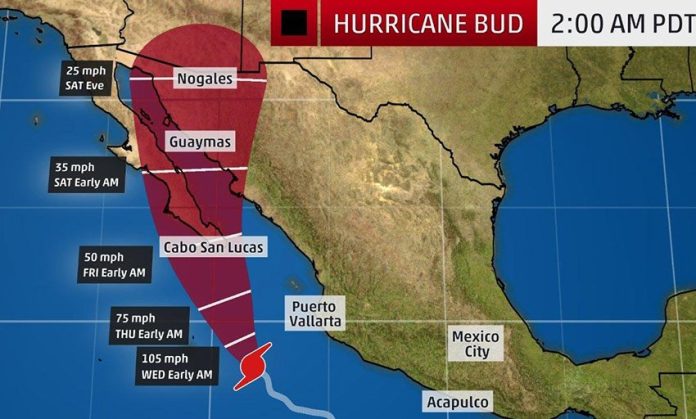
Hurricane Bud strengthened to category 4 overnight but is expected to weaken later today, the United States National Hurricane Center (NHC) said this morning.
Nevertheless, the National Meteorological Service is forecasting torrential storm conditions for Michoacán and coastal and southern areas of Jalisco and Colima. Wind gusts up to 60-80 kilometers per hour are predicted and wave heights of three to five meters.
The NHC said Bud was about 365 kilometers southwest of Cabo Corrientes, Jalisco, and 560 kilometers south-southeast of Cabo San Lucas, Baja California Sur, at 4:00am. Maximum sustained winds were 215 kilometers per hour.
Forecasters warned that citizens in Baja California Sur should monitor the hurricane’s progress. On its forecast track, Bud will be near the southern coast of the state on Thursday.
A weakening trend is expected to begin later today and the storm should be below hurricane intensity by Wednesday night, the NHC said.
The Weather Channel said predicted it would be a tropical storm when it arrives in Baja California Sur.
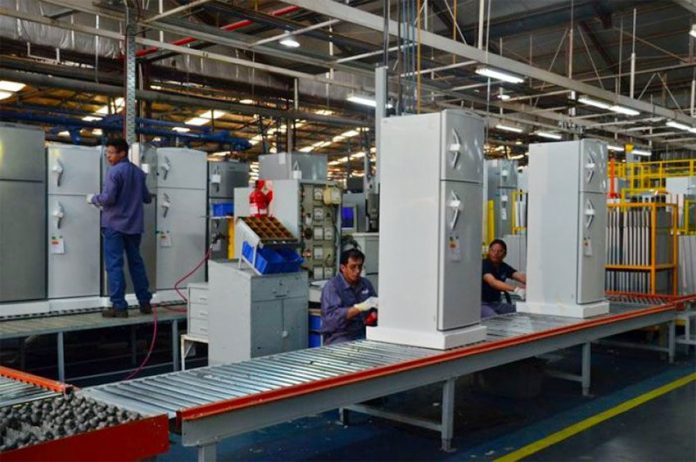
Two leading home appliance manufacturers have announced that prices of their products will increase due to the decline of the peso and continuing uncertainty about the future of the North American Free Trade Agreement (NAFTA).
In a statement, the company said that “the exchange rate and the price of supplies” have both increased significantly in recent months, specifically citing higher costs for steel and petroleum products that it can no longer absorb.
Three days later, the Mexican company Mabe said its prices would go up by 9.5% on July 1, the same day that Mexicans will vote for a new president and Congress.
It also cited increased cost pressures stemming from a lower peso and higher prices for its key supplies.
The newspaper El Universal reported today that industry sources it consulted had indicated that other companies, such as Teka, would also soon follow suit.
Stoves, refrigerators, ovens, washers, driers and blenders are among the products that will soon become more expensive.
For both Whirlpool and Mabe, the July 1 price hike will be the second time they have raised prices in the space of a single year after 15% and 5-7% respective increases took effect in January. The higher prices will affect around 10 different brands that the two companies own between them.
Trilateral talks to renegotiate a new NAFTA deal have been drawn-out and contentious and the United States tariff announcement last month further complicated the process and placed additional pressure on the peso.
While uncertainty about the future of the trade deal remains, the Bank of México said the value of the peso against the US dollar is one of the variables that will suffer the most.
According to the currency conversion website operated by foreign exchange company XE, one US dollar currently buys just under 20.6 Mexican pesos.
Some analysts said last month that the peso could trade at up to 22 to the US dollar before the presidential election.
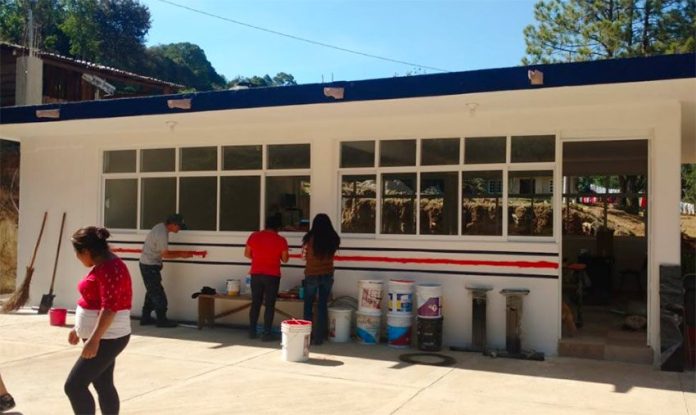
Seeking to build trust, the Federal Police have constructed and opened a new primary school in the Otomí town of San Francisco de las Tablas in México state.
Education facilities described as “precarious” triggered the move to build the school with the help of parents in the municipality of Chapa de Mota.
Eleven months later, the school is now catering to 11 students although the facilities are intended to benefit at least 70 families living nearby.
The 96-square-meter school has a 120-square-meter multiple-use area and a 160-square-meter soccer field.
Five computers will be available to start, along with a library containing 1,000 books. All these resources were donated by local residents, businesses and the Federal Police. One report observed that the school has electricity and running water.
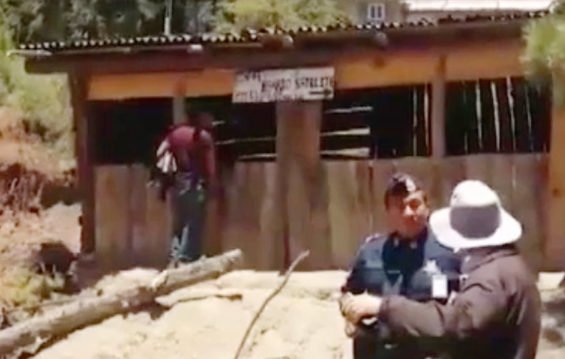
This used to be the community’s primary school.
The plan for the school in future is to bolster social inclusion for the Otomí community, and promote the human rights of the indigenous peoples of Mexico, said Federal Police Commissioner Manelich Castilla Craviotto.
The force’s social proximity department has the task of strengthening citizens’ trust in police by improving social conditions and promoting active citizen participation in their own social development, the commissioner said.
[wpgmza id=”26″]
The Otomí people live in the states of México, Puebla, Veracruz, Hidalgo, Guanajuato, Querétaro, Tlaxcala and Michoacán, and speak three distinct dialects of their language.
Some have proposed to use the name Hñähñu as a more formal or correct way to call themselves, but little traction has been gained. Hñähñú refers to the dialect of the language spoken in the Mezquital Valley region in central Mexico.
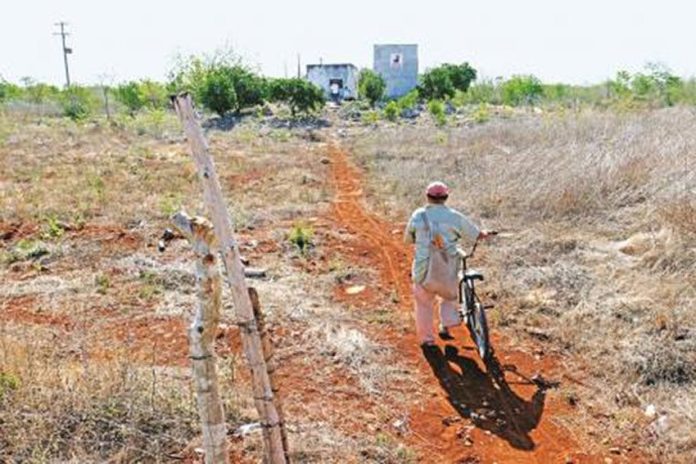
Site of a processing plant that was never built. el universal
At least 34 federal and state-funded agricultural infrastructure projects in Yucatán that were slated to be built between 2014 and 2016 amounted to nothing, according to the state’s College of Agronomists.
College president Lorenzo Alvarado Sosa said that 15 of the abandoned projects involved the installation of irrigation systems, while the other 19 included the construction of greenhouses, a solar-powered agricultural processing plant and an organic farm.
The Yucatán state government and federal agricultural authorities announced the latter two projects with pomp and circumstance four years ago.
But neither project went beyond the planning stage and thieves looted the few materials that arrived at the proposed sites in the municipality of Tahmek, such as solar panels and parts for an irrigation system.
Similar scenarios played out on the other projects which were planned for other rural areas in the state, with the money allocated ending up in the pockets of unscrupulous government officials and contractors, according to intended beneficiaries.
[wpgmza id=”25″]
“They cheated us, we thought that they would help us. We trusted them, that’s why we gave them the 450,000 pesos [US $21,850 at today’s exchange rate] from the checks. We cashed them, gave the project engineers [the money] and then they disappeared,” Tahmek resident María Cornelia Keb Canul told the newspaper El Universal.
She and at least 17 other producers from the area had planned to grow habanero chiles, citrus fruits and other crops to supply the planned processing plant.
Keb Canul said that two engineers — one each from the federal Agriculture Secretariat (Sagarpa) and the state government’s rural development department — personally accompanied her to a bank where she cashed the check and handed over the funds with the assurance that they would start the work quickly.
“That day [in 2014], after we cashed the check and gave them the money, they invited us to have breakfast . . . in Mérida. Then they brought us back to the farm and never returned,” she said.
The 54-year-old woman and her husband Silvino Puc Ek told El Universal that they didn’t report what had happened out of fear that they wouldn’t receive any government support in the future and because the engineers kept the documents related to the project.
Another factor that complicates accountability is that under Sagarpa rules, project beneficiaries are required to hand over the funds that they have been granted to officials or contractors, although it’s the farmers who remain legally responsible for the execution of the work.
A Sagarpa official who spoke to El Universal on the condition of anonymity said the absence of responsibility on the part of anyone but the beneficiaries of the projects had led to the practice of taking the cash and running, so to speak, becoming commonplace.
The same two state and federal officials who swindled Keb Canul also failed to deliver on a promised farm project after receiving funds in 2014 from a cooperative made up of eight farmers in Tahmek.
Alfonso Baas Casanova, an ejidatario, or communal landowner, and the cooperative’s head told El Universal that he cashed a check for 460,000 pesos and gave the proceeds to Máximo Paredes Rodríguez of the state government’s rural development department, and Sergio Muñoz de Alba of Sagarpa.
Again, the understanding was that work on the project would start soon but, as before, the farmers never saw the men again. The site that today should be a working, organic farm instead lies abandoned.
Alvarado Sosa, who worked for the state government before heading up the Yucatán College of Agronomists, said that frauds of this type are not only discouraging for farmers but also leave many with no other option than to abandon the countryside and look for opportunities elsewhere.
“There are more and more migrants who go to Mérida and Cancún, more migrants who go abroad, there are few or none who want to sow crops. The Yucatecan countryside yields profits but we have to be well-organized, apply the resources honestly and really get to work,” he said.
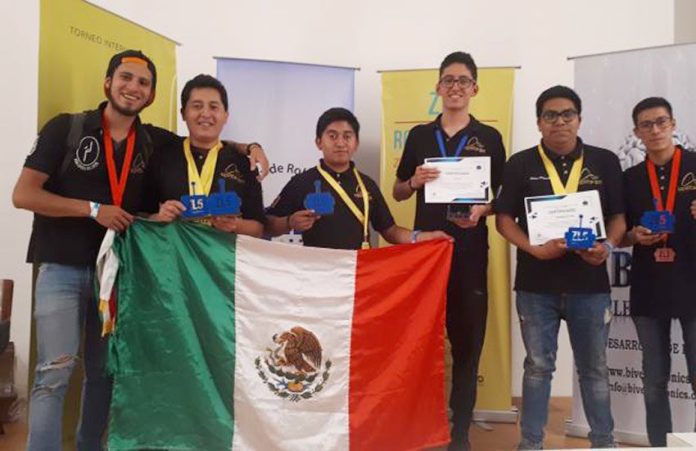
Six students from the National Polytechnic Institute (IPN) came home with eight medals after participating in the fifth Robot Games Zero Latitud in Quito, Ecuador.
The young men returned with five gold medals, one silver and two bronze, earning a total of 59 points that ranked their team No. 2 at the event.
The IPN students competed against more than 500 of their counterparts from all over the world in three intense days that concluded earlier this month.
The mechatronics students won in the Mini Sumo RC category, the three-pound combat category, Autonomous Mini Sumo and 12-pound combat categories.
Along with bragging rights, the five victories gave the IPN roboticists international certifications to join prestigious international robotics competitions in six of 31 categories.
In just five years, the first international robotics tournament to be held in Ecuador has become the most important robotics competition in the region.






 López Obrador’s promise to review and likely upend the airport plan could open the door to its wholesale transformation, putting people and nature at the core of a plan ostensibly designed for the public good.