Home Blog Page 2202

Ex-mayor gets 247 years for multiple homicide in Michoacán

0
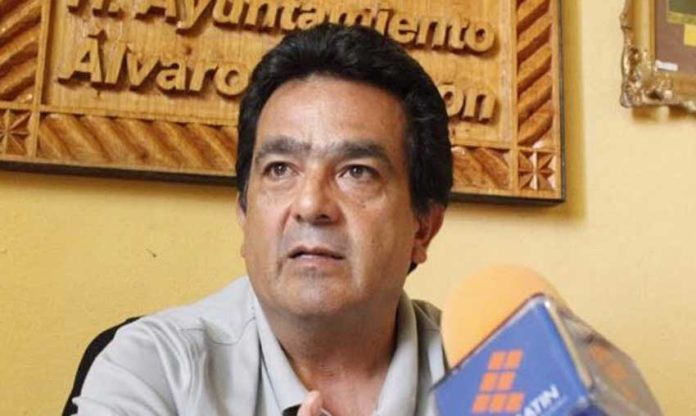
Arreygue: long jail term.

A former mayor was sentenced yesterday to 247 years in prison for his role in the murder of 10 young men in Michoacán in July 2016, while four municipal police officers received 300-year terms for the same crime.

Juan Carlos Arreygue Núñez, ex-mayor of the Michoacán municipality of Álvaro Obregón, and the police who were under his charge at the time of the homicides were found guilty of the crime in July.

Investigators found that municipal police detained the 10 men on orders of Arreygue, who had personal differences with one of them.

They were shot dead on a property in Álvaro Obregón before being burned inside a pickup truck on another property in the neighboring municipality of Cuitzeo.

At the public hearing in the state capital of Morelia, the court also ordered the five guilty men to pay just under 3.7 million pesos (US $191,000) in reparations.

The Michoacán Attorney General’s office said in a statement that the sentences are subject to appeal but also stressed that “there will be no impunity.”

Arreygue, who was elected mayor under the banner of the Labor Party (PT), had been suspected of having ties to the Caballeros Templarios criminal organization before winning office.

Source: El Universal (sp)

Quite a bit late and several bodies short: new Congress begins session

0
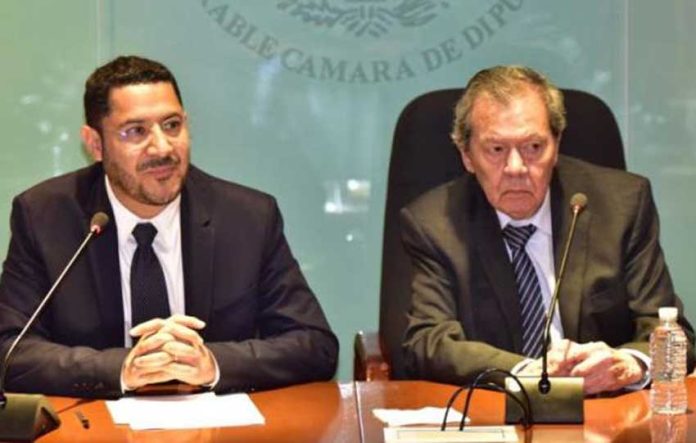
Martí, left, and Muñoz, presidents of the Senate and the Chamber of Deputies respectively.

Tardiness and absenteeism marked the first day of the 64th Legislature, the first leftist Congress in Mexico’s history.

It was also the first day on the job for the 628 lawmakers either elected on July 1 or named under proportional representation. But not all of them made it on time, and some never even made it in to work.

Scheduled to begin at 11:00am, the first day in session of the Chamber of Deputies officially started on Mexican time — 13 minutes late. And only 347 of the 500 deputies were in attendance.

The tardiness earned a rebuke from the president of the lower house, Deputy Porfirio Muñoz Ledo y Lazo de la Vega, who reprimanded the deputies in attendance “for not being able to start the assembly on time.”

One hour later, another 139 deputies had arrived for the first day of their three-year terms. That only left 14 unaccounted for.

They adjourned after three hours, at the end of which Muñoz Ledo asked his fellow legislators to be on time for the next scheduled session on Thursday.

Things were even worse in the upper house. Senate President Martí Batres Guadarrama rang the opening bell at 11:43: the first session of the senators’ six-year terms in office was 43 minutes late starting and short 43 of the 128 senators.

Earlier this week the two congressional leaders, both members of the Morena party, announced they would work together on legislation to implement the 12-point plan outlined last month by president-elect Andrés Manuel López Obrador and a new congressional legislation to address corruption and legislative immunity (known as the fuero).

Source: El Universal (sp)

Economy secretary says Mexico did not betray Canada in trade pact

0
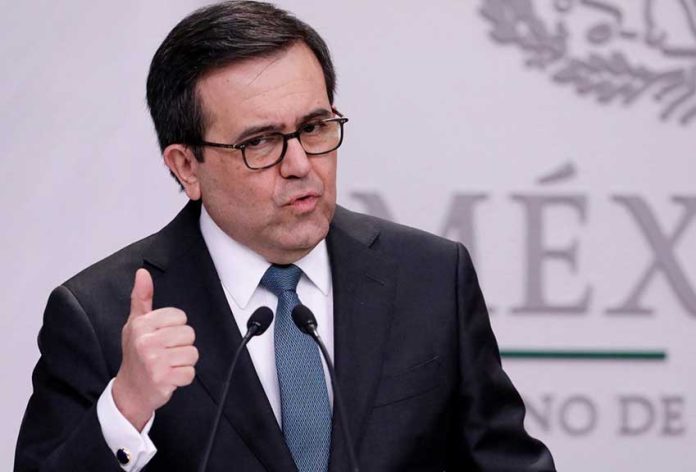
Economy Secretary Guajardo: hoping for white smoke on Friday.

Economy Secretary Ildefonso Guajardo has rejected any suggestion that Mexico betrayed Canada by reaching a bilateral trade deal with the United States after accusations by some Canadians it had done just that.

“Here nobody betrayed anyone,” Guajardo said in a radio interview yesterday with Grupo Fórmula.

The economy secretary, who has been Mexico’s chief negotiator in the drawn-out talks to ink an updated NAFTA deal, added that he has a “great personal relationship” with Canadian Foreign Minister Chrystia Freeland and that he can “look her in the eyes” with “integrity and conviction” and tell her that there was no betrayal.

“I have no doubts about my moral authority to continue working with the Canadians, to move forward and to support the vision that . . . this agreement has to be trilateral,” Guajardo said.

In Canada there have been charges that Mexico “threw Canada under the bus” and betrayed its NAFTA partner by negotiating a two-way deal.

United States President Donald Trump announced August 27 that Mexico and the United States had reached a new trade pact that could exclude Canada. After four days of negotiations in Washington D.C. last week failed to yield a trilateral agreement, he notified U.S. Congress Friday that his administration intends to sign a new trade agreement in 90 days with Mexico and Canada, if the latter “is willing.”

The next day, he wrote in a Twitter post that “there is no political necessity to keep Canada in the new NAFTA deal” and that “if we don’t make a fair deal for the U.S. after decades of abuse, Canada will be out.”

Announcement of the bilateral arrangement, which Trump said would be called “the United States-Mexico trade agreement” because NAFTA has a “bad connotation” for the U.S., followed five weeks of separate negotiations between the two countries that resolved a range of contentious issues including rules of origin for the auto sector and the so-called sunset clause, which was scrapped and replaced with a six-year “review.”

Guajardo charged that holding separate talks with the United States was nothing out of the ordinary.

“The bilateralism of the negotiation has been a constant since day one,” he said, adding that a trilateral conversation would take place once all two-way issues have been solved.

Guajardo said he was hopeful that a deal between the United States and Canada — paving the way for a three-way accord — would be reached by the end of the week.

“I would hope there will be white smoke for this Friday,” he said, referring to the traditional announcement of the election of a new pope.

Guajardo added that after Friday the time frame became more complex. Mexican officials hope that a new deal can be reached before President Enrique Peña Nieto leaves office at the end of November.

Senior United States and Canadian officials resumed talks in Washington D.C. today but Canadian Prime Minister Justin Trudeau indicated yesterday that Canada would not cave in to U.S. demands.

“As I’ve said, no NAFTA is better than a bad NAFTA deal for Canadians,” Trudeau told reporters.

Before entering meetings with United States Trade Representative Robert Lighthizer today, in which irksome issues such as access to Canada’s dairy market and the future of a dispute resolution system will be on the agenda, Freeland said “we are looking forward to constructive conversations.”

The Mexican government said in a statement Friday that it will closely monitor the talks and continue to push for a deal of which Canada is part.

Source: Expansión (sp), Politico (en)

Pregnant woman died of vaginal hemorrhage, but no sign of her baby

0
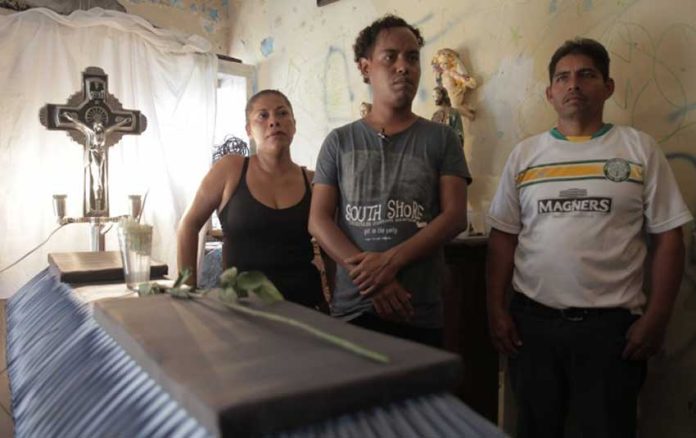
Rodríguez's family would like to know what happened to her baby.

A search continues in Veracruz after a pregnant woman was found dead on Sunday — minus her unborn child.

Ángela Rodríguez Carvajal, 19, was seven months pregnant when she died of a vaginal hemorrhage after giving birth, authorities in the city of Veracruz said.

Her body was found on a vacant lot, but there was no sign of the baby.

A theory that Rodríguez died following an attempted abortion has been rejected by her family, who claim the young woman wanted the baby. Despite complications that arose during the pregnancy she always sought medical help, said a friend.

At one point she had to be hospitalized and told her family that if she died and the baby survived she wanted an aunt in Tijuana to care for the child. Before that she had suffered from kidney failure.

Meanwhile, Rodríguez’s family is hoping the baby can be found.

There are similarities in the case to two others that occurred in April. Also in Veracruz, a 23-year-old pregnant woman was murdered by another woman who extracted the unborn baby from the womb. The infant was later found and survived.

A little more than a week earlier, a 20-year-old Tamaulipas woman who was eight months pregnant disappeared in Tampico. Her body was found four days later in the home of a woman who allegedly used a knife to extract the fetus while the mother was still alive. Neither mother nor child survived the ordeal.

Source: XEU (sp)

18 students expelled after violent confrontation at university

0
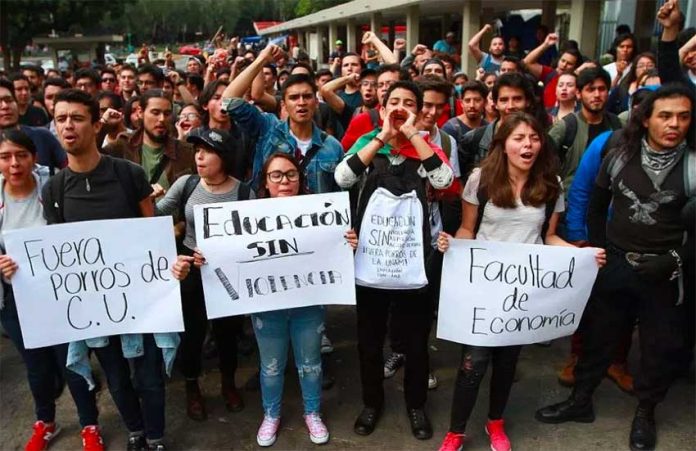
UNAM students protest Monday's aggression.

Eighteen students have been expelled from the National Autonomous University (UNAM) after a violent confrontation at the university’s main campus in Mexico City Monday that left two students seriously injured.

A group of aggressors armed with sticks, stones, knives, Molotov cocktails and other weapons attacked students from the university’s College of Sciences and Humanities (CCH) and other UNAM departments who were protesting peacefully on a range of issues following the recent murder of a female student.

The clash took place in front of the rectory at the campus known as Ciudad Universitaria (University City) in southern Mexico City.

A number of students sustained minor injuries while two were severely hurt, including a 19-year-old male student whose skull was fractured. The two students remain in hospital in serious condition.

A statement issued by UNAM rector Enrique Graue Wiechers said that there is evidence that three students’ groups as well as other outside organizations, all of which are “at the service of interests external to our university,” were responsible for the violence.

“I have now signed for the definitive expulsion of 18 individuals enrolled in the university and they are being sent to the University Tribunal for ratification,” Graue said.

The aim of the incendiary groups, known as porros, is to destabilize the university and “create a climate of insecurity and uncertainty,” the statement charged.

Graue also said in a later video message that “reports of the incidents have already been filed with the [Mexico City] prosecutor’s office and they will proceed . . . against those who are responsible for these actions.”

Investigations are continuing to identify the rest of the offenders “and those who facilitated their arrival [at the university] and sponsored the aggression,” the rector added. “We will not rest until we see them disappear from our surroundings.”

Mexico City Mayor José Ramón Amieva said the aggression was pre-planned and that a bus and private cars had transported the aggressors en masse to the university.

“We have information that there was prior organization, in other words, they boarded these buses, they got into private cars and obviously when they arrived there, they had their own weapons with which to attack, they didn’t [just] find them . . .” he said.

Amieva added that all evidence, including surveillance camera footage of the armed group traveling to the university, will be turned over to the federal Attorney General’s office (PGR).

Mayor-elect Claudia Sheinbaum, a political ally of president-elect Andrés Manuel López Obrador, also condemned the actions of the porros and said that such violence is always sponsored by other groups.

Given that Ciudad Universitaria is a federal zone, she said, the PGR must initiate an investigation to determine who was behind the attack.

A total of 41 university faculties and other UNAM-affiliated institutes implemented work stoppages in response to the violence and protests calling for porros to be eliminated from all university campuses are continuing.

Source: Milenio (sp), Reporte Indigo (sp)

Medical services suspended in Tabasco after 12,000 workers strike

0
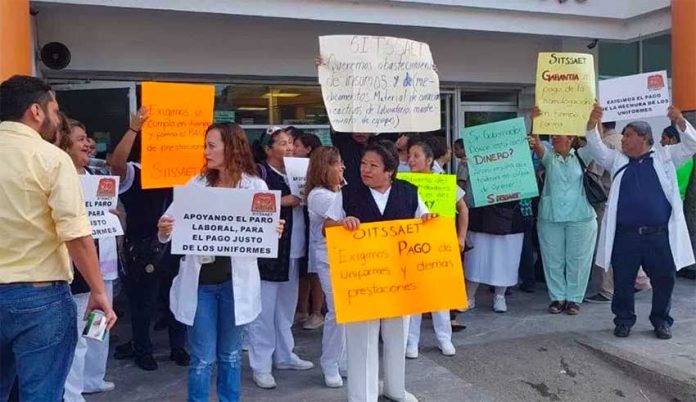
Striking health workers in Tabasco.

All but the most essential medical services have been suspended in Tabasco after at least 12,000 health workers went on strike Monday.

The unionized workers, employed by the federal and state governments, began job action after payments to reimburse the workers for the cost of their uniforms were not made last Thursday as scheduled. The amount to be paid is about 50 million pesos (US $2.58 million).

The workers are also protesting a shortage of medications and other supplies and poor infrastructure.

Workers at specialized clinics and hospitals throughout the state joined the strike, leaving only skeleton crews to continue working.

Doctor’s consultations, general medical care and scheduled surgeries have been suspended.

Many patients went home due to the lack of care available. Typical was the case of a patient who appeared in a video on local media: the woman was transferred from the hospital on a gurney while connected to a ventilator. Her family was taking her home to care for her.

Health workers met with representatives of the federal Health Secretariat but no agreement was reached.

The state government issued a statement to inform workers that the monies owed would be paid and that the delays were not due to “disinterest” or “negligence, but due to the budgetary limitations of state finances.”

Source: El Universal (sp)

New austerity measures win unanimous support in Senate

0
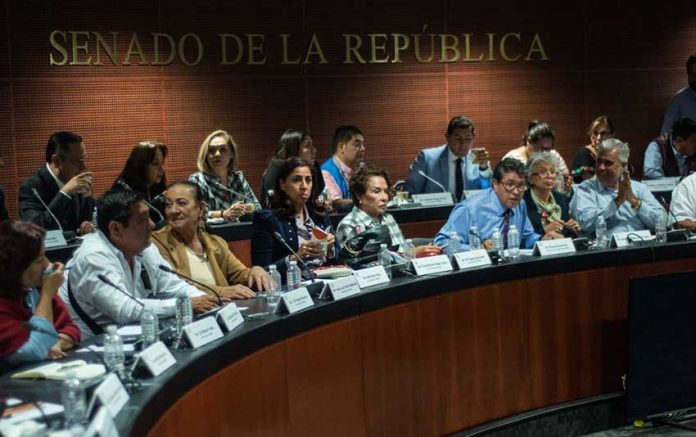
Morena party senators introduced spending cuts.

Under the slogan “no more rich parliament and poor people,” the Senate is undergoing a downsizing following the introduction of the government austerity policy by president-elect Andrés Manuel López Obrador.

Senators gave unanimous approval to the plan presented by the Morena party majority, which represents a 30% reduction in the Senate’s budget.

No longer will the taxpayers pay for senators’ fuel expenses, mobile phone bills, food vouchers, major medical expenses, toll booth fees, the maintenance of their personal vehicles or individualized end-of-employment insurance, among other perks.

The lawmakers will also have to work with less: the political parties represented in the upper chamber will no longer be allocated budgetary funds. Of the existing 64 legislative commissions, only 42 will continue to operate and 16 will be completely eliminated.

The new Senate, sworn in a week ago, also put a cap on professional fee expenses and food costs.

Durango Senator Alejandro González Yáñez said the austerity measures are expected to save 599 million pesos (US $30.9 million) this year, and 1.4 billion ($72 million) in 2019.

The measures, which are intended reduce expenditures to those that are “strictly necessary,” were passed unanimously.

Senators are also considering a pay cut of 13,300 pesos, reducing their monthly salary to 105,000. This would mean that senators no longer earn more than the president.

The president of the house’s political coordination council, Senator Ricardo Monreal Ávila, said the Senate could not “live within a sphere of privilege in front of a world of inequality [and] by no means can it continue to maintain a status quo that is far removed from that which exists outside its precincts.”

Source: El Universal (sp), El Financiero (sp)

4 out of 10 earthquake-damaged schools still await repairs in Oaxaca

0
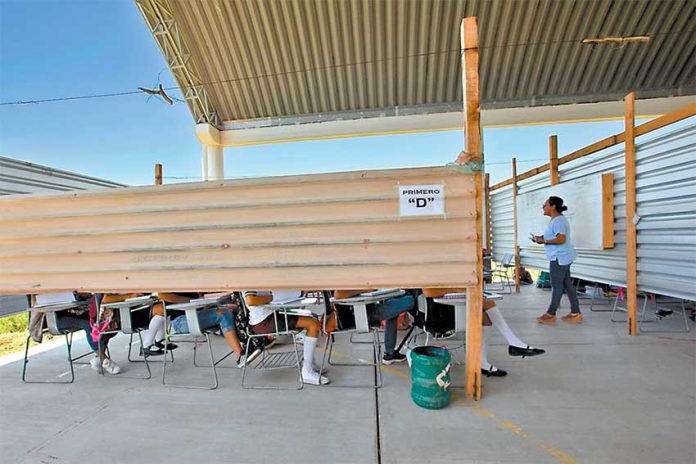
Outdoor education in Oaxaca.

Four out of 10 schools in Oaxaca that were damaged in last September’s first devastating earthquake still haven’t been repaired almost a year after the disaster hit, statistics show.

According to data from Iocifed, a state government institute which oversees the construction of education infrastructure, 2,952 schools in Oaxaca — primarily in the Isthmus of Tehuantepec region — sustained some degree of damage in the powerful 8.2-magnitude earthquake that struck just before midnight on September 7, 2017.

Of those, 1,952 have been rebuilt or repaired but the remaining 1,000 are either still under repair or awaiting attention.

In the latter category is the Number 50 Technical Secondary School in Juchitán, where around 800 students attend classes outside under trees, in classrooms that were badly damaged but still haven’t been demolished or in makeshift, partitioned learning spaces built on the basketball court with sheet metal purchased by parents.

The conditions are far from optimal for learning.

In addition to being highly susceptible to seismic activity, the Isthmus of Tehuantepec is one of Mexico’s windiest regions and the capital of the country’s growing wind energy sector.

But while gales are good for making wind turbine blades spin, they are not helpful for middle school students trying to concentrate on the educational task at hand.

Reporters from the newspaper Milenio observed students from one class struggling to keep control of the pages of their notebooks as wind blew while they took dictation in the open air, while swirls of dust and an errant soccer ball from a physical education class created further problems.

“It’s not his fault,” said typing teacher Claudia Torija when a student was struck in the head with the wayward ball.

“It’s the fault of the education authorities that haven’t followed up as they should have. In the news, they said that 100% of schools were ready [for the new school year] but we’ve found out that’s a lie,” she said.

“What you can see over there was the base of a two-meter by five-meter building that housed my workshop and the cafeteria. Today, it’s just dirt where rainwater stagnates. Do you think that a young person is going to learn in these conditions? We get distracted, they get hit by balls . . . .”

Héctor Pineda, the school’s academic coordinator, told Milenio that authorities promised to completely rebuild or repair schools in less than six months after the quake.

But six months passed before rubble was even cleared and any new construction work began, he explained.

“Attention was only given to one school [in Juchitán], the Centro Escolar Juchitán, which is already finished. The rest, well they’re under construction that is a little slow, as you can see. In our case only the foundations of four classrooms have been laid but we need at least 18,” Pineda said.

“They [the students] say themselves, ‘Teacher, our notebooks are all battered, when are we going to have a classroom? It’s cold, it’s too hot, what are we going to do when it starts to rain?’”

Iocifed official Mario Bustillos said the state government has been allocated 1.6 billion pesos (US $82.1 million) to carry out repair work but added that a shortage of construction workers had made the rebuilding process “a little slow.”

José Juan Carrasco, principal of the Number 50 school, said that as in other schools still awaiting repairs, students and teachers have grown desperate for adequate learning conditions.

If the problems continue, the CNTE teachers’ union will start to take extreme measures, he warned.

Source: Milenio (sp)

Economic zones sign up energy projects worth US $2.5 billion

0
Coatzacoalcos, energy capital of Mexico.

Mexico’s special economic zones (SEZs) have signed agreements for energy projects worth US $2.5 billion, the executive secretary of the federal initiative has announced.

In an interview with the newspaper Milenio, Enrique Huesca said the Coatzacoalcos, Veracruz; Salina Cruz, Oaxaca; Dos Bocas, Tabasco; and Campeche SEZs will take the lion’s share of investment in the sector because they already boast energy infrastructure that was built by Pemex but is no longer used by the state oil company.

The ability to use existing infrastructure in those zones reduces costs for private companies and makes investment more attractive, he explained.

“Pemex left a quantity of infrastructure that can be reconfigured, which is very valuable . . .” Huesca said.

Coatzacoalcos, a port on the northern coast of the Isthmus of Tehuantepec, has the “undoubted” capacity to become “the natural energy capital of Mexico” because of the number of projects planned for the city, he added.

Investment of $2.2 billion has been committed towards 21 projects in the Gulf Coast port, which in turn is expected to generate 10,000 jobs.

All told, the investment pledged for energy projects in the seven SEZs, which President Enrique Peña Nieto created by decree, account for 36% of all investment attracted so far.

Across all sectors, Huesca said, agreements representing more than $7.1 billion in investment have now been signed, and that Lázaro Cárdenas, Michoacán, is leading the way with almost $3.2 billion committed to 12 projects, which are also expected to create 10,000 jobs.

Other investment secured so far includes $218 million for Progreso, Yucatán, creating 550 jobs; $200 million for Puerto Chiapas, creating 4,200 jobs; $550 million for Salina Cruz, creating 600 jobs; $100 million for Campeche, creating 500 jobs; and $120 million for Tabasco, creating 1,000 jobs.

Huesca highlighted that a lot of the SEZ cities haven’t received investment of such a large scale for many years.

The SEZ executive secretary also said he has kept the incoming federal government up to date about the progress of the planned projects, and informed future officials of the Secretariat of Finance about the rules and regulations of the special zones.

Earlier this year, Peña Nieto announced a 50-billion-peso government stimulus package to attract investment to the SEZs, which offers companies a zero tax rate for 10 years as well as other financial benefits.

Source: Milenio (sp)

Mexico, Canada must work together to tame ‘beast’ in White House: Fox

0
Vicente Fox holds a sign bearing a message for Trump regarding the border wall.

Former president Vicente Fox has urged Canada to join Mexico in the trade deal already reached with the United States so the two countries can work together to confront the “wild beast” in the White House.

In an interview on the Canadian radio show The Current punctuated by his trademark blunt language and provocative humor, Fox also described United States President Donald Trump as “the elephant in between” Mexico and Canada and said that Mexico City and Ottawa need to help each other when dealing with him.

“We must stick together, because the challenges are in the East, [they] are in other economies, and we have to remain strong, remain successful, remain competitive, remain productive,” he told host Anna Maria Tremonti.

“Now we know Trump much better than before and he’s not a good dealer,” added the former National Action Party (PAN) president, who held office from 2000 to 2006.

“It’s clear his game. He attacks first, he tries to reduce the capacities of the opponent, and then he takes all the marbles, and like a good kid, he runs away with the marbles.”

Trump announced last Monday that the United States and Mexican had reached a bilateral deal that could exclude Canada and after four days of negotiations failed to yield a trilateral pact, he reiterated that possibility via Twitter Saturday.

“There is no political necessity to keep Canada in the new NAFTA deal. If we don’t make a fair deal after decades of abuse, Canada will be out . . .” he wrote.

Like Trump, Fox also has a predilection for making provocative comments on social media, especially when aimed at the U.S. president.

“Mexico is not going to pay for that fucking wall” and “your mouth is the foulest shithole in the world” are among the goading Twitter posts he has directed at the 45th U.S. president.

But in his Canadian radio interview, Fox charged that “you cannot be provocative when you’re in the public arena, when you’re the president of a nation, when you represent 300 million Americans, when you have the power to destroy with atomic bombs or with an army.”

He added that the “presidency deserves a much better leader, a compassionate leader with a human attitude” and that he hoped that the Democratic Party would win control of the U.S. Congress in November midterm elections so that “this wild beast will be domesticated.”

Turning to the topic of drugs, Fox said that Mexico was caught in the middle in the illegal drug trade, sandwiched between drug producing countries such as Colombia and Bolivia to the south and large drug-consuming markets to the north.

The marijuana legalization advocate, who was in Toronto in his capacity as one of the newest members of the board of Canadian medical cannabis company Khiron Life Sciences Corp, said that Mexico itself is not a big drug-consuming nation.

“The big, the huge consumer markets of drugs are the United States, and secondarily Canada,” he said.

In a separate interview with Bloomberg last week, Fox said that marijuana trade should be included in an updated NAFTA deal.

“We can change criminals for businessmen, we can change underground, illegal non-taxpayers into an industry, a sector of the economy.”

Source: CBC (en)