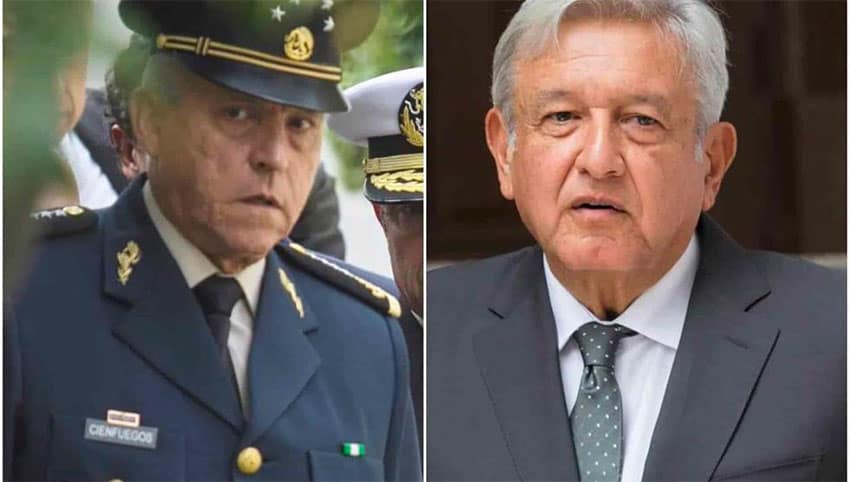
Last month, the U.S. government dropped drug-related charges against Salvador Cienfuegos, Mexico’s former defence minister and a retired four-star general. The decision was surprising given the U.S. record of prosecuting top Mexican politicians for their links with organized crime.
Late last year, for example, the U.S. arrested Genaro García Luna, the minister of public security under former president Felipe Calderón, and charged him with taking bribes from Joaquín “El Chapo” Guzmán, the notorious drug lord now serving a life sentence in the U.S.
In that instance, President López Obrador, widely known as AMLO, claimed the charges demonstrated Mexico’s status as a “narco-state.” Now, by contrast, he has gone to considerable lengths to secure Mr. Cienfuegos’ release, successfully threatening a range of countermeasures, including the previously unthinkable expulsion of the U.S. Drug Enforcement Administration if the charges were not dropped. What, then, is different about Mr. Cienfuegos? And why did the Mexican government make such efforts to secure his freedom?
The decision seemingly reveals Mr. López Obrador’s continuing desire to coddle the army, an institution that has been gaining political power and funding for over a decade. In 2009, then-president Mr. Calderón announced the deployment of 2,500 soldiers to his home state of Michoacán to stop rising violence. From there, his administration deployed the military to “new hotspots” of violence with increasing frequency. The subsequent administration of Enrique Peña Nieto continued the trend. By 2018, the last year of that administration, 54,000 soldiers were deployed throughout Mexico.
During his 2018 presidential campaign, Mr. López Obrador pledged to reverse this escalation, and to “return the army to the barracks.” Yet, over the following two years, his administration instead expanded its reach, placing the military at the forefront of public security.
In the first months of his mandate, he created a National Guard, largely dependent on the army, tasked with “crime prevention, preserving public safety, and combating crime.” This militarization has since expanded far beyond security: the army is now in charge of customs programs and is even helping build one of the president’s pet projects: the Maya Train, a US $7.4-billion railway.
The growing militarization of civilian affairs was already troubling; the defence ministry is subject to more complaints filed over human rights violations (such as forced disappearance, torture and extrajudicial executions) than any other institution in Mexico. The release of the 72-year-old Mr. Cienfuegos suggests that the situation is only likely to get worse.

As defence secretary, he headed the military during its involvement in a number of well-documented scandals, most notoriously the disappearance — and suspected torture and murder — of 43 students in Ayotzinapa, plus the Tlatlaya massacre where 22 civilians were executed by soldiers after rendition. In both instances, lengthy and convoluted judicial processes clouded any chance of holding members of the military accountable. It is in this context of widespread human rights abuses and impunity that the López Obrador government has gone to unprecedented lengths to appease the military by protecting its top brass.
On the evening of November 17, Mr. Cienfuegos flew back to Mexico after the U.S. charges had been dropped. Upon his arrival, he was formally notified that an investigation had been opened against him. He then headed home.
All there is to do now is wait for Mr. Cienfuegos to be “investigated and, if appropriate, charged under Mexican laws,” as the U.S. and Mexican governments jointly put it. I’m not holding my breath.
The writer is an assistant professor at the University of Texas at San Antonio.
© 2020 The Financial Times Ltd. All rights reserved. Please do not copy and paste FT articles and redistribute by email or post to the web.