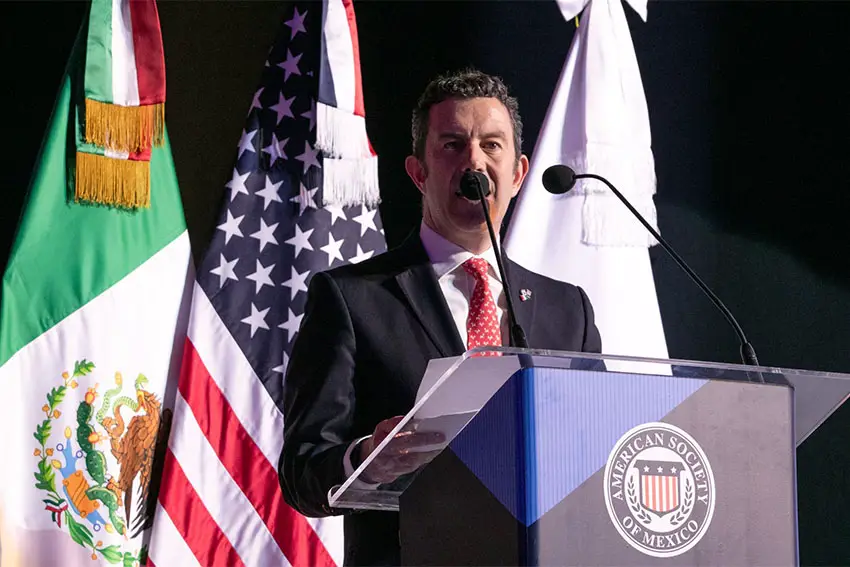
The arrival in Mexico of the new United States ambassador will help the Mexican government “understand what the priorities are” for the Trump administration, according to Larry Rubin, president of the American Society of Mexico (AmSoc).
Mexico News Daily recently spoke to Rubin, a dual Mexican and United States citizen who is a representative of the U.S. Republican Party in Mexico.
Un gusto platicar con el futuro Embajador de EUA 🇺🇸 en México 🇲🇽 pic.twitter.com/qkc3T4d4nU
— Larry Rubin 🇲🇽🇺🇸 (@lrubin) January 20, 2025
He said he was “very optimistic” about the arrival of Ronald D. Johnson, a former ambassador to El Salvador who United States President Donald Trump nominated as his pick for ambassador to Mexico. Johnson is currently awaiting confirmation of his appointment by the U.S. Senate.
“We really believe that his work in Mexico will be crucial on many fronts,” Rubin told MND.
Although Trump has made it clear he wants action from Mexico to stem the flow of drugs and migrants to the United States, the AmSoc president believes that Johnson will provide even greater clarity to the Sheinbaum administration about the priorities of the U.S. government.

On immigration control and the fight against transnational drug trafficking, “definitely Mexico and the U.S. need to work together,” Rubin said.
Johnson could be a crucial intermediary between Trump and the Sheinbaum administration, conveying to Mexican officials what needs to be done to appease the U.S. president and avoid — or have lifted — punitive measures such as the imposition of tariffs on Mexican exports, for example.
“The Trump administration has been very clear that they don’t expect anything but results, and so the time when Mexico could get away with beautiful press releases, and forums and discussions and inviting ministers to come down and talk about it or go up to D.C. and talk about it is long gone,” Rubin said in an interview before the extradition of 29 Mexican cartel figures to the United States.
“Now it’s about action … and that’s what we get with this [U.S] administration,” he said.
Los aranceles no son buenos para nadie. Tampoco lo es el crimen organizado. Trabajemos juntos México 🇲🇽, Estados Unidos 🇺🇸 y Canadá 🇨🇦 para erradicar este cáncer que nos ha invadido a las 3 naciones
— Larry Rubin 🇲🇽🇺🇸 (@lrubin) March 4, 2025
Rubin stressed that action against narcotics and illegal immigration is also “good for Mexico,” and said he had spoken about that to “different stakeholders” in the Mexican government.
It’s not about doing “a favor” for the U.S., but about “what’s in it for Mexico,” he said, referring to benefits such as an improved domestic security situation.
“Working together, the U.S. and Mexico, there really is an opportunity for both countries to benefit,” Rubin said.
With regard to Mexican drug cartels — six of which were recently designated as foreign terrorist organizations by the U.S. government — the AmSoc president said that the criminal organizations “have tentacles all over the U.S.”
“If you want to get rid of those tentacles you have to go to the source and the source is these Mexican drug lords in Mexico,” said Rubin, who compared high-ranking cartel operatives in the U.S. to “small-time managers.”
Rubin: Stopping flow of weapons to Mexico not a priority for US
Asked whether he believed the United States would take meaningful action to stem the flow of weapons to Mexico, Rubin responded that he didn’t believe it was “a priority for the U.S. government.”
“And I don’t see it becoming a priority,” he added.
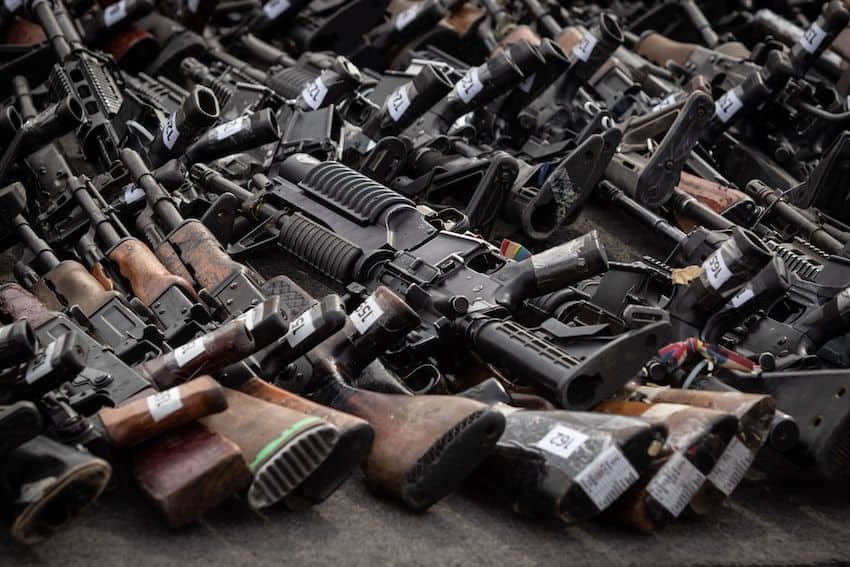
The United States is the primary source of weapons for cartels, but Rubin said that Mexican criminal organizations also obtain weapons from other parts of the world and could rely on those connections if the illicit supply from the U.S. dries up.
“They don’t need the U.S. to get their weapons,” he said.
Rubin said that “the way Mexico can control illegal weapons from coming in is really securing their borders.”
“At the end of the day who’s responsible for anything coming into Mexico is not the U.S., it’s Mexico,” he said, adding that the U.S. is also “responsible for closing down its borders” to stop the entry of drugs and migrants.
The AmSoc president advocated greater engagement with Texas on the arms trafficking issue, noting that approximately 70% of the Mexico-U.S. border runs through the Lone Star state.
“I think these issues can be discussed … state to country, more than at a federal level,” he said, adding that he believed Texas Governor Greg Abbott was “open” to such talks.
USMCA is ‘a very valuable instrument’
Rubin said that the United States-Mexico-Canada Agreement, the free trade pact that superseded NAFTA in 2020, is “a very valuable instrument, not only for Mexico but also for the U.S. and Canada.”
The agreement has created opportunities for small companies as well as large corporations “to look beyond their local markets,” he said ahead of the 2026 review of the pact.
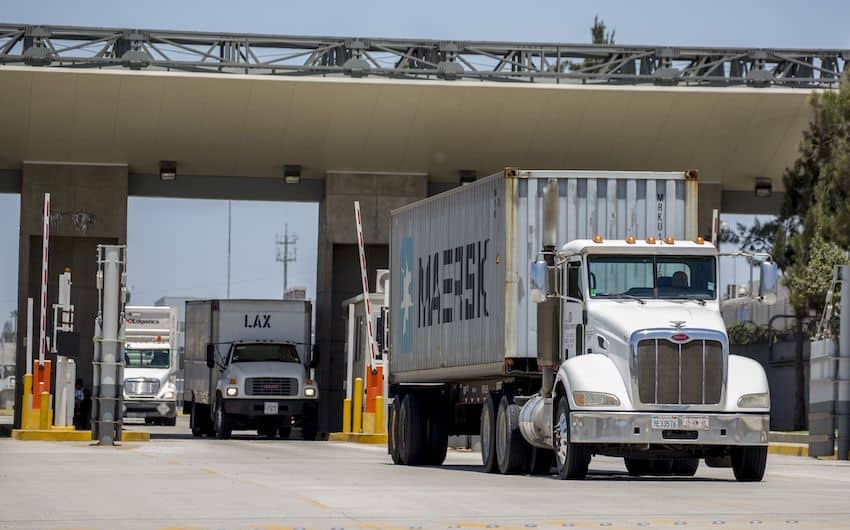
As an extension of the economic integration in North America, Rubin said that the United States could seek to alleviate shortages in certain sectors, such as nursing and trucking, by hiring Mexican workers.
There are “tons of opportunities to help the U.S. economy by bringing in legal workers” who can be “vetted” by authorities before entry, he said, adding that expanding legal pathways for migration is something that the Trump administration will likely look at.
Rubin sees increased US immigration to Mexico as a positive
“We’re excited to see these growing numbers because we do believe that makes our societies even more integrated,” Rubin said, referring to the increased presence of Americans in Mexico.
He said that some 2 million U.S. citizens currently live in Mexico.
“Obviously these individuals are spending money in Mexico, which is fantastic — they’re supporting local economies, which is very, very important,” said Rubin, who in his role at AmSoc represents the U.S. community in Mexico as well as U.S. companies and NGOs.
Due to the large number of Mexican-Americans in the U.S., and the growing number of U.S. citizens living in Mexico, he predicted the emergence on both sides of the border of more leaders from those communities in politics, business and other fields.
Mexico News Daily asked the AmSoc president whether he had detected any increase in anti-American sentiment due to current tensions in the Mexico-U.S. relationship, including those related to Trump’s mass deportation plan.
“Fortunately I have not picked up anything yet. Of course, we have to be vigilant because the tide could turn,” he said.
“But part of what we try to do at the American society is promote the fact that our two countries are stronger together.”
By Mexico News Daily chief staff writer Peter Davies (peter.davies@mexiconewsdaily.com)
Peter and Mexico News Daily CEO Travis Bembenek spoke to Larry Rubin in February