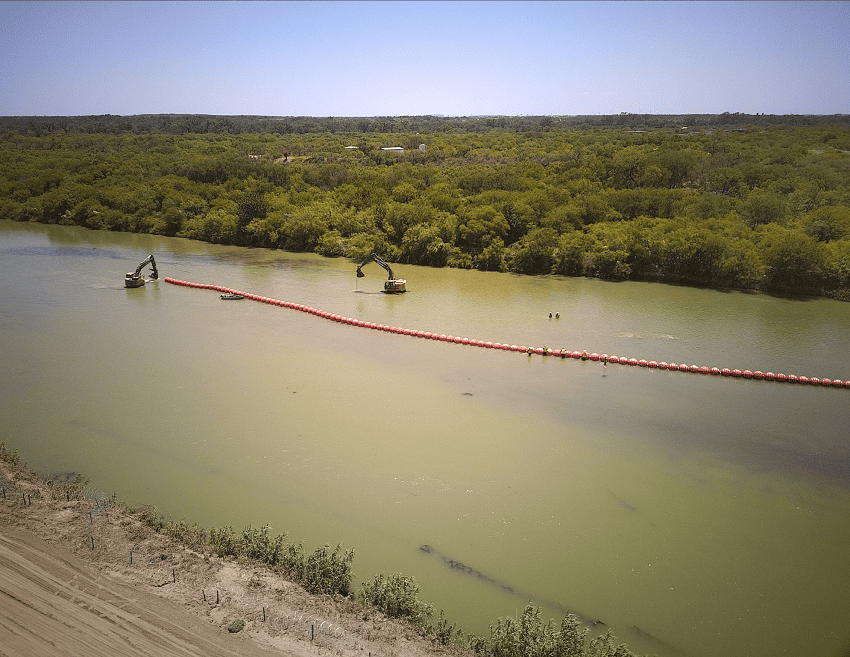
The state of Texas has been ordered by a federal judge to remove the floating border barriers it placed in the Rio Grande to discourage migrants from crossing the river from Mexico into the United States.
On Wednesday, a U.S. federal judge issued a preliminary injunction instructing Texas to move its 1,000-foot string of wrecking-ball sized orange buoys out of the water by Sept. 15, calling them a threat to people’s safety and to U.S.-Mexico relations.

In his ruling, District Judge David Ezra said the barriers could violate treaty agreements between the United States and Mexico. He also cast doubt on their effectiveness. “The State of Texas did not present any credible evidence that the buoy barrier as installed has significantly curtailed illegal immigration across the Rio Grande River,” wrote Ezra, a Reagan administration appointee.
Within hours of the decision, Texas had filed an appeal. “Texas is prepared to take this fight all the way up to the Supreme Court,” Gov. Greg Abbott wrote on social media, calling the judge’s ruling an attack on the state’s “sovereign authority.” The $850,000 floating barrier was installed in July near Eagle Pass, Texas, as part of a larger migration deterrence effort known as Operation Lone Star.
In August, Mexico’s Foreign Affairs Ministry (SRE) expressed concern “about the impact on migrants’ human rights and personal security that these state policies could have, as they go in the opposite direction to close collaboration.” Meanwhile, the U.S. Department of Justice sued the state, accusing Texas of violating federal law by putting a barrier on an international boundary without permission. The suit also said the barrier raised humanitarian and environmental concerns.
Shortly after the judge’s ruling, the SRE issued a brief statement on the matter on X social media platform: “We will remain attentive to the final resolution and we reiterate the urgency of definitively removing the buoys on our shared border; as well as the importance of respecting the Bilateral Treaty of 1944 and safeguarding the human rights of migrants.”
El @GobiernoMX, a través de la @SRE_mx, reconoce la decisión emitida por la Corte Federal para el Distrito Oeste en EE. UU., en la que ordena retirar la instalación de boyas colocadas dentro del Río Bravo en el área de Eagle Pass, Texas.
Nos mantendremos atentos a la resolución…
— Relaciones Exteriores (@SRE_mx) September 6, 2023

President López Obrador also addressed the judge’s ruling in his Thursday morning press conference, saying “I must extend my sincere thanks to the U.S. Attorney’s Office, which filed this complaint, and to the judge who ruled that the buoys should be removed by no later than Sept.15.” He chastised the Texas government for not seeking federal authorization before installing the barrier and said that the ruling is “good news for the Mexican people.”
The buoys, which hold up nets meant to keep migrants from swimming beneath them, are attached to concrete anchors using 12-meter chains and can shift greatly in the current. In August, Texas quietly moved the buoys back to the U.S. side of the Rio Grande, with Abbott saying they had simply “drifted” into Mexican territory. He offered no apology to Mexico, which had complained for weeks about the violation of its sovereignty.
The U.S. Justice Department submitted evidence to the federal court that roughly 80% of the barrier was on the Mexican side of the border at that time, citing a survey by the International Boundary and Water Commission, the binational agency that controls the river. Moreover, an 1899 U.S. law prohibits construction in a waterway without federal approval.
Abbott has said Texas needs no such permission because it’s under “invasion” by migrants and drug smugglers. District Judge Ezra addressed this claim in his ruling: “Under this logic, once Texas decides, in its sole discretion, that it has been invaded, it is subject to no oversight of its ‘chosen means of waging war,’” the judge wrote. “Such a claim is breathtaking.”
With reports from AP, Texas Tribune and Dallas Morning News