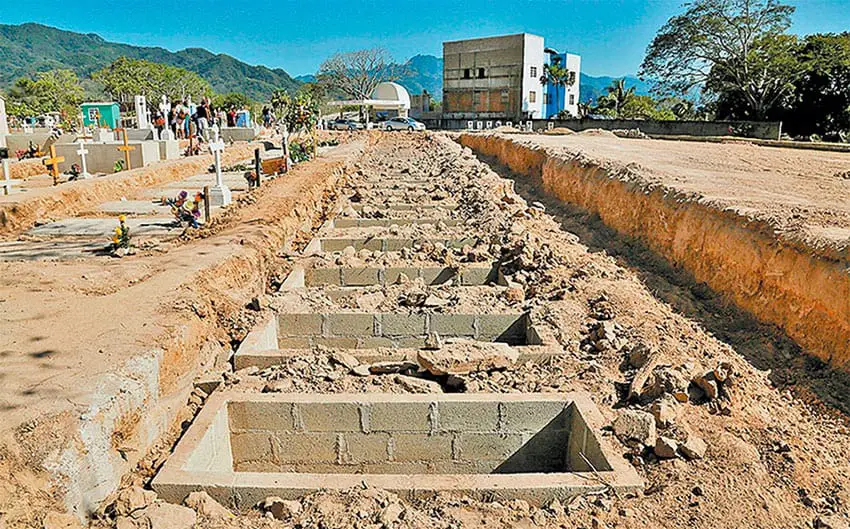
Although the federal Health Ministry announced that the bodies of those who have died from Covid-19 cannot spread the virus after having been disinfected, many states are setting their own varying regulations on how to process the remains of victims of the global pandemic.
Three weeks after Mexico recorded its first death from Covid-19, the virus is changing how Mexicans physically process death.
Hidalgo has some of the strictest regulations in the country, mandating that cadavers be put into sanitary biodegradable bags clearly labeled as biohazards and that they be buried in coffins that are resistant to pressure caused by gas.
Health workers in México state who come into contact with a Covid-19 cadaver will be equipped with a hermetically sealed disposable biohazard suit with goggles and an N-95 face mask. They will have to follow a strict hygiene protocol and completely clean and sanitize all areas and equipment used to deal with the remains.
The Tabasco state Health Ministry prohibits citizens from holding wakes in their homes and mandated that cadavers be cremated in sealed coffins within 12 hours of death. San Luis Potosí enacted a similar measure with a 24-hour postmortem period.
Authorities in Coahuila ordered that all funerals be limited to 10 people.
The federal Health Ministry said that a properly disinfected Covid-19 cadaver “poses no risk” and that the preferable way to dispose of one is cremation, but interment also acceptable. All ceremonies can follow traditional customs.

In expectation of the worst of the pandemic still to come, the hospital systems of the National Autonomous University (UNAM) and the National Polytechnic Institute (IPN) began withdrawing medical interns from hospitals across the country on Monday to safeguard personnel.
Deputy Health Minister Hugo López-Gatell warned the public in late March that phase three of local transmission, in which the rate of contagion is highest, would come in April.
Source: Milenio (sp)