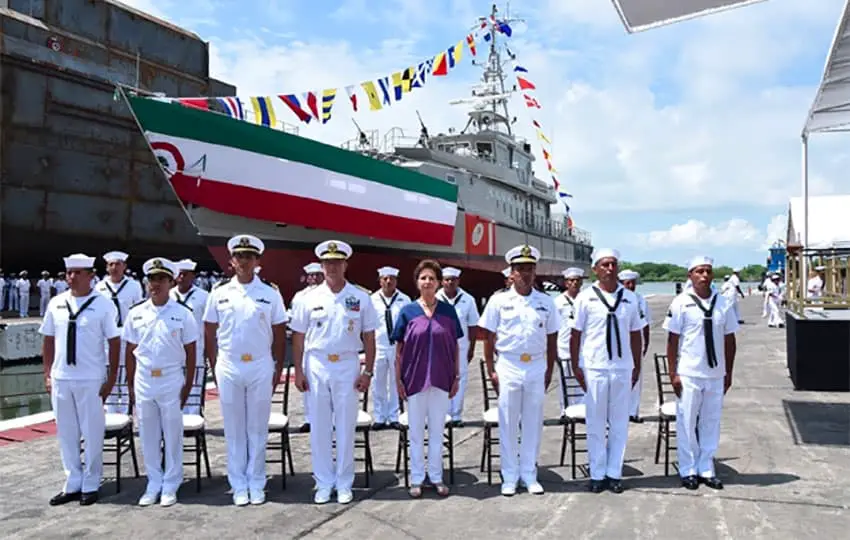
From fishboats to patrol vessels, yard looks back on 65 years of shipbuilding

Patrol vessels, tugboats and shrimp boats are among the more than 100 watercraft built at Naval Shipyard No. 1 in Tampico, Tamaulipas, over the past 65 years.

Located on the Gulf of Mexico in the south of the northern border state, the naval shipyard is the most productive among seven in the country, according to its project director, Captain Jesús Manuel Gómez Álvarez.

The shipyard was established in 1930 but its boatbuilding records only date back to 1955. Gómez, a 30-year veteran of the navy, told the newspaper Milenio that 104 hulls and entire ships have been built at the yard since then.

The boatbuilding process has changed over the years, he explained, noting that naval boatbuilders now use cutting-edge technology that allows them to complete their work more quickly. Gómez also said that the shipyard now employs both male and female workers among its 600-strong workforce whereas in the past boatbuilding was considered the exclusive pursuit of men.

The naval captain explained that boats are built upside down, a strategy he said makes it easier to weld the different parts of a vessel together.

When a boat is ready to be launched, an official ceremony is held, Gómez said, explaining that the required electrical and plumbing work is undertaken once a vessel is in the water.

After a vessel is fully equipped and naval engineers have verified that everything is working as it should be, it is delivered to its final destination, he said.

Among the boats built in recent years at the Tampico shipyard are 10 Tenochtitlán-class patrol vessels. Naval boatbuilders began the project in 2011 and by 2018 had completed and delivered all 10 of the 42-meter patrol boats.

More recently, a Oaxaca-class patrol vessel was completed and launched in the Pánuco River, which flows into the Gulf of Mexico. It is currently undergoing testing prior to delivery and deployment.

Patrol vessels such as those built at Naval Shipyard No. 1 are used for a range of purposes including ocean surveillance, search and rescue missions and disaster relief.

Source: Milenio (sp) 

Have something to say? Paid Subscribers get all access to make & read comments.
Manzanillo, Colima, México, 13 de marzo de 2026. La doctora Claudia Sheinbaum Pardo, presidenta Constitucional de los Estados Unidos Mexicanos en conferencia de prensa matutina, “Conferencia del Pueblo” desde Colima. La acompañan Indira Vizcaíno Silva, gobernadora Constitucional del Estado de Colima; Omar García Harfuch, secretario de Seguridad y Protección Ciudadana (SSPC); Raymundo Pedro Morales Ángeles, secretario de Marina (Semar); Bulmaro Juárez Pérez, divulgador de lenguas originarias, presentador de la sección “Suave Patria”; Ricardo Trevilla Trejo, secretario de la Defensa Nacional (Sedena); Jesús Antonio Esteva Medina, secretario de Infraestructura, Comunicaciones y Transportes; Bryant Alejandro García Ramírez, fiscal general del Estado de Colima; Fabián Ricardo Gómez Calcáneo; Rocío Bárcena Molina, subsecretaria de Desarrollo Democrático, Participación Social y Asuntos Religiosos de la Secretaría de Gobernación; Efraín Morales López, director general de la Comisión Nacional del Agua (Conagua); Marcela Figueroa Franco, secretaria ejecutiva del Sistema Nacional de Seguridad Pública (SESNSP) y Guillermo Briseño Lobera, comandante de la Guardia Nacional (GN). Foto: Saúl López / Presidencia

Mexico’s week in review: Congress deals Sheinbaum her first legislative defeat

0
The week of March 9 in Mexico was marked by standoffs between allies in Congress and adversaries at the airport. Here's what you missed.
A soldier displays seized handguns

The US and Mexico, growing together and growing apart: A perspective from our CEO

1
From a historic drop in homicides to opposite bets on electric vehicles, Mexico News Daily's CEO breaks down where the U.S. and Mexico are converging — and where they're not.
Veracruz Gov.

Veracruz governor blames private vessel for 200-kilometer Gulf Coast oil spill

1
The spill, which has spread to over 200 kilometers of Mexico's Gulf Coast beaches, has been traced to a private oil tanker off the coast of Tabasco.
BETA Version - Powered by Perplexity