Absence of tourists puts raccoons at risk in Tamaulipas vacation spot

The raccoons of Playa Miramar in Ciudad Madero, Tamaulipas, are feeling the effects of the coronavirus: their main source of food — tourists — has become scarce. 

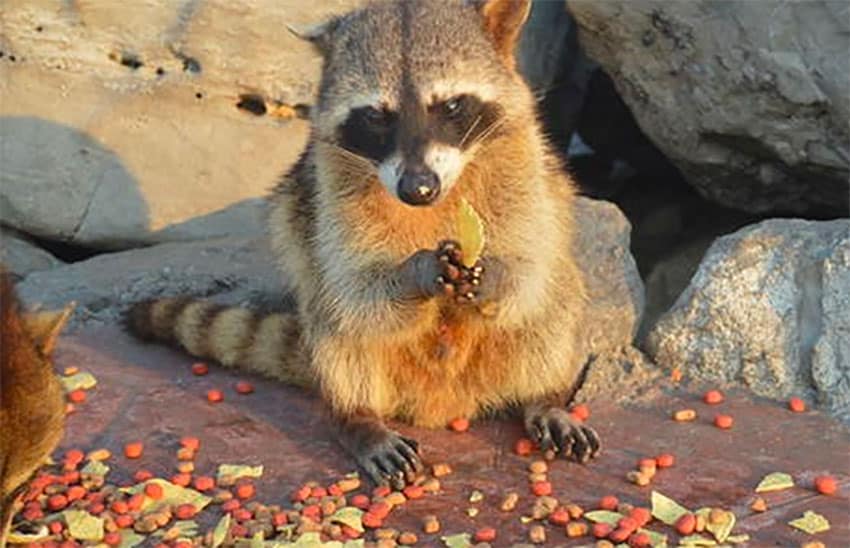
The beach-dwelling raccoons lost their natural habitat in the nearby forest due to construction and moved down to the jetty several years ago. There, they frolic on the rocks and delight visitors who are quick to offer them a snack and snap a photo of the furry mammals, which will eat just about anything you offer them and do so from right out of your hand.

As a result, raccoons have become a major tourist attraction. 

Hortencia Ruvalcaba Infante, president of the seven-year-old Miramar Raccoon Protection and Preservation Board, says that her agency has stepped in to help the creatures, keeping them fed until tourists are able to return and the beaches have reopened. 

“Since there are no people at Miramar beach, we have given ourselves the task of redoubling efforts to be able to visit them and bring them food that is normally obtained through the generosity of tourists,” she said. 
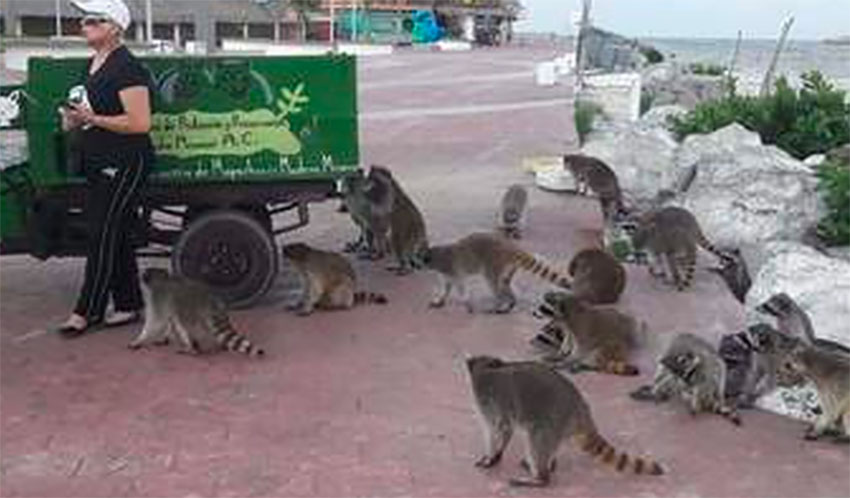
Some 200 raccoons are fed by local volunteers.

This amounts to some 130 liters of water and 120 kilos of food daily, representing an expense of more than 4,000 pesos (US $179) a week to keep the approximately 200 raccoons provided with tortillas and kibble. Ruvalcaba says she also has a veterinarian who offers his services to wildlife at no charge. 

To help support their work, raccoon advocates have sold food, held raffles and made coronavirus masks emblazoned with the image of a raccoon that became very popular in the area and were sold on the group’s Facebook page for 60 pesos each.

But it’s mainly the love for these and all animals that drives Ruvalcaba, a retired Pemex worker, and her fellow raccoon lovers. 

“Sometimes I spend up to 18 hours of my day to help the Miramar beach raccoons as well as other defenseless animals, but this work would not be achieved without the support of the same citizens” who buy masks that help buy food, she said. 

Source: Milenio (sp)

Have something to say? Paid Subscribers get all access to make & read comments.
Manzanillo, Colima, México, 13 de marzo de 2026. La doctora Claudia Sheinbaum Pardo, presidenta Constitucional de los Estados Unidos Mexicanos en conferencia de prensa matutina, “Conferencia del Pueblo” desde Colima. La acompañan Indira Vizcaíno Silva, gobernadora Constitucional del Estado de Colima; Omar García Harfuch, secretario de Seguridad y Protección Ciudadana (SSPC); Raymundo Pedro Morales Ángeles, secretario de Marina (Semar); Bulmaro Juárez Pérez, divulgador de lenguas originarias, presentador de la sección “Suave Patria”; Ricardo Trevilla Trejo, secretario de la Defensa Nacional (Sedena); Jesús Antonio Esteva Medina, secretario de Infraestructura, Comunicaciones y Transportes; Bryant Alejandro García Ramírez, fiscal general del Estado de Colima; Fabián Ricardo Gómez Calcáneo; Rocío Bárcena Molina, subsecretaria de Desarrollo Democrático, Participación Social y Asuntos Religiosos de la Secretaría de Gobernación; Efraín Morales López, director general de la Comisión Nacional del Agua (Conagua); Marcela Figueroa Franco, secretaria ejecutiva del Sistema Nacional de Seguridad Pública (SESNSP) y Guillermo Briseño Lobera, comandante de la Guardia Nacional (GN). Foto: Saúl López / Presidencia

Mexico’s week in review: Congress deals Sheinbaum her first legislative defeat

1
The week of March 9 in Mexico was marked by standoffs between allies in Congress and adversaries at the airport. Here's what you missed.
A soldier displays seized handguns

The US and Mexico, growing together and growing apart: A perspective from our CEO

1
From a historic drop in homicides to opposite bets on electric vehicles, Mexico News Daily's CEO breaks down where the U.S. and Mexico are converging — and where they're not.
Veracruz Gov.

Veracruz governor blames private vessel for 200-kilometer Gulf Coast oil spill

1
The spill, which has spread to over 200 kilometers of Mexico's Gulf Coast beaches, has been traced to a private oil tanker off the coast of Tabasco.
BETA Version - Powered by Perplexity