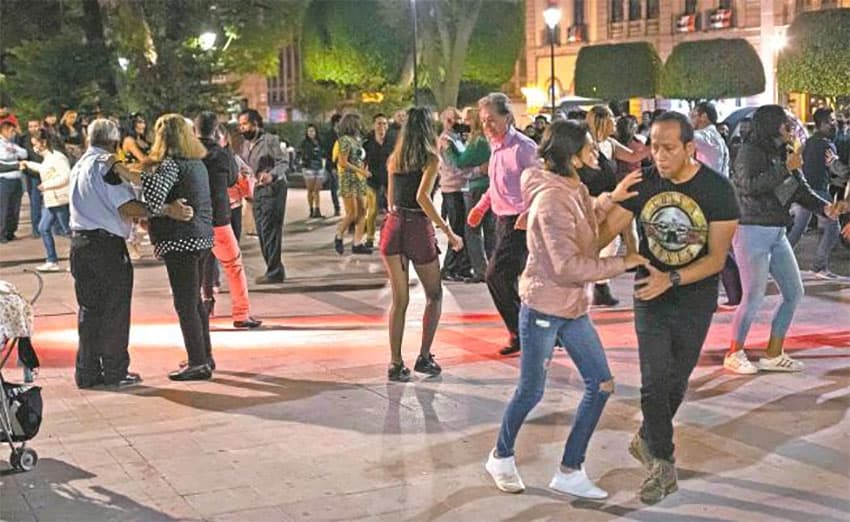
The coronavirus pandemic has forced the cancelation of many social events but not dancing in the historic center of Querétaro.
At least 100 people gather every weekend in Jardín Zenea, a pretty park in the state capital, to dance danzón in the late afternoon and salsa, cumbia and bachata after the sun goes down.
It’s like the coronavirus simply doesn’t exist – the revelers not only dance with strangers but hug each other and laugh together into the late hours of the night and early hours of the next morning.
Face masks are not part of most dancers’ attire, according to a report by the newspaper El Universal.
“I’m not afraid [of the virus], I come here to dance every weekend,” a woman told the newspaper during a recent gathering.
“We don’t have weddings, we don’t have any kind of parties so we have to make the most of it. Everyone says that this pandemic is going to last forever, that we have to learn to live with the virus so why limit ourselves?”
However, limits on all manner of things – the number of customers allowed in restaurants, for example – are the order of the day as authorities grapple with how to stop the spread of the coronavirus without trampling on people’s rights and freedoms and completely destroying the economy.

In Querétaro, where more than 900 people across the state have lost their lives to Covid-19, some of the coronavirus restrictions are strictly enforced.
At 11:00 p.m. – just as the dancers are finding their groove – government inspectors and Civil Protection personnel make the rounds of the historic center to ensure that all the restaurants have ushered their customers out and closed their doors in accordance with state-mandated virus rules.
Yet police and other authorities turn a blind eye to the dancers and allow their public merry-making to go on – and on and on – despite their clear violation of social distancing norms.
The double standard rankles some restaurant workers who have seen their earnings drop due to limits on diners and operating hours.
“It’s not fair that they ask some of us to stop working at 11 at night and at the same time they allow a lot of people to get together and dance,” Francisco Martínez, a cook, told El Universal.
“According to … [the authorities], the service hours [in restaurants] are reduced to avoid infections, to avoid crowds but at the same time they allow a dance with almost 150 people. It’s not fair, ” he added.
A resident of the historic center also expressed annoyance at both the people who gather to dance every weekend and the authorities’ failure to stop them.
“It’s very frustrating that in the middle of a health crisis we see these actions when we know that a lot of businesses have gone bankrupt, a lot of people have died and a lot of people are sick,” Daniel López said.
“Even so the authorities allow this to happen. As a society we lack a lot of commitment. We shouldn’t need the police to tell us what to do but people unfortunately don’t respect the [health] measures,” he added.
“I’ve reported the situation because … it’s unbearable to have the noise so close to home every weekend; the music lasts until four in the morning some nights. I’ve reported it by telephone and on social media; I’ve proven it with photos and videos but I’ve never seen any authority show up.”
While escaping the loud music might not be an option for those who live in close proximity to Jardín Zenea, the female dancer who spoke with El Universal offered some blunt advice to anyone else who is bothered by the noise and carefree fun.
“To the people who report us I would say if you don’t like what we do, stay away – period!”
Source: El Universal (sp)