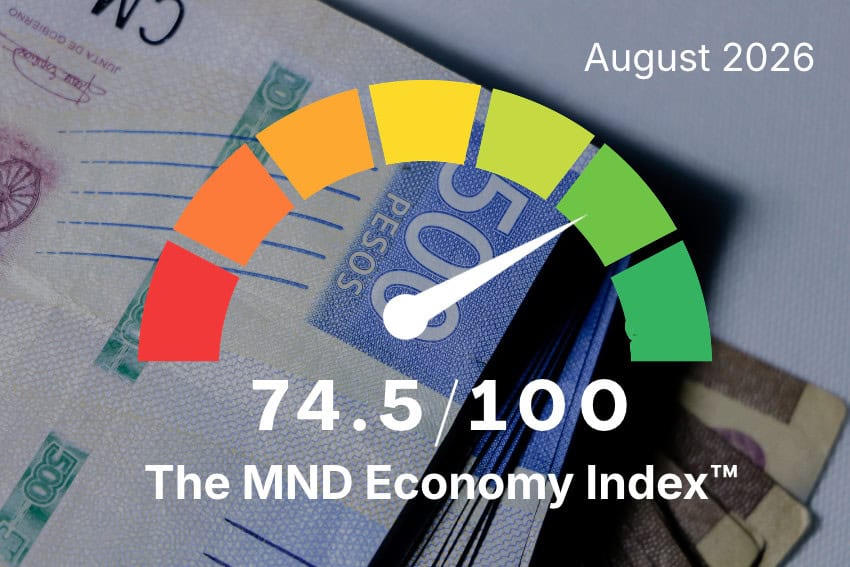
THE MND ECONOMY INDEX™
Providing broad insight into the Mexican economy
MND Intelligence · Sixth edition
Welcome to the sixth edition of the MND Economy Index™, part of the MND Intelligence™ suite of data products from Mexico News Daily.
The MND Economy Index™ is a 10-pillar, 19-indicator composite index that compiles a broad range of economic data into a single score between 0 and 100, giving Mexico News Daily readers a clear, accessible picture of how the Mexican economy is performing across multiple dimensions.
In the inaugural MND Economy Index™ article, published in late May, we not only analyzed the index score — 63.4 out of 100 — but also explained what the index is, why we developed it and how it works. Click here to read (or re-read) those explanations.
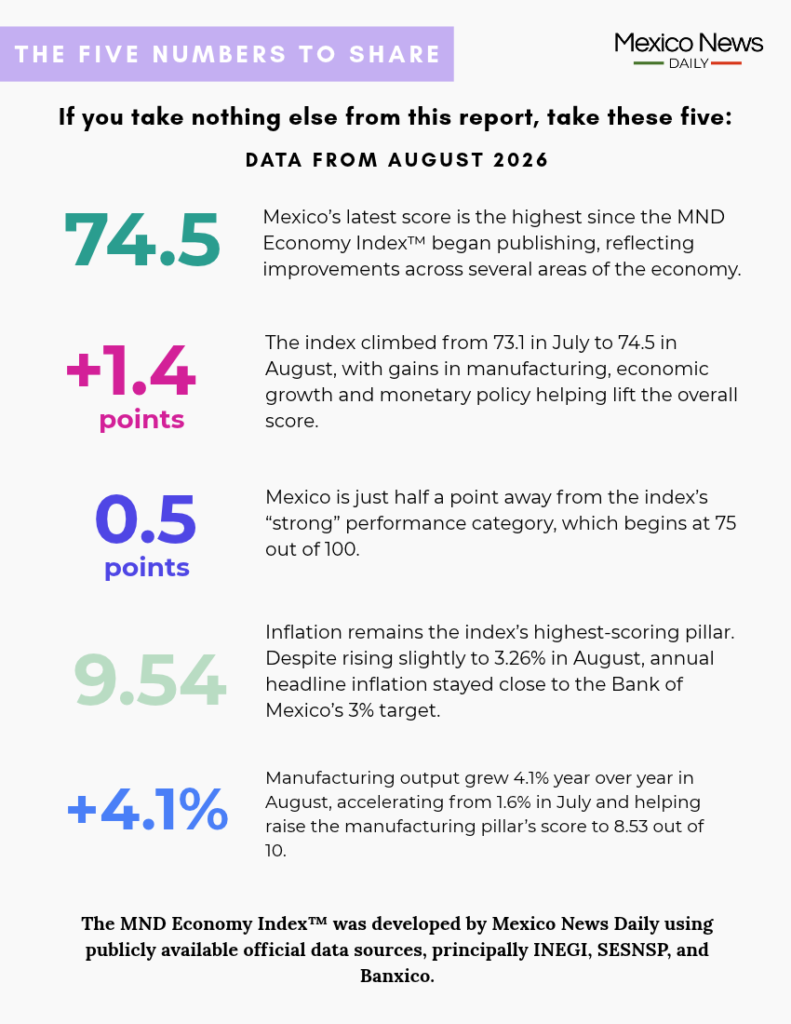
In this edition of the MND Economy Index™ — which uses economic data primarily from the month of August — the index score is 74.5, an increase of 1.4 points compared to the previous score.
The score for August is the highest since we began publishing the MND Economy Index™, reflecting improvements in various parts of Mexico’s economy.
Before we look more closely at the latest index result, here is a short guide to what the overall index score means.
- 85–100: Exceptional — the economy performing at a high level across nearly all indicators.
- 75–84: Strong — strong broad-based performance with only minor areas of concern.
- 60–74: Above neutral — meaningful strengths, but with notable room for improvement.
- 50–59: Mixed — passing marks overall, more indicators above benchmark than below.
- Below 50: Broad underperformance — more indicators below benchmark than above.
Mexico’s economy on the verge of a ‘strong’ assessment
As noted above, the latest MND Economy Index™ score is 74.5, an increase of 1.4 percentage points compared to the previous score. The latest score is just 0.5 percentage points below the score required for a “strong” assessment for Mexico’s economy.

Below you will see the score for each of the ten pillars that make up the index, expressed out of 10 to reflect each pillar’s exact contribution to the final composite score.
Pillars are color-coded using a traffic light system: green (a score above 7.5) indicates strong performance; yellow (5.0–7.5) signals decent performance but with room for improvement; and red (below 5.0) flags a pillar that is falling short of its benchmark. Where a pillar score has improved compared to the previous month, an upward arrow appears alongside its corresponding traffic light; a downward arrow indicates a deterioration; and a pause symbol denotes no change.
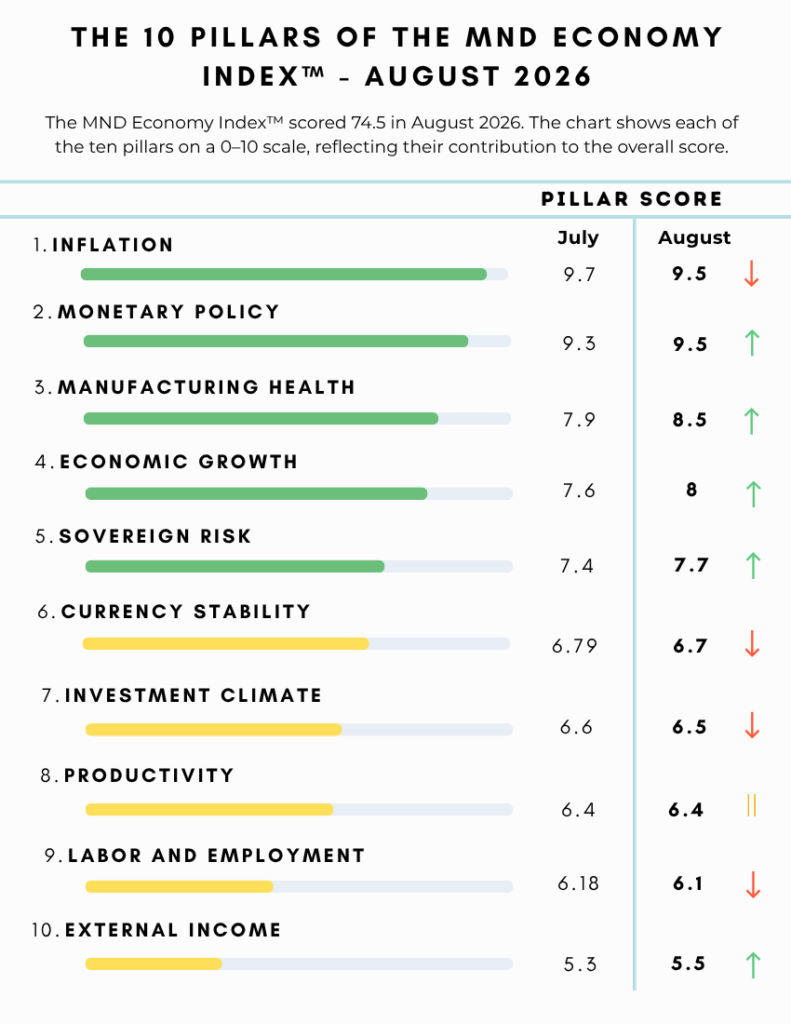
As you’ll see below, scores for four of the ten MND Economy Index™ pillars increased in August compared to the previous month. Scores for five pillars declined, while the score for one was unchanged.
Collectively, the increases were more significant than the decreases, allowing the index score to rise.
🟢 ⬇️ INFLATION (9.54)
The score for this pillar fell to 9.54 in August from 9.68 in July. Despite the decline, the inflation pillar retained its position as the top contributor to the overall MND Economy Index™ score.
Mexico’s annual headline inflation rate increased to 3.26% in August, ending a four-month streak of declines. The increase caused a slight decrease in the score for the current inflation component of the pillar as the headline rate moved away from the Bank of Mexico’s 3% target.
The score for the pillar component that considers the 12-month forward inflation forecast was unchanged as the Bank of Mexico’s outlook for the third quarter of 2027 is applicable to both July and August. The central bank is predicting a headline inflation rate of 3.2% in the third quarter of next year.
🟢 ⬆️ MONETARY POLICY (9.46)
The score for this pillar increased to 9.46 from 9.32 in July.
The Bank of Mexico’s benchmark interest rate remained at 6.50% in August after the central bank’s board voted to keep it at that level at a monetary policy meeting on Aug. 6. Therefore, there was no change in the interest rate component of the pillar score.
The increase in the pillar score was due to a decline in Mexico’s real interest rate in August — i.e., the Bank of Mexico’s benchmark interest rate minus the annual headline inflation rate.
The real interest rate in August was 3.24%, a reading 0.54 points above the 2.7% neutral midpoint.
The real interest rate in July, at 3.38%, was further away from the neutral midpoint than the reading in August.
🟢 ⬆️ MANUFACTURING SECTOR HEALTH (8.53)
The score for this pillar increased in August, rising to 8.53 from 7.9 in July.
The exports component of the pillar remained at the maximum score due to a 40.4% annual increase in export revenue in August, well above the 16.7% threshold needed for a perfect ten. Official data shows that over 94% of Mexico’s export revenue in August came from the shipment abroad of manufactured goods.
The increase in the overall pillar score was due to 4.1% year-over-year growth in manufacturing output in August. The year-over-year gain represented a significant improvement from the 1.6% increase in July.
🟢 ⬆️ ECONOMIC GROWTH (8)
The score for this pillar increased to 8 in August from 7.6 in July.
The increase was due to a higher annual economic growth rate in August. The annual growth rate in August was 3.5%, according to final data published by INEGI on Oct. 23. Year-over-year growth in July was slightly lower at 3.3%.
At her morning press conference on Oct. 26, President Sheinbaum said that growth of 3.5% in August was “very good news.”
She noted that construction, including housing and public infrastructure projects, was helping to drive growth. Sheinbaum also noted that the production of electronics in Mexico was providing momentum to the economy.
🟢 ⬆️ SOVEREIGN RISK (7.72)
The score for this pillar increased to 7.72 in August from 7.41 in July.
The score for the sovereign credit ratings component of the pillar remained unchanged in August, as there were no month-over-month changes to the Mexico ratings of Moody’s (Baa3/stable); S&P (BBB/negative); and Fitch (BBB-/stable).
The increase in the overall pillar score was due to a narrowing in Mexico’s 5-year credit default swap spread. The credit default swap spread was 77.89 basis points at the end of August, down from 87.19 basis points at the end of July. The narrower spread reflected a decrease in the market-implied cost of insuring against a Mexican sovereign default.
🟡 ⬇️ CURRENCY STABILITY (6.73)
The score for this pillar declined slightly to 6.73 in August from 6.79 in July.
The standard deviation of daily exchange rate movements decreased to 0.25% in August from 0.40% in July, leading to an increase in the score for that component of the pillar.
The decrease in the pillar score in July was due to a lower spot rate score. The score for that component declined because the peso strengthened against the US dollar in August to trade at 16.99 to the greenback at the end of the month, an appreciation of 1.9% compared to the end of July.
The exchange rate was thus more distant from the index’s 19.00 USD:MXN baseline, which is based on the 2025 average rate. This pillar penalizes significant deviation from the 19.00 USD:MXN baseline in either direction, recognizing that a peso that has strengthened too far from this benchmark can erode export competitiveness and reduce the purchasing power of remittances, just as a weakening peso raises import costs.
The spot rate component of the currency stability score will increase in the next MND Economy Index™ as the peso depreciated 6% in September to trade at 18.08 to the dollar at the end of that month.
🟡 ⬇️ INVESTMENT CLIMATE (6.46)
The score for this pillar decreased to 6.46 in August from 6.58 in July.
The decrease was due to lower annual growth on the S&P/BMV FIBRAS Total Return Index, which tracks the performance of Mexico’s listed real estate investment trusts. The index grew 24.9% annually to the end of August, down from a 27.4% year-over-year increase at the end of July.
The score for the foreign direct investment component of the pillar remained steady as the latest available data is still that published by the Economy Ministry in late August. That data shows that foreign direct investment in Mexico increased 2.1% annually in the first six months of 2026 to reach a record-high $34.96 billion. Annual FDI growth of 25% is required for a perfect score in that component of the investment climate pillar.
🟡 ⏸️ PRODUCTIVITY (6.4)
The score for this pillar remained steady at 6.4 in August after increasing to that level in July from 3.8 in June.
Data published by the national statistics agency INEGI on Sept. 10 showed that the IGPLE — INEGI’s quarterly productivity measure — increased 1.7% annually in the second quarter of 2026. That level of productivity growth was significantly stronger than the +0.1% reading in the first quarter of 2026.
INEGI will publish productivity data for the third quarter of 2026 in early December.
🟡 ⬇️ LABOR AND EMPLOYMENT (6.11)
The score for this pillar decreased to 6.11 in August from 6.18 in July. Scores for two of the pillar’s three components stayed the same while one declined.
The number of people in formal sector jobs rose 1.5% in the 12 months to the end of August, on par with the annual growth rate at the end of July.
Nominal wages were up 6.7% year-on-year at the end of August, the same increase recorded at the end of July.
Year-over-year growth in Mexico’s informality rate was 0.2 points at the end of August, up from an annual increase of 0.1 points at the end of July. In August, 55% of all Mexican workers worked in the informal economy. Lowering the informality rate is a major challenge for the Mexican government.
🟡 ⬇️ EXTERNAL INCOME (5.51)
The score for this pillar increased in August, rising to 5.51 from 5.26 in July. A year-over-year reduction in remittances in August — just the second decline this year — was a drag on the pillar score, but a strong increase in international tourism revenue more than offset it.
Incoming remittances declined 3.6% year-on-year to US $5.45 billion in August, the first decline of any month since January.
Thus, the score for the remittances component of the pillar fell sharply, although not so far as to warrant a score of zero, as that would require a year-over-year decline of 16.67%.
The pillar score increased in August as international tourism revenue grew compared to the same month of last year, whereas it declined in July. International tourist spending increased 7% year over year in August to reach $2.4 billion.
The MND Economy Index™ trend
In the graph below you can see how the MND Economy Index™ score has changed over time.
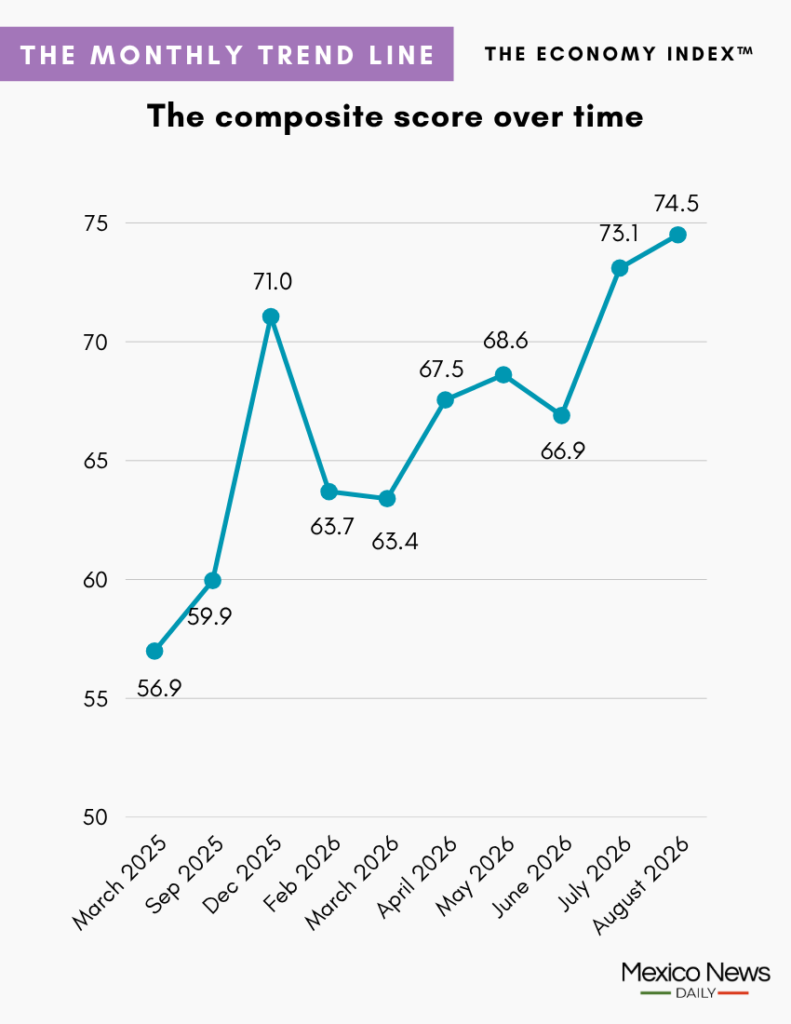
We have now calculated a total of ten index scores in the period between March 2025 and August 2026. The difference between the lowest score (56.9 in March 2025 — predating the publication of the first MND Economy Index™ article) and the highest (74.5 in August 2026) is 17.6 points.
The much higher score in this edition of the MND Economy Index™ indicates that Mexico’s economy is performing much better now than it was early in President Sheinbaum’s six-year term.
The improvement in the index score this year has been significant, increasing more than 10 points between March and August.
Mexico News Daily