Mexico attracted US $34.968 billion in foreign direct investment (FDI) between January and June 2026, marking the highest amount ever recorded for a first semester, the Economy Ministry (SE) reported.
The figure represents a 2.1% year-on-year increase compared to the same period last year and confirms Mexico’s continued appeal as a destination for established international companies.
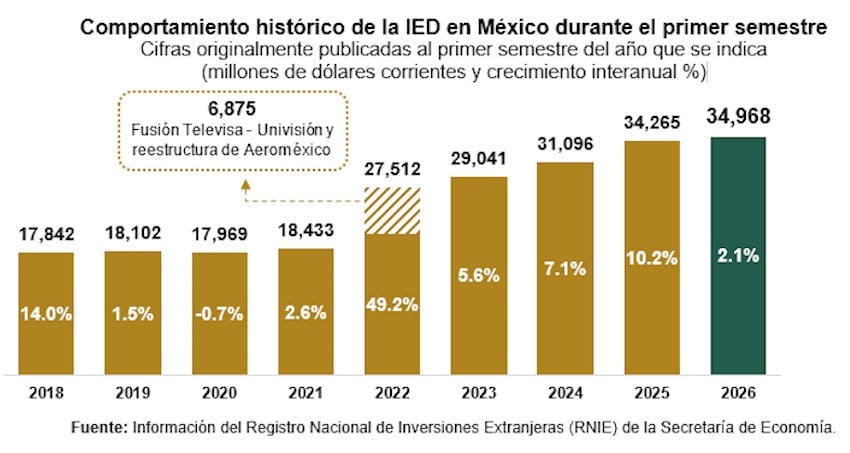
Going back further, foreign investment practically doubled, with an accumulated growth of 89.7%, compared to the first half of 2021, when Mexico attracted US $18.433 billion,
The 2026 advance lost momentum, however, during the second quarter, when revenues reached $10.464 billion, 3.5% less than the $10.848 billion originally recorded during the same period in 2025.
The SE attributed the contraction to last year’s high base of comparison and indicated that it does not represent a change in trend. Despite the year-on-year decline, the result for the second quarter of 2026 was the second highest in the last 16 years.
Who received the foreign investment?
The manufacturing industry was the primary recipient of the arriving resources, receiving $13.482 billion, equivalent to 38.6% of total FDI. The figure represents a 9.3% year-over-year increase for manufacturing.
Financial and insurance services ranked second, with $10.15 billion, followed by the transportation, postal, and warehousing sectors, which registered the strongest growth, attracting $2.65 billion.

Mexico City came in as the top destination for foreign investment, receiving $16.862 billion, or 48.2% of the national total. It was followed by Nuevo León, with $3.712 billion; México state, with $2.114 billion; Baja California, with $1.743 billion; and Jalisco, with $1.406 billion.
Together, these five states accounted for 73.9% of all FDI received during the first half of the year.
Where did the first semester FDI come from?
In the first half of 2026, the United States remained the leading source of FDI in Mexico, with a flow of $16.871 billion, equivalent to 48.2% of the total.
Spain ranked second with $4.954 billion, followed by Canada ($1.741 billion), Australia ($1.698 billion) and Germany ($1.647 billion).
According to the SE, the positive FDI numbers are attributed to the country’s macroeconomic and institutional fundamentals and the guidelines of Plan México, the government’s flagship economic and policy strategy.
Mexico News Daily