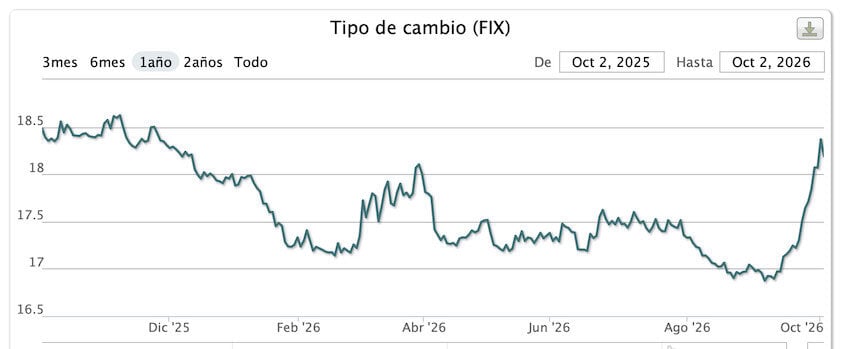
The peso weakened 6.32% in September, its largest monthly depreciation since June 2024, pressured by monetary tightening and the less attractive interest rate differential with the United States.
Last month’s poor performance has prompted the question of whether the phenomenon known as the “super peso” has run its course or is merely suffering a setback.
Mexico’s currency had demonstrated unexpected strength in recent months, but the US dollar strengthened after the U.S. Federal Reserve raised its benchmark interest rate to 4% on Sept. 16.
The dollar recovery extended pressure on the peso, which was already suffering from fluctuating oil prices and risks of a broader war in the Middle East, adding an inflationary component and complicating the monetary policy outlook while increasing market volatility.
When Mexico’s central bank kept its rate steady at 6.50% on Sept. 24 — reducing the spread between the two countries to just 250 basis points — the peso’s decline intensified as long-term U.S. bond yields climbed to multi-year highs.
The smaller spread weakened one of the supports of the “super peso,” reducing the appeal of “carry trade” operations, which for much of 2025 and the first half of this year generated demand for pesos.
Janeth Quiroz, a Grupo Financiero Monex analyst, warned that the carry-trade mechanism can now work in the opposite direction, telling El Economista that as the additional return decreases, the incentive to hold positions in pesos falls.

But although a stronger dollar and high yields on U.S. Treasury bonds add exchange rate pressure, Quiroz insisted it might be more accurate to speak of a loss of strength of the super peso rather than of its “definitive end.”
BBVA Mexico chief economist Carlos Serrano attributed the depreciation to external factors, pointing to the uncertainty surrounding the USMCA free trade deal.
He identified fiscal discipline and greater depth of the domestic financial market as supporting factors, suggesting the peso is still relatively strong and perhaps even overvalued.
For Mexican households, the depreciation cuts both ways. Families receiving dollar remittances gain purchasing power, while imported goods and fuel can become more expensive if the weaker peso lasts.
As October started, the peso closed at 18.30 per US dollar on Thursday, slipping 1.29%, but was up 0.67% at 1:30 p.m. Friday, trading at 18.1808.
And despite the recent jump above 18 pesos, the latest consensus from the central bank and Citi Mexico anticipates an appreciation to 17.50 pesos per US dollar by the end of 2026.
With reports from El Economista, EFE, El Financiero and Expansión