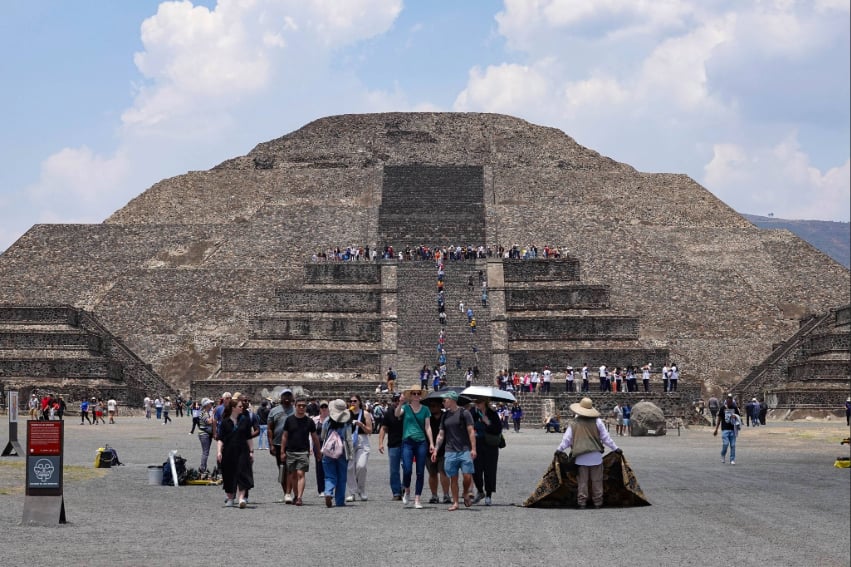
Despite increased travel costs, a decline in air arrivals and a lack of promotion, Mexico registered record figures in international tourist arrivals and spending during the first nine months of 2026.
Data compiled by national statistics agency INEGI through September indicates that foreign currency spending by travelers grew 1.4% year-on-year to nearly US $26.1 billion and the number of international tourists rose 3.8% to 35.97 million people.
However, rising travel costs are blamed for a drop in the segment of tourists arriving by air which experts link to the lower dynamism observed since these travelers represent 80% of tourism foreign exchange.
The INEGI report, released on Thursday, reveals that the 1.4% increase in tourism revenue is lower than the 6.1% growth recorded during the first three quarters of 2025.
Additionally, the International Travelers Survey (EVI) found that the 3.8% increase in international tourist arrivals (by air and by land) came in below the 6.4% rise registered during the same period last year.
After the release of the EVI and INEGI data, the Tourism Ministry on Friday lauded “the historic records both in the arrival of international travelers and in their spending.”
The private sector does not share this enthusiasm.

Humberto Molina, tourism analyst at Grupo Empresarial Estrategia, told El Economista newspaper that although the accumulated results are good, it’s clear that tourism “isn’t taking off,” lamenting the lack of a public policy to provide certainty of sustained growth in the short term.
“In addition to the lack of promotional campaigns, next year will be impacted by the 17.8% increase in the Non-Resident Tax paid by foreign tourists (1,158 pesos starting in January),” he said.
The private sector has also criticized the government’s lack of attention to the tourism sector, describing the 20 million pesos dedicated to tourism in the 2027 budget proposal as “clearly insufficient to promote the different destinations and segments of tourism in the source markets and in the national market.”
The decline in air arrivals is seen as the biggest challenge.
The INEGI figures reflect a cumulative decrease for two consecutive years in that indicator, unseen since records began, impacting the country’s three primary sun and beach destinations: Cancún, Los Cabos and Puerto Vallarta.

The Center for Advanced Research in Sustainable Tourism (STARC) at Anáhuac University Cancún reported that, through October, the airports that service these three locations have seen a cumulative reduction of 1.9 million international passengers compared to 2025.
Still, spending by tourists arriving by air increased by 7.1% in September.
One reason cited for the September boost is the gradual recovery of business tourism, which had contracted due to this summer’s World Cup.
This could be good news for the tourism sector since the second half of the year is popular for Mexico’s meetings industry, with an increase in congresses, exhibitions and conventions.
With reports from El Economista, UnoTV and La Jornada