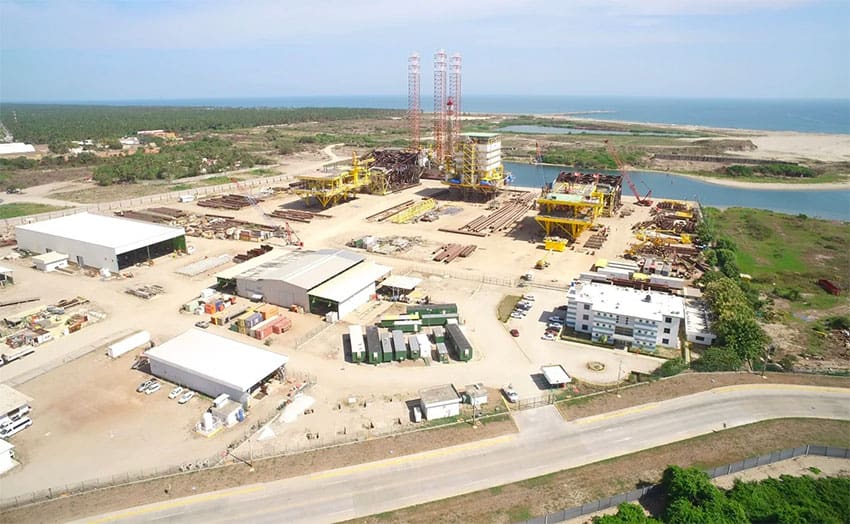
The International Monetary Fund (IMF) has recommended that construction of the new oil refinery on the Tabasco coast be postponed.
In a concluding statement after an official staff visit to Mexico, the IMF said that Pemex’s business strategy, including construction of the Dos Bocas refinery, is “crowding out resources for essential spending.”
Given the state oil company’s “widening losses,” it is advisable that it focus production only in profitable fields, the organization said.
Many analysts have criticized the plan to build the US $8-billion refinery on the grounds that it diverts resources from Pemex’s more profitable exploration business.
To improve its financial position, the state-run company, which has debt in excess of US $100 billion, should “sell non-core assets, curb plans to increase refining output at a loss and postpone new refinery plans …” the IMF said.
It recommended that Pemex partner with private firms, asserting that doing so would supply “needed capital and know-how.”
The government has been criticized for not allowing Pemex to enter into new joint ventures known as farm-outs with private companies.

In its concluding statement, the IMF also noted that the coronavirus pandemic “has exacted a tragic human, social and economic toll on Mexico.”
Given the coronavirus-induced economic downturn, Mexico needs more near-term fiscal support, the organization said.
“The [Mexican] authorities are providing very modest near-term direct fiscal support. They increased health spending and direct budget support to households and firms by 0.7% of GDP. However, this compares with over 3% of GDP support among G20 emerging markets,” the IMF said.
“To stem the decline in economic activity and rise in poverty, Mexico would benefit from higher temporary near-term fiscal support of 2½–3½% of GDP (relative to pre-pandemic policy settings). Mexico has some fiscal space and enjoys comfortable market access that could be used during these difficult times.”
The IMF also said that there “appears to be room for further monetary easing,” even though the central bank has cut interest rates seven times this year, lowering the Bank of México’s benchmark rate from 7.25% at the start of 2020 to 4.25%.
Lower interest rates would provide further relief to the economy, “with likely limited risk to external financial stability,” the monetary fund said.
“A lower cost of borrowing would help reduce debt servicing pressures, especially among weaker borrowers, possibly boost investment, and increase the marginal attractiveness of the credit facilities of the central bank.”
Source: El Universal (sp)