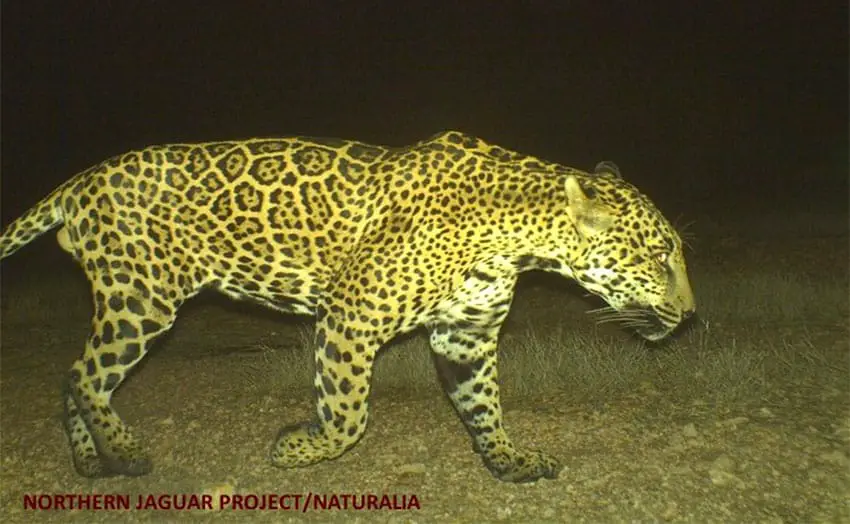
New video footage of a young male jaguar on a ranch in northern Sonora has given conservationists hope that North America’s only big cat could soon be seen in greater numbers in northern Mexico and the southern United States.
Researchers captured footage of a jaguar dubbed “El Bonito” (The Beautiful) on four cameras since December 2020.
Owned by a Sonora-based conservation organization called Cuenca Los Ojos, the ranch where the jaguar was filmed is just a few kilometers south of the point where the Arizona, New Mexico and Mexico borders intersect, a location where construction of the border wall stopped just two months ago.
“It was like finding a needle in a haystack,” said Ganesh Marin, a doctoral student at the University of Arizona and a National Geographic explorer who has set up about 100 camera traps at the ranch.
Gerardo Cabellos, a wildlife researcher at the National Autonomous University, told National Geographic that the sighting of a juvenile jaguar so close to the border suggests that the species’ breeding range is extending north.

He said the jaguar was likely born less than 100 kilometers south of the border in Sonora, where there are believed to be as many as 200 of the cats.
Cabellos said that jaguars are now breeding “on the doorstep of the United States,” where the animals were exterminated by hunters in the 19th and 20th centuries.

Only seven male jaguars have been seen in the southern part of Arizona in the last 25 years, meaning that the sighting of one just a few kilometers across the border is big news.
Marin said the sighting, and a study that found that much of central Arizona and New Mexico is prime jaguar habitat, emphasize the importance of maintaining binational wildlife corridors, some of which were affected by the construction of former U.S. president Donald Trump’s border wall.
“Maintaining open wildlife corridors is hugely important,” said Eric Sanderson, lead author of a paper on the study and a researcher with the Wildlife Conservation Society. “After all, wildlife don’t have passports.”
To extend into the United States, the jaguar population in Sonora needs to grow, National Geographic reported. But while efforts have been made to protect them in Mexico, such as by offering incentives to landowners, ranchers still sometimes kill jaguars after they have attacked their cattle. The survival of the species is also threatened by prey depletion and the construction of new roads.
But despite the threats, Marin believes that the sighting of the young jaguar indicates that conservation efforts are helping to protect the apex predator to some extent.
“We have a lot of things to do but if we continue, the females and the cubs will come to the borderlands soon,” he said.
Source: National Geographic (en)