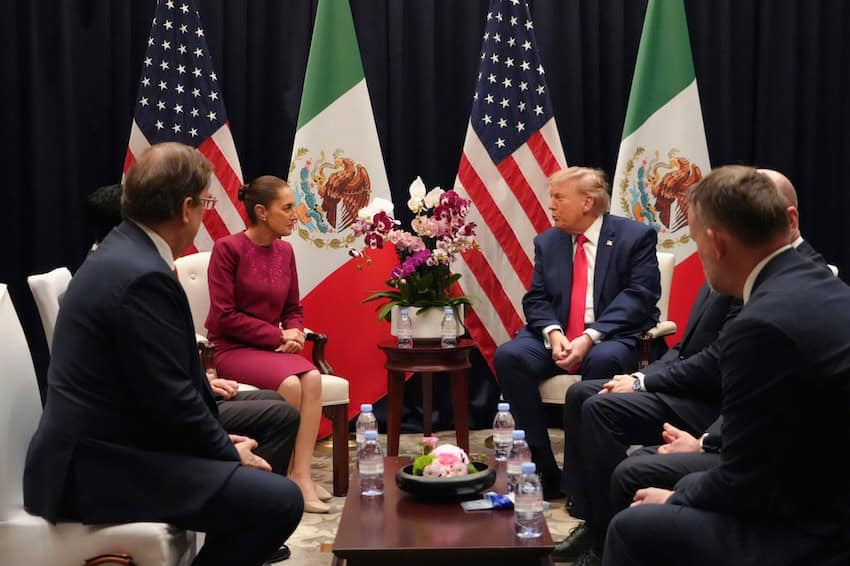
Trade was the main focus of a formal meeting between Mexican President Claudia Sheinbaum and U.S. President Donald Trump in Shenzhen, China, on Wednesday.
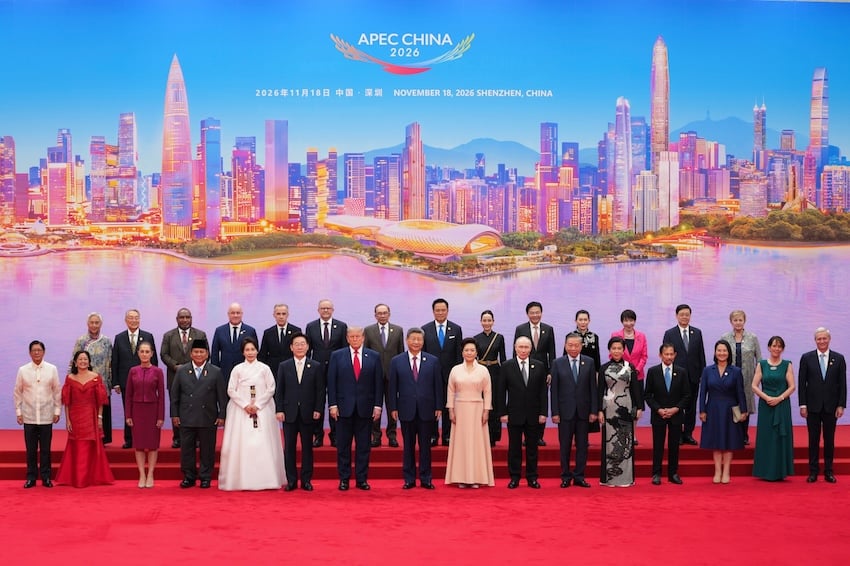
Sheinbaum and Trump — who are both in Shenzhen for the Asia-Pacific Economic Cooperation (APEC) Leaders’ Meeting — met at The Langham Hotel in the southern Chinese city.
“We held a very good meeting with President Trump and his team,” Sheinbaum wrote on social media at around 6:30 a.m. Mexico City time.
“We continue to make progress on our shared agenda,” she added.
Economy Minister Marcelo Ebrard and Foreign Affairs Minister Roberto Velasco accompanied Sheinbaum at her first formal face-to-face meeting with Trump.
The meeting took place as Mexico and the United States seek to resolve a range of trade differences that contributed to the U.S. government’s decision in July to not renew the USMCA free trade pact for an additional 16 years to 2042. Trump is particularly concerned about the United States’ large trade deficit with Mexico, while the Mexican government is pushing for a reduction of U.S. tariffs that currently apply to Mexican steel, aluminum and vehicles.
Bilateral trade negotiations are ‘very far along,’ says Sheinbaum
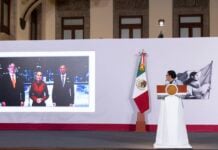
Speaking by video link from Shenzhen, Sheinbaum elaborated on her meeting with Trump during the government’s Wednesday morning press conference, which was led by Interior Minister Rosa Icela Rodríguez.

“The meeting lasted around 20 minutes and we mainly discussed the issue of trade agreements,” she said, noting that U.S. Commerce Secretary Howard Lutnick, Secretary of State Marco Rubio, White House Chief of Staff Stephen Miller and Trade Representative Jamieson Greer were also present.
She said that Trump was informed about the progress that has been made in the bilateral trade talks that have taken place in the months since the U.S. government decided not to renew the USMCA.
“We can say that we’re very far along,” Sheinbaum said without offering any details on when a bilateral deal might be reached.
“It was a very good meeting, very pleasant. President Trump was in a very good mood,” she said.
“We agreed to meet again at the G20 meeting at Mar-a-Lago,” Sheinbaum added, referring to next month’s G20 Leaders’ Summit in Florida.
Sheinbaum, Trump to meet again at G20 after ‘very good’ APEC meeting: Wednesday’s mañanera recapped
Ebrard, who leads Mexico’s trade negotiations with the U.S., said that 56 bilateral trade-related “technical meetings” have taken place. He also said that progress has been made in trade talks, but didn’t reveal whether the United States was prepared to cede ground on tariffs.
Standing next to Sheinbaum in Shenzhen, Ebrard described the relationship between the Mexican and U.S. presidents as “warm” and “respectful.”
Neither he nor Sheinbaum mentioned Trump’s recent tariff threat in their remarks on Wednesday morning. Last Thursday, the U.S. president threatened to double tariffs on Mexican goods if Mexico didn’t stop a migrant caravan that is currently heading north through the southern state of Chiapas.
As of midday Wednesday, neither Trump nor the U.S. government had publicly commented on the meeting with Sheinbaum. Trump arrived in Shenzhen shortly before the meeting took place.
Sheinbaum and Trump speak regularly by telephone and met at the FIFA men’s World Cup draw in Washington, D.C., last December and at the World Cup final in New Jersey in July. However, their meeting in Shenzhen was the first time they held formal in-person talks.
Beyond trade, there are several pressure points in the Mexico-U.S. relationship, including Sheinbaum’s allegation that the United States has interfered in Mexican affairs.
Outcome of bilateral trade negotiations is ‘critical’ for Mexican and US manufacturers, reports Reuters
Reuters reported on Wednesday that the outcome of the trade negotiations between Mexico and the United States is “critical for manufacturers on both sides of the border.”
“The two countries are each other’s biggest trading partners and exchanged about [US] $779 billion in goods in the first nine months of this year, while supply chains in industries such as auto manufacturing routinely span the border,” reported the news agency, which noted that Mexico’s economy is “deeply intertwined” with that of the U.S.
A trade deal between Mexico and the United States — which both Sheinbaum and Trump said last month is “very close” — could make the U.S. government more willing to back a 16-year extension of the USMCA, although unresolved trade disputes between Washington and Ottawa could still stand in the way.
Beyond its large trade deficit with Mexico, other concerns for the United States include Mexico’s energy sector rules and its trade relationship with China. Trump has accused Mexico of being a transshipment hub for Chinese goods, a claim the Mexican government has denied.
Still, the Mexican government imposed new and higher tariffs on a wide range of imports from China at the start of 2026, a move seen, in part, as an effort to allay U.S. concerns.
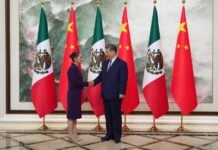
Despite increased protectionism against Chinese goods, Mexico is seeking closer ties with China across a range of areas including science, technology, healthcare and clean energy. Sheinbaum, who met with Chinese President Xi Jinping in Shenzhen on Tuesday, has said that Mexico’s engagement with China shouldn’t affect its trade negotiations with the U.S.
Sheinbaum also held a bilateral meeting with Canadian Prime Minister Mark Carney in Shenzhen. Both expressed firm support for the renewal of the USMCA, which was negotiated and took effect during Trump’s first term as president.
Carney also met with Trump in Shenzhen on Wednesday. According to a statement from his office, the two leaders “discussed the work underway to reach a mutually beneficial trade agreement that would create good jobs, boost affordability, and fully respect Canada’s languages, culture and sovereignty.”