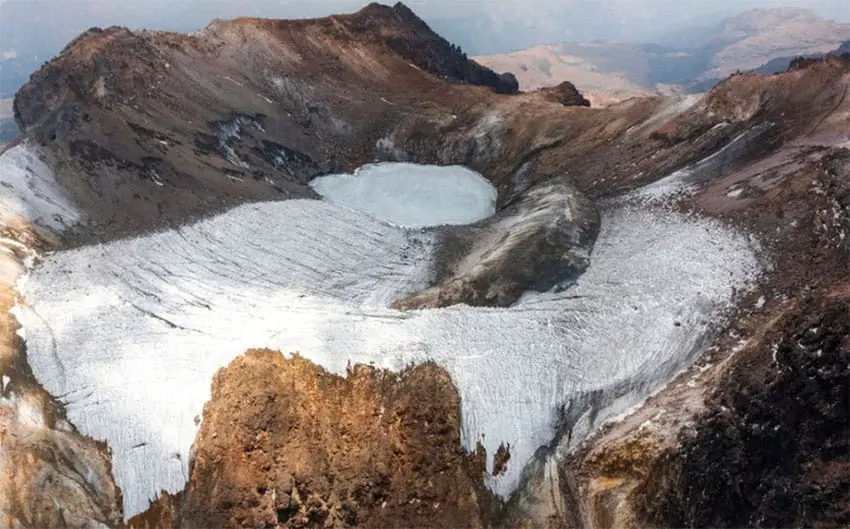
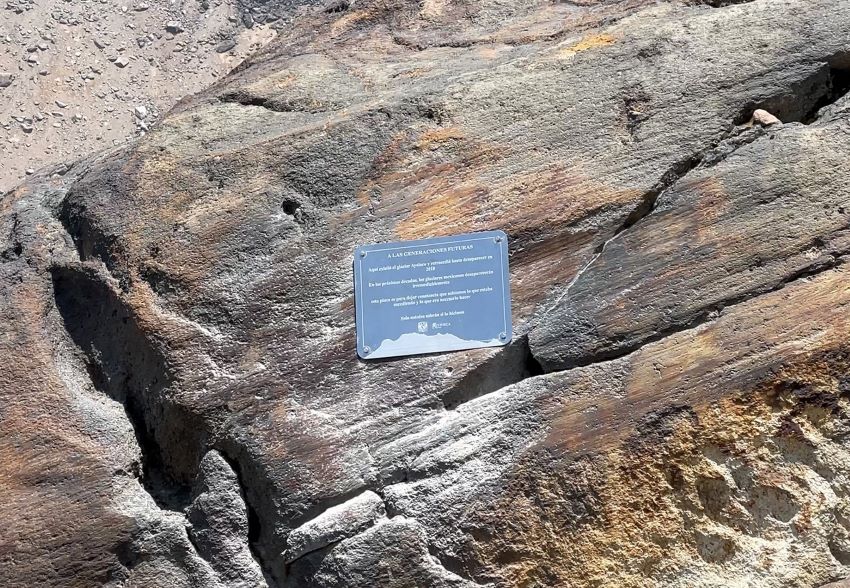
A group of scientists has erected a plaque that officially acknowledges the “death” of the Ayoloco glacier, an erstwhile ice mass on the Iztaccíhuatl volcano that disappeared in 2018.
Experts from the National Autonomous University (UNAM) faculty of geophysics, ecologists and others trekked to the site of the now nonexistent glacier on Wednesday to install the metal plaque, which reads:
“To the future generations: the Ayoloco glacier existed here, but it retreated until it disappeared in 2018. In the coming decades, Mexican glaciers will inevitably disappear. This plaque is to leave proof that we knew what was happening [climate change] and what needed to be done. Only you will know if we did it.”
Hugo Delgado Granados, one of the scientists who completed the 7-kilometer hike to the glacier site, told the newspaper Milenio that the main consequence of the disappearance of Ayoloco and other glaciers is a reduction in the quantity of water on Earth. Without large ice masses on mountain peaks, he added, temperatures will increase.
In addition to being ecologically and environmentally important, the Ayoloco glacier has inspired a range of artists. It was extensively photographed, filmed and depicted in artworks, and inspired many Mexican writers.
“For sports people, volcanoes are one thing, for the people who dedicate themselves to literature, they are something else and for geologists, they are another thing,” said Ana Elsa Pérez Martínez, director of literature at UNAM’s culture dissemination department.
Pérez, who also completed the hike, said the plaque acknowledging the disappearance of Ayoloco is not one of honor but rather of dishonor. It’s a sign of the “shame we feel” as a result of the inadequate response to the climate emergency, she said.

Delgado, a geologist, vulcanologist and keen mountain climber, said that Ayoloco was one of Mexico’s most emblematic glaciers, explaining that it was visible from the Valley of México, which includes Mexico City.
“This loss will have a definitive impact on … water, flora and fauna, since it is on these peaks where the liquid originates,” he said.
Source: Milenio (sp), El Universal (sp)