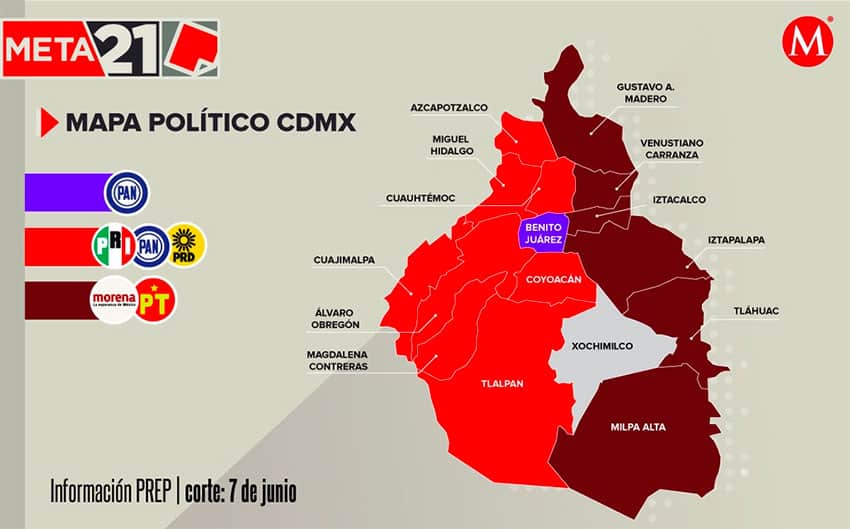
Voters in Mexico City – a stronghold of Mexico’s ruling Morena party in recent years – have rejected the leftist party founded by President López Obrador in a majority of the capital’s 16 boroughs.
Morena currently governs 11 of the capital’s alcaldías (boroughs or municipalities) as well as Mexico City as a whole but only managed to win seven at elections on Sunday, according to preliminary results.
Eight of the other nine went to a coalition made up of the National Action Party (PAN), the Institutional Revolutionary Party (PRI) and the Democratic Revolution Party (PRD), while one went to PAN on its own.
Morena held on to the northern borough of Gustavo A. Madero, the eastern alcaldía of Iztacalco, sprawling, densely populated Iztapalapa in the southeast and Tláhuac, the southeastern municipality where a tragic subway accident occurred last month.
It also appeared to win reelection in a close race in Xochimilco, a borough well known for its canals and the colorful boats that take tourists for rides along them.
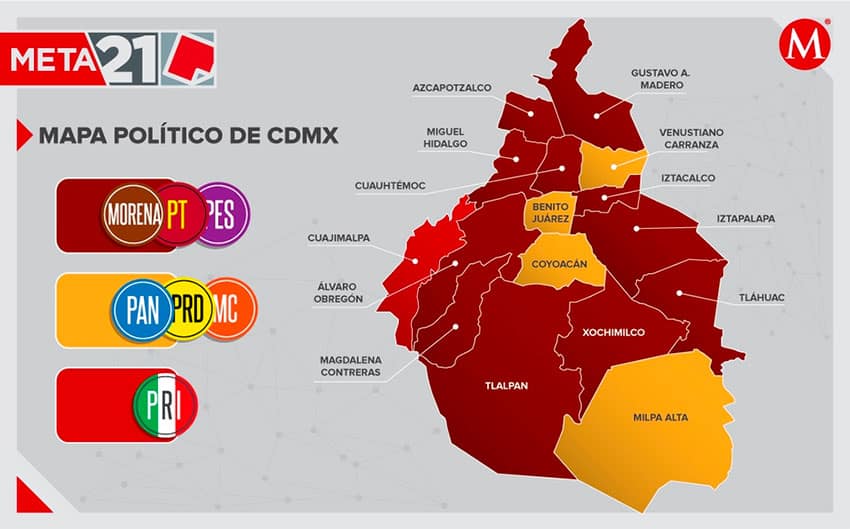
In addition, Morena triumphed in Venustiano Carranza, where the Mexico City airport is located ,and in Milpa Alta, a largely rural southern municipality. In both cases, it seized control from its political opponents.
The four boroughs Morena lost all went to the the PAN-PRI-PRD alliance. They are Álvaro Obregón, Azcapotzalco, Cuauhtémoc – which includes Mexico City’s historic center – and Magdalena Contreras.

The three-party alliance also won Miguel Hidalgo – home to affluent neighborhoods such as Polanco and Lomas de Chapultepec, Tlalpan, Coyoacán and Cuajimalpa, which borders México state. The PAN retained Benito Juárez, a mainly middle class borough, on its own.
President López Obrador acknowledged Morena’s poor showing in Mexico City at his regular news conference on Monday morning, attributing it to several factors but blaming it largely on the media.
“… We have to take into account that here [in Mexico City] there is more media bombardment; here is where the dirty war is felt more, here is where you can read that magazine from the United Kingdom, The Economist,” he said.
The Economist published an editorial late last month that was highly critical of the president and urged Mexicans to vote against Morena.
“Everything is here [in Mexico City]. I’ve always said you put the radio on and its against, against, against, against [the government], you change the station and it’s the same. So, it bewilders and confuses [people], it’s propaganda, day and night, against [us],” López Obrador said.
Mayor Claudia Sheinbaum, who governs Mexico City for Morena and is a leading contender to succeed the president, made similar remarks.
“In recent months there was a very powerful smear campaign against the [Morena] movement, which had an impact on [some] sectors of the population,” she said.
With reports from Milenio (sp), Reforma (sp) and El País (sp)