The first study into the origins of the huge sinkhole in the state of Puebla discounted overexploitation of groundwater sources. Now a second study has turned that theory on its head, only for its author to muddy the waters further by denying its own participation.
Water exploitation, soil erosion and recent intense rain caused the ground to part in Santa María Zacatepec and leave a massive sinkhole, said Beatriz Manrique Guevara, head of the state Environment Ministry.
She was quoting from a study that analyzed 25 hectares around the sinkhole, finding a number of illegal wells among 47 others that were registered for water extraction. Three years of drought followed by intense rain this year were also named as factors.
The study was credited to the National Polytechnic Institute (IPN). However, in an unusual turn of events, the IPN looked to distance itself from the study and denied having “any official connection” to it on Friday, raising questions over its findings.
Guevara assured that there is an agreement between the government and the IPN, but that the organization had failed to process documentation to make the relationship official. It is not immediately clear why the IPN looked to distance itself further on Friday.
An earlier study by the National Water Commission decided that the most likely cause of the sinkhole was the dissolution of calcareous rocks, such as limestone or dolostone.
The giant chasm measures 126 meters across, having first emerged as a 10-meter hole on May 29 in Zacatepec, 20 kilometers northwest of Puebla city.

Guevara highlighted the findings of the latest study: the use of illicit wells amounted to a “massive exploitation of water” and in the last eight years the water level in the area had dropped by eight meters, due in part to the intensification of exploitation.
“[Overexploitation] has dragged away silt or clay, which is the element that binds the earth,” she said.
It revealed that 80% of wells in the area were used for agriculture, 15% for domestic use and 5% for industrial purposes.
The turbulent climate has also played a role: a lack of rain in the region had caused water levels to drop 35% below the average. In contrast, this year intense rainfall left the area with levels 85% above average.
The study pointed to the combination of factors. “The natural erosion of the soil through human activities and natural erosion, and the natural phenomenon of intense rain has caused the collapse of the soil, which has no resistance,” it read.
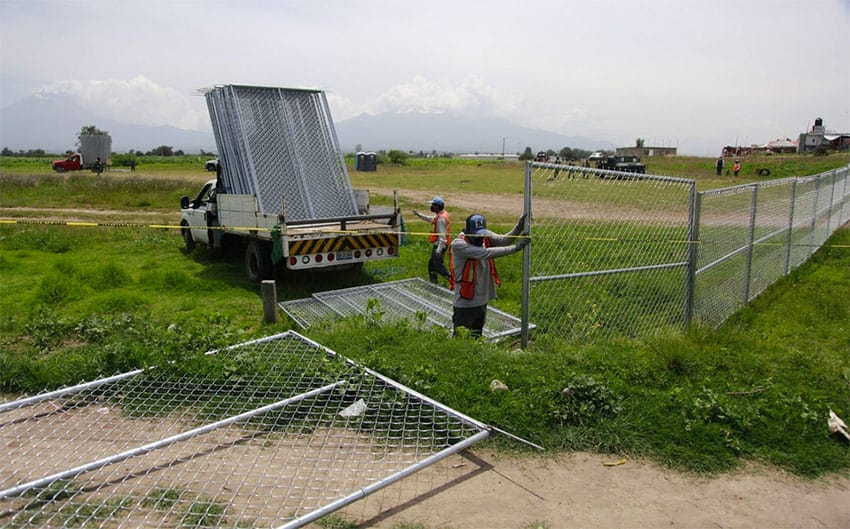
Authorities began Monday to extend the perimeter line around the sinkhole and erect a fence to prevent people from accessing the site, given the discovery of unregistered wells and the conclusion that the ground is unstable. An area of 25 hectares is being cordoned off, a move that comes just days after two men entered the secured area and walked to the edge of the hole where one of the two urinated in it, an event they captured on video.
Meanwhile, Puebla Governor Miguel Barbosa was keen to point out that the investigations not final, and that opinions from other scientific institutions remain welcome. He added that determining the precise cause could take all the rest of the 21st century: it could be “79 or 78 years from now,” he said.
With reports from Milenio