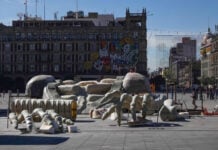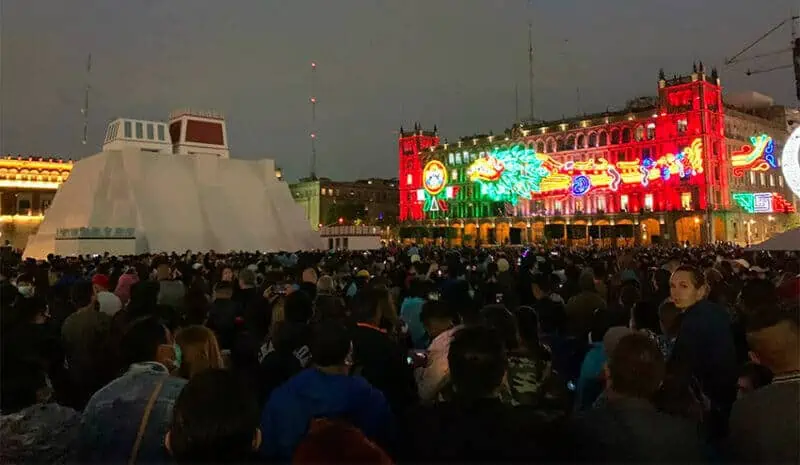
Mexico City’s central square was the scene Friday of the first showings of “Luminous Memory,” a multimedia show celebrating the history of Tenochtitlán on the 500th anniversary of its fall, in a ceremony led by President López Obrador and Mayor Claudia Sheinbaum.
Thousands of people attended the opening night and again on Saturday, but few paid any regard to social distancing measures being promoted to curb the third wave of the coronavirus. Mayor Sheinbaum confirmed that there was an overflow crowd but observed it was fortunate that the event was held outdoors where there was a reduced risk of contagion.
The show, which is part of the government-organized commemoration “500 years of indigenous resistance,” will be shown nightly at 8:30, 9 and 9:30 p.m. until September 1.
A replica of the Templo Mayor serves as the backdrop for the 15-minute show, with images projected on the pyramid’s four sides. The show recounts the legend of the founding of Tenochtitlán, capital of the Aztec empire and precursor to Mexico City, including how the god Huitzilopochtli ordered the Aztecs to build a city in the place where they found an eagle eating a serpent atop a cactus. It goes on to depict the cultural and economic development of the war-like Aztecs, the arrival of Hernán Cortés and his Spanish soldiers, and the eventual fall of the Aztec capital.
To see the show, spectators can enter via the avenues 20 de Noviembre, 6 de Septiembre, Francisco I. Madero and 5 de Mayo. The exits are via Pino Suárez, 5 de Febrero and Tacuba.
The spectacle can also be seen on the city’s Capital 21 television station at 3 p.m. and 7:30 p.m., or online.
The city government has also installed dramatic decorative lighting on the buildings of zócalo, as well as displays in Paseo de la Reforma and three screens on the street 16 de Septiembre, the Plaza del Empedradillo and the intersection of Paseo de la Reforma and Insurgentes. The lights show the glowing image of Quetzalcóatl, the feathered serpent god, as well as other figures from Aztec mythology and Mexican history.

The city government asked that spectators wear a face mask covering both the nose and mouth, use hand gel frequently and bring a raincoat rather than an umbrella, so as to not block the view.
With reports from Milenio