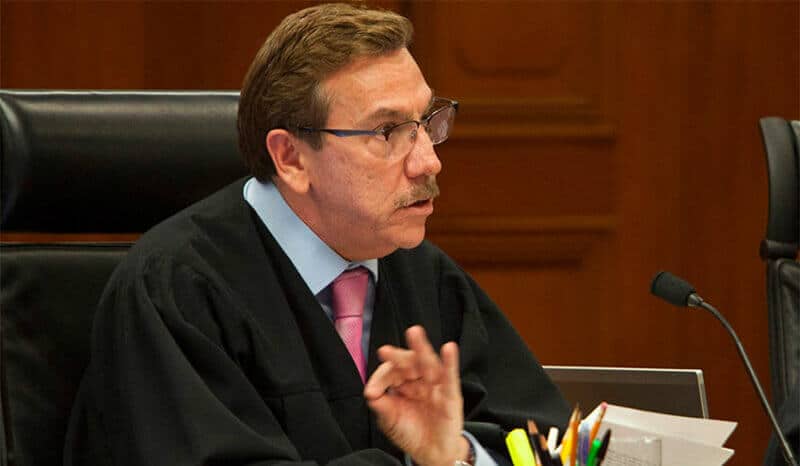
A Supreme Court (SCJN) justice was detained in Coahuila on Saturday for driving under the influence of alcohol, but the judge denies he was intoxicated.
Justice Javier Laynez Potisek was stopped by municipal police and arrested in the center of Torreón in the early hours of Saturday morning and was held in police custody until later the same day.
In a statement issued by the SCJN on Tuesday, Laynez said he never accepted nor will he accept that he was driving in a state of inebriation. He also said he didn’t have the opportunity to prove his sobriety, and wasn’t told why he had been detained.
The justice said his arrest didn’t occur at a sobriety checkpoint and asserted that it wasn’t until the next day – although in fact he was referring to the same day – that he learned that the police justified his arrest because he changed lanes at an “inopportune” time.
But “that never occurred,” Laynez said. “Despite my respectful and repeated requests throughout this whole event I was never able to see or speak to a doctor, an authority, a judge, a prosecutor’s office … or a human rights representative,” he said.
“The next day [Saturday], following the instructions they were given, my family members made the payment of of 6,500 pesos (‘only in cash’). And despite their express request, they were denied a receipt or proof of payment,” the justice said.
“I want to make it clear that I completely agree with … anti-alcohol operations. No one has the right to drive in a state of intoxication and this conduct must be severely sanctioned. However, these operations must be subjected to strict standards that avoid corruption and respect citizens’ human rights,” Laynez said.

Some details in the justice’s statement are incongruent with local media reports, which indicated that the justice was aware of the reason for his arrest and was required to pay a fine of 44,000 pesos (US $2,140) to secure his release.
With reports from Reforma, El Universal and Expansión Política