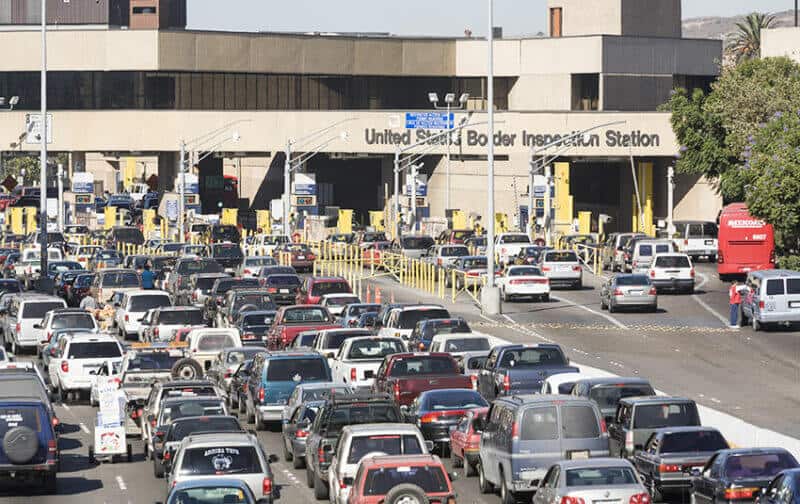
The United States reopened its land border with Mexico on Monday, almost 20 months after it closed due to the COVID-19 pandemic.
The land border with Canada also reopened, as did flights from 33 countries, including the U.K., much of Europe, China, Brazil and South Africa.
U.S. authorities are only allowing entry to people who had vaccines approved by the World Health Organization. The Sputnik V and CanSino vaccines, administered to millions of people in Mexico, are not currently on that list.
Mexicans were largely banned from crossing the border during the pandemic, which transformed the lives of many who live in border cities. Seeing family and friends, medical appointments or shopping over the border were all ruled out. U.S. citizens, on the other hand, enjoyed greater freedom to travel between the two countries.
Traffic levels at ports and in the land crossings were expected to register millions of travelers, hitting levels seen prior to the pandemic, the newspaper El País reported, but Monday’s traffic was not as heavy as expected, according to several media reports.
The Department of Homeland Security (DHS) stated that visa holders should bring proof of vaccination and verbally indicate their reason for travel at the border.
DHS Secretary Alejandro Mayorkas said the reopening was a positive decision. “We are pleased to take another step toward easing travel restrictions at our borders in a manner that strengthens our economy and protects the health and safety of the American public … We continue working closely with our international partners to sustainably implement new rules for resuming travel,” he said.

The accepted vaccines for nonessential travel are: Pfizer, Moderna, Johnson & Johnson, AstraZeneca, Covishield, Sinopharm and Sinovac.
People travelling for essential reasons are not required to be vaccinated until January 2022, when a new phase of border regulations will take force.
As for under 18s, they will need a negative COVID-19 test taken a maximum of three days before departure, if they are traveling with a vaccinated adult. However, if they are traveling alone or with an unvaccinated adult, they must submit a negative test carried out 24 hours before the trip.
Grandmother Martha Ochoa Moreno, 68, from Ciudad Juárez, was one of many people reunited with loved ones on Monday. She had not seen her 28-year-old granddaughter, Laura Tinajero, since the border closed. Prior to the closure she crossed several times a week to shop and visit family.
“There is nothing like being able to hug [loved ones]; video calls helped us a lot all during those months, but it’s not the same. Today I will finally be able to hug my granddaughter,” she told the Dallas Morning News.
Another relieved family member was 60-year-old Ramón Delgado, from Chihuahua, who saw his sister Bertha Galván, 71, an El Paso resident.
“I was very happy because [we had] not seen each other for a long time since the pandemic began,” said Delgado. “My sister got COVID, not me, and I was scared. And that’s why I really wanted to see her and give her a hug,” he added.
“There is a lot of emotion to finally be able to hug him; the truth was I was afraid. I thought they were not going to let people through. When he called me and said, ‘I’m here,’ I didn’t believe it,” Galván said.
The U.S. Embassy in Mexico warned that wait times at borders are expected to increase, and that travelers should plan for longer than normal wait times and exercise patience.
With reports from The Dallas Morning News and El País