Archaeologists have uncovered the remains of a man who may have been killed during a battle against invading French forces in the 19th century.
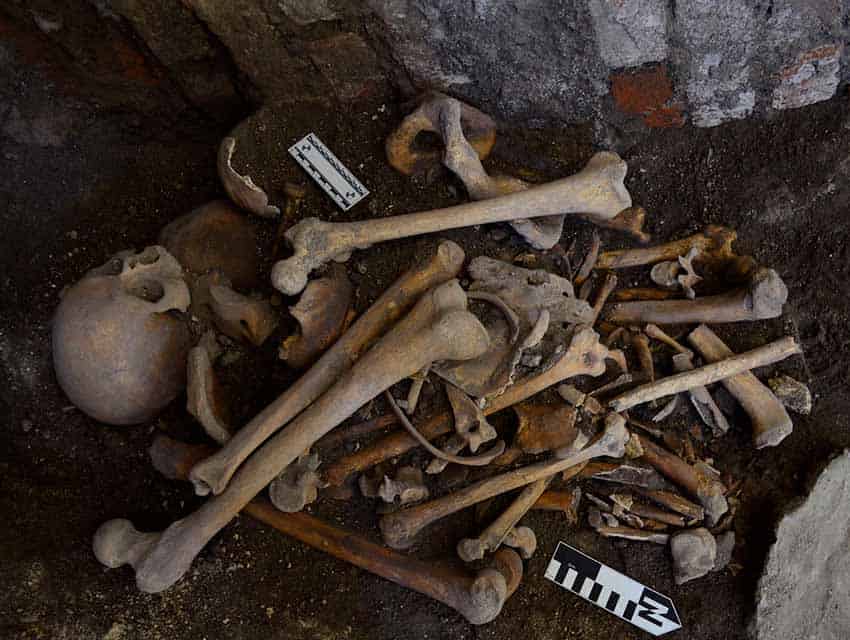
The National Institute of Anthropology and History (INAH) said in a statement that a team of specialists found a group of human graves at the Saint Francisco Javier Temple in the historic center of Puebla city. The remains of 20 individuals, including children, have been uncovered.
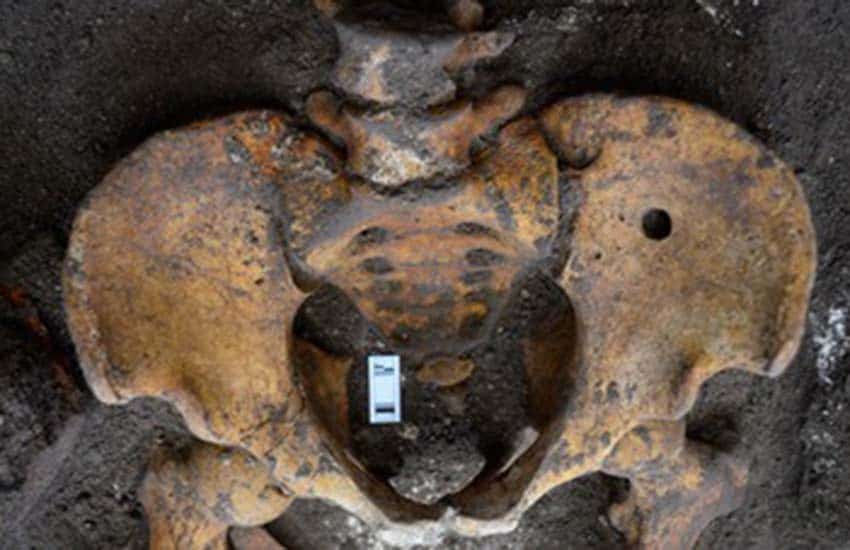
The majority “could be related to 19th-century epidemics,” INAH said, but the discovery of a male ilium, part of the hip bone, with a bullet hole – as well as the bullet that caused the wound – led researchers to theorize they had found the remains of a soldier killed during the second French intervention in Mexico between 1862 and 1867.
The San Francisco Javier Temple was “used as a fortification by the Republican fighters after the French advance on the Loreto and Guadalupe forts in 1863,” INAH said. The temple has also functioned as a hospital and a jail.
Lizbeth Chicas Martínez, an anthropologist, said the man who was apparently shot would have died from his injury. The bullet “probably pierced important organs, and given the time it was unlikely that a person would have survived,” she said.
The INAH archaeologists also found a range of items that are believed to have originated in the second half of the 19th century. They include cannonballs, buttons, coffin nails, shoe soles, a metal cross and fragments of Talavera pottery.
“We believe that it’s an unprecedented discovery because on one hand it gives us information about the Jesuit religious complex of Saint Francisco Javier, but it also tells us how the city of Puebla was, at least in the 19th century,” INAH Puebla director Manuel Villaroel told the newspaper El País.

“[It’s] a space that became a stage for the French invasion battles. There are remains of a person who probably died from a bullet wound, as well as elements such as buttons and bullets that can start to give us information about the battle, which occurred in the streets of Puebla … to defend the sovereignty of our country,” he said.
The French, along with the British and Spanish, invaded Mexico in late 1861 after then president Benito Juárez stopped making foreign debt repayments. The British and Spanish left the country after receiving a guarantee they would receive the money they were owed, but the French remained.
Mexican forces defeated the French army at the famous Battle of Puebla on May 5, 1862, but the city fell to the French just over a year later.
With reports from El País