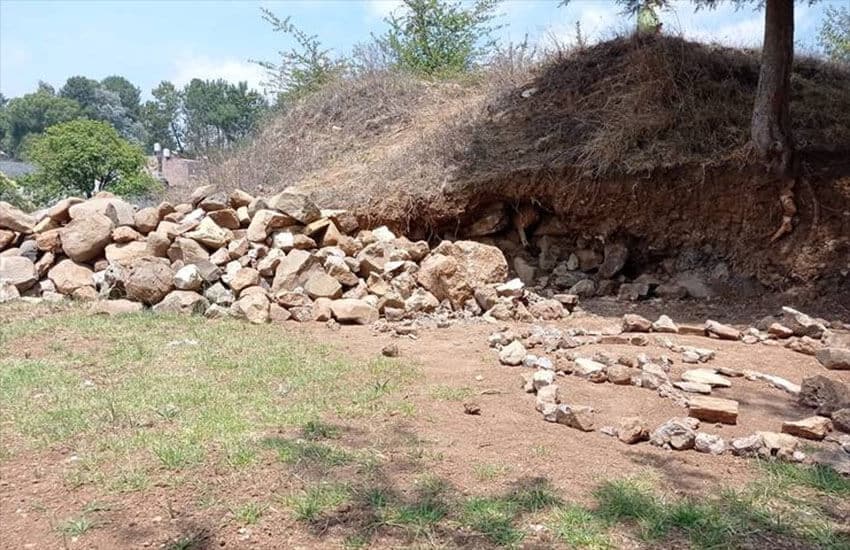
The only remaining pre-Hispanic pyramid in a community near the city of Zacatlán, Puebla, is at risk of being demolished by a private citizen who reportedly plans to appropriate the land on which it stands.
The approximately 6-meter-high structure is located on a piece of cultivated land in San Pedro Atmatla, a community about 2 kilometers from Zacatlán in northern Puebla. The pyramid, which looks more like a hillock as it is covered with dirt, grass and other vegetation, was likely built between the 10th and 16th centuries, according to a report by El Sol de Puebla.
The newspaper reported that a local plans to appropriate the land where the pre-Hispanic ceremonial temple stands. Residents who spoke with El Sol de Puebla said a man is planning to demolish the pyramid.
There is already evidence that the structure has been recently damaged, apparently “by the hand of man,” the newspaper said. Some of the stones used to built it have been removed and now lie beside the structure’s side. It was unclear whether local authorities planned to intervene to stop the destruction of the pyramid.
The land where Zacatlán is located was inhabited by the Chichimeca people early in the second millennium of the Common Era, but local historian Sergio Ramos González believes the pyramid may have been part of an Olmec settlement.
There are three other pyramids in the broader local area but they are not in San Pedro Atmatla. Five others have been lost over the years.
With reports from El Sol de Puebla