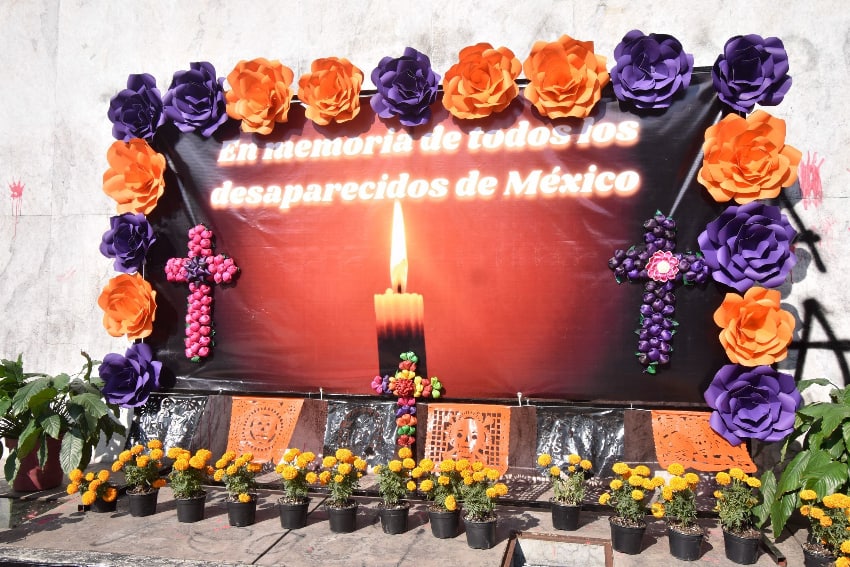
Today, our dead symbolically return to life as millions of tiny orange and black-winged, spotted-white monarch butterflies. Our beloved annual migrants return to their homeland.
And today, we celebrate Día de Muertos in Mexico. A ritual of fondness, eulogy, longing, grief, and joy for our loved ones passed; a day that reminds us that death is, inexorably, part of life.
I doubt there is another day like this one anywhere, in which an entire nation connects – as we Mexicans do wherever we are on the planet – to remember and honor our dead: our ancestors, our heroes, our friends, and our beloved ones. A day when we all chant an emphatic NO to oblivion and proclaim that death is not non-existence but a living, ethereal presence.
This is probably an imprecise, but nevertheless respectful portrait by a Colombian who many years ago transformed into a Mexican; one who is now an orphan, but will fondly remember his parents today at the altar of the dead – an altar adorned with cigarettes and aguardiente, small clay hens, champagne, bread and coffee, some photographs from when they were young and a few marigolds to remember and honor them both.
The Day of the Dead is an odd celebration. A blend of paganism and indigenous defiance that resisted, but nevertheless ended up camouflaging the Christian canon brought to us by Spanish conquistadores from across the Atlantic Ocean in the 16th century. The Mexica, Mixtec, Texcocoans, Zapotec, and other indigenous peoples adapt to the day with devotion to their past and the Christian calendar.
Today, our dead return from the afterlife to visit us, accompany and embrace us. The souls of the “small dead,” the children, arrived on Nov. 1 as the advance party, followed today by the adults as the rear guard.
To their joy, when arriving at the banquet, the children’s souls will find their toy xoloitzcuintle dogs and little human sugar skulls.

The dead come back to gaze at their own photographs, taken when they were among the living, placed on a colorful altar in their honor – where they see themselves accompanied by those things they most enjoyed seeing, smelling, eating and drinking when they were alive among us.
Today, our home smells of bursera copal and frankincense, as well as honeyed floral aromas. Today is the day of the sweet calacas and the salt and the water, and of colorful papel picado. The dead’s skeletons turn into the bread of the dead (pan de muerto), which they share with the living.
Today, floral offerings and remembrances and altars lovingly cover up the frozen gravestones of all graveyards across our country.
Today — only today — the souls of our beloved pass through from the world of the dead to the province of the living, to quench their thirst — because they have traveled across trails made of marigold petals and candles and the elixir of copal and sweet water lovingly prepared by their families.
Today, and only today, our newborns, children, adults and elderly can jubilantly wing their way, like monarch butterflies, from the realm of the dead to gather with their families in the world of the living. Today is the day of all souls, of worshipping death and life in accord.
It is a day for celebration and a day to remember those we buried in their own personal petates – those sleeping mats that are the only belongings we will take with us when we finally leave this world.
Today we favor memories over oblivion, joy over emptiness and pain, or the sorrow caused by the eternal absence left by our dearest dead. Let us eat and drink the food and beverages our dead most loved.
But let’s not forget, not for a second, that today is also a day to reflect on what is deadly wrong with our beloved country. A day to grieve and raise our voices in anger, and look at ourselves in the national mirror. To see the brutal violence that has for so long devastated hundreds of thousands of families across the land.
Because Mexico today resembles a graveyard itself. A macabre puzzle of clandestine tombs that scores of mothers have painstakingly traced, in hopes of finding the corpses, or at least some remains, of their dead or disappeared daughters and sons.
The horrifying video that was displayed in the media on Oct. 27 — of a dog in Zacatecas carrying a human head while wandering on a sidewalk into the night — is the image of brutality, the antithesis of Día de Muertos. It is the image of a country where every day has become Día de Muertos, a Day of the Disappeared; a country that must rise up and engage the immoral forces destroying our families and our great traditions.
In memory of the more than 3,309 children, less than 17 years of age, who have been killed in Mexico between 2021 and 2022, according to the Network for Childhood Rights in Mexico.