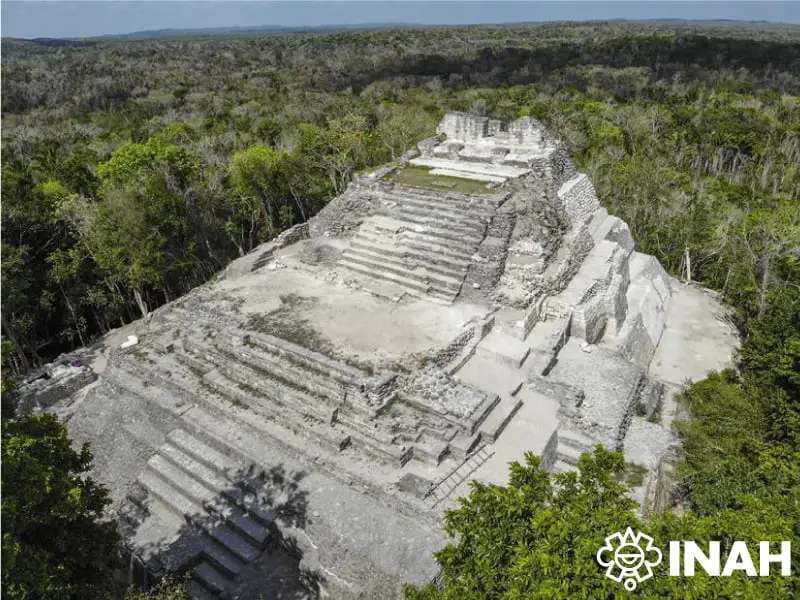
On route to the Bacalar lagoon in Mexico’s Yucatán Peninsula, the site of the ancient Maya city of Ichkabal (City of Snakes) will soon open to visitors, according to Diego Prieto Hernández, Director of the National Institute of Anthropology and History (INAH).
Although there is no confirmed date for its opening, researchers and authorities hope that the first tangible results of work on the project will be seen by tourists by mid-2023.
“Ichkabal is not open to the public because it is not easy to access the area,” Prieto said at a press conference.
With a large portion of the city still lying beneath the jungle, the site is currently being excavated by the National Institute of Archaeology and History (INAH) as part of the Program for the Improvement of Archeological Sites (Promeza), an initiative to improve and/or develop archaeological sites along the route of the under-construction Maya Train, a commuter and tourist railroad route that will have stops near many tourist cities and attractions in southern Mexico.
As recently as last month, the Promeza initiative uncovered an ancient Maya stela at the established Uxmal archaeological site in Yucatán.
Located 30 kilometers away from what would be the Bacalar station of the railway project, Ichkabal was only discovered 28 years ago by archeologists Enrique Nalda Hernández and Javier López Camacho, although there had been talk of an archaeological site in the region since the 1930s.
So far, excavation at Ichkabal has revealed a central set of five buildings that are at least 2,400 years old. Standing out among them is a 40-meter-high pyramid twice the size of the large Kukulkán temple in Chichén Itzá. The Ichkabal pyramid has a base area similar to that of the Pyramid of the Sun in Teotihuacán.

The building’s size supports the findings of previous investigations of the site, which have suggested the importance of Ichkabal for the Maya. Some researchers believe the city is the origin of the Kaanu’l (serpent) dynasty, one of the most powerful ruler groups of the Maya civilization.
Archeological findings at the site ranging from between the Pre-Classic period and the Maya civilization’s collapse (400 B.C.–A.D. 900) demonstrate the city’s permanence through time, also an indicator of the site’s importance.
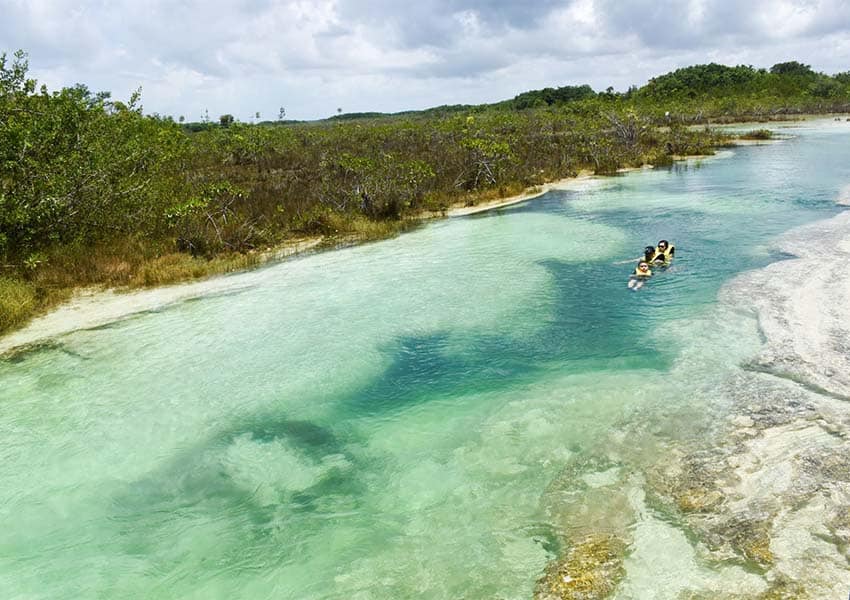
The artificial lagoons used as water reservoirs for the ancient city have also surprised archaeologists. In an interview with the newspaper La Jornada, INAH archeologist Sandra Balanzario said that the lagoons used an advanced hydraulic technique to avoid erosion and water seepage, allowing the lagoons to support the daily life of a city of 100,000 inhabitants spread over an area of 60 square kilometers.
To date, 26 archaeological zones along the Mayan Train are currently undergoing renovation work, with Quintana Roo being home to the largest number of zones in the program.
With reports from La Jornada and Travesías