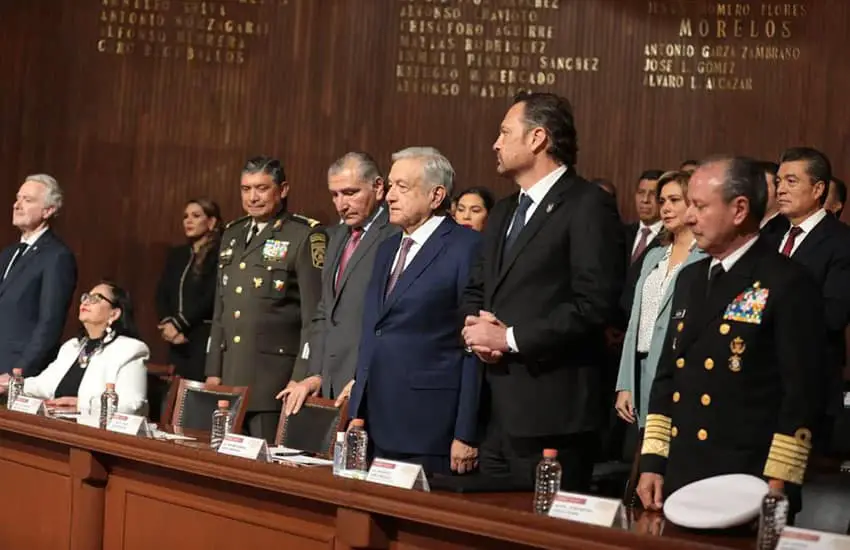
President López Obrador declared Monday that he was “very pleased” and proud that the chief justice of the Supreme Court (SCJN) didn’t stand up before he delivered an official address in Querétaro on Sunday.
Norma Piña, who last month became the first ever female chief justice of the SCJN, remained seated when other officials rose to applaud López Obrador before he gave a speech marking the 106th anniversary of the Mexican constitution.
Speaking at his regular news conference on Monday, the president said Piña may have been tired or simply didn’t want to stand up to acknowledge his presence.
“I was very pleased — very, very pleased because that wasn’t seen before; the court justices used to be employees of the president,” said López Obrador, who has been highly critical of Mexico’s judiciary.
“… Since the rule of Porfirio Díaz the division of powers, the balance between the powers was spoken about but in reality the power of powers was the executive,” he said.
“When had a chief justice ever remained seated at a ceremony like that? That fills me with pride because it means we’re carrying out changes, it’s a transformation. It’s no longer the president who gives orders to [Supreme Court] justices, and it’s also a lie when, in an exaggerated way, a dictatorship or tyranny is spoken about.”
López Obrador’s remarks contrasted with those of his communications chief, Jesús Ramírez, who posted a photo of a seated Piña to Twitter on Sunday and wrote that it was “unfortunate that not everyone respected the protocol of the ceremony.”

In her own address on Sunday, Piña said that “judicial independence isn’t a privilege of judges,” but rather “the principle that guarantees the proper administration of justice.”
With reports from Animal Político, Infobae and El País