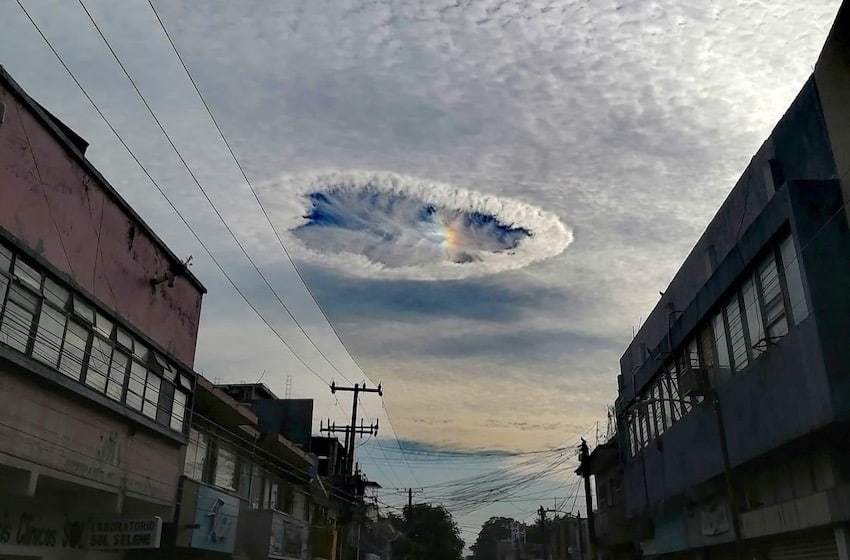
On Wednesday morning, the residents of Tuxtla Gutiérrez, Chiapas observed a peculiar event in the sky: a hole in the clouds.
The phenomenon occurred at around 9:00 a.m., when some captured an unusual cloud formation with a hole in it. The cloud appeared either oval or round, depending on the location from which it was observed, with an irregular rainbow also visible in its center.
#MNTV | #Mundo | Habitantes de #Chiapas se sorprendieron al ver una misteriosa figura en el cielo.
Se trataba una “Nube Cavum” que ocurre cuando la nube se compone de gotas de agua fría. pic.twitter.com/j50oy0cNbJ
— Más Noticias Televisión (@mntvhn) December 28, 2023
Images of this distinct phenomenon went viral on Wednesday, giving way to all kinds of conjectures.
While some people suggested it was an extraterrestrial ship with an invisibility effect, others claimed it was a portal or an apocalyptic signal. Even Mexico’s best-known ufologist Jaime Maussan shared the videos of the strange cloud on his social media accounts, saying it could be “atmospheric” but could also be an “anomaly.”

However, as odd as the sighting was, it was none of the above. The spectacle was a rare but natural occurrence known as a cavum. According to NASA, cavum “are among the most eye-catching cloud formations spotted by sky watchers.”
Also known as hole-punch clouds, cavum are formed due to cold air temperatures and atmospheric instability. When viewed from below, they look like a small lake of blue sky surrounded by feathery clouds, and – though cavum appear to have the exact circumference of a UFO – they are often triggered by a passing aircraft.
With reports from Infobae