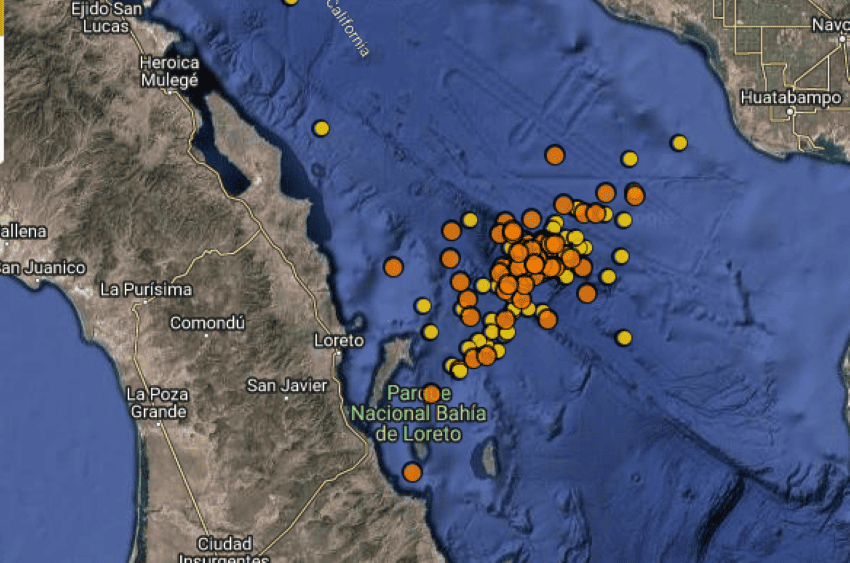
The cities of Mexicali, Tijuana and Tecate, Baja California were hit by a series of earthquakes early on Monday.
The first earthquake, which registered a magnitude of 4.8 on the Richter scale, occurred at 12:36 a.m. Its epicenter was located 3 km from El Centro, a city in Imperial County, California.
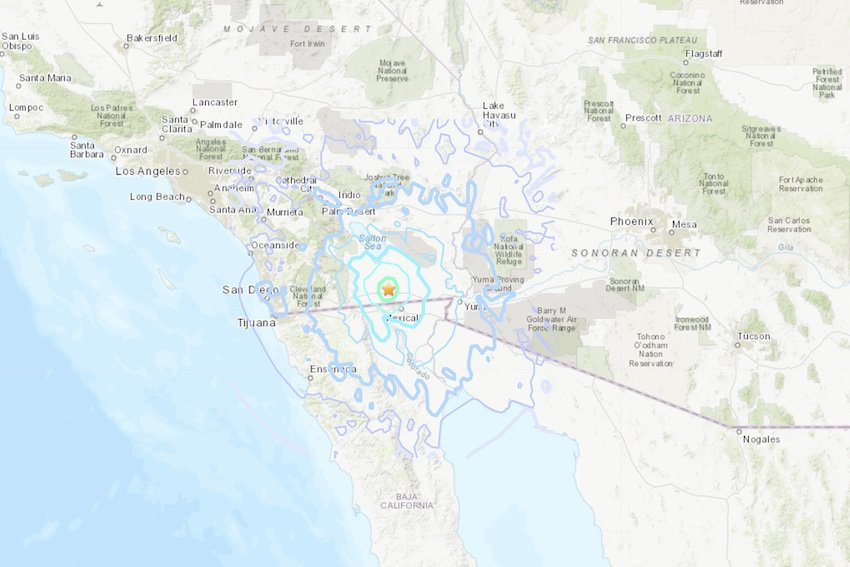
At 2:32 a.m., Mexico’s National Seismological Service (SSN) reported another earthquake with a magnitude of 5.3 and a depth of 10 kilometers southeast of the Santa Isabel municipality in Mexicali.
According to the United States Geological Survey (USGS), over 20 aftershocks occurred between 12:36 and 5:24 a.m. Monday, with magnitudes ranging between 3.5 to 4.8.
As a precautionary measure, Baja California Governor María del Pilar Ávila Olmeda ordered schools in Mexicali to close on Monday so that authorities could assess the safety of school infrastructure.
She added that no damages had been reported so far. According to local media, the Health Ministry reported that the state’s hospitals have been operating normally.
In an interview with the National Autonomous University of Mexico (UNAM), the head of the SSN Arturo Iglesias Mendoza explained that the term “earthquake swarm” refers to the occurrence of multiple earthquakes in the same region within a short period of time. Typically, these earthquakes have similar magnitudes.

This could help explain the cluster of earthquakes that happened today between Mexico and the United States, which seem to have originated from the San Jacinto fault system, one of the most active faults in Southern California.
With reports from La Jornada, Infobae, Zeta Tijuana and ADN 40