
What feels like an interminable heat wave (in reality, it has been three separate ones) has been scorching large swaths of Mexico since early March, with temperatures reaching above 40 C (104 F) in multiples regions of the country, and even surpassing 50 C (122 F) in a few places in the north.
The extreme heat has resulted in 90 deaths according to the federal Health Ministry as of June 7, a more than 1000% increase over the same period last year.

On Wednesday, Hermosillo, the state capital of Sonora, set a new record when the mercury topped out at 49.5 C. El Cubil — a locality in the state of Sonora — hit 51.9 C on Wednesday, the highest maximum temperature reached in Mexico that day, according to the National Meterological Service (SMN).
Three other municipalities in the state set new local records: Ciudad Obregón reached 48 C, Empalme hit 45.5 C and Navojoa reached 45 C. A Sinaloa geophysicist told the newspaper Milenio that Sonora was seeing temperatures comparable to those seen in the Sahara desert.
A fifth heat wave is expected before the end of the month.
However, rains and cooling temperatures have also been predicted across the country for the second half of June, as the weather phenomenon El Niño is expected to end and give way to La Niña.
On Thursday, the SMN forecast torrential rains for much of southern Mexico. The Gulf Coast states of Campeche and Tabasco as well as the states of Yucatán and Chiapas can expect 150 to 250 millimeters of rain while Oaxaca, Quintana Roo and southern Veracruz will see 75 to 150 millimeters of rain. In addition, 50 to 75 millimeters of precipitation is forecast for Guerrero on the Pacific Coast.

The SMN warned of landslides, fast-rising rivers and flooding in the affected areas, while urging the public to pay heed to recommendations from Civil Protection authorities. The weather agency also warned of the approach of the initial tropical cyclones of the hurricane season.
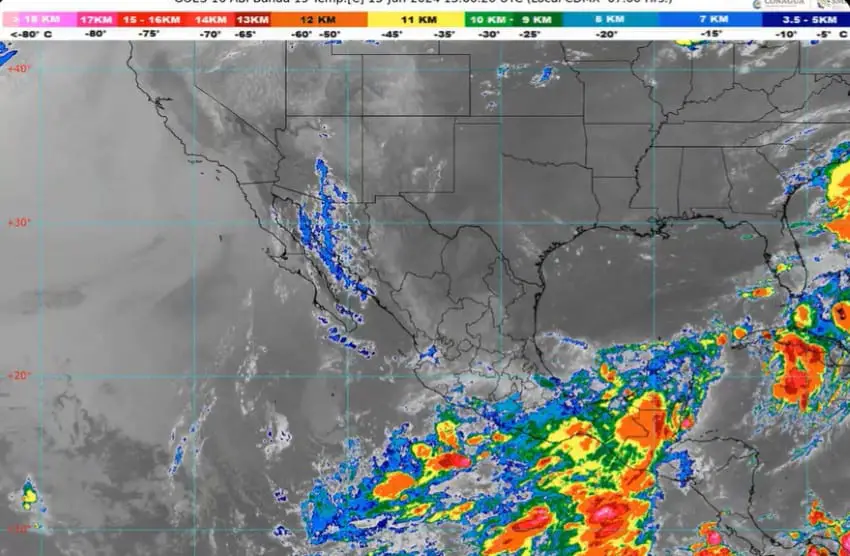
The SMN identified three potential storms:
- The first just off the coast of southern Florida and possibly headed toward Quintana Roo
- A second in the southeastern regions of the Gulf of México
- A third in the Pacific Ocean off the coasts of Guerrero, Oaxaca and Chiapas
In the meantime, sweltering conditions continue in northern Mexico:
- Baja California and Sonora residents are experiencing temperatures above 45 C.
- Baja California Sur, Chihuahua, Coahuila, Guerrero, Jalisco, Michoacán, Nayarit, Nuevo León, San Luis Potosí, Sinaloa, Tamaulipas, which are all experiencing temperatures ranging from 40–45 C, have been warned to protect themselves from the extreme heat.
With reports from El País México, Milenio and El Universal