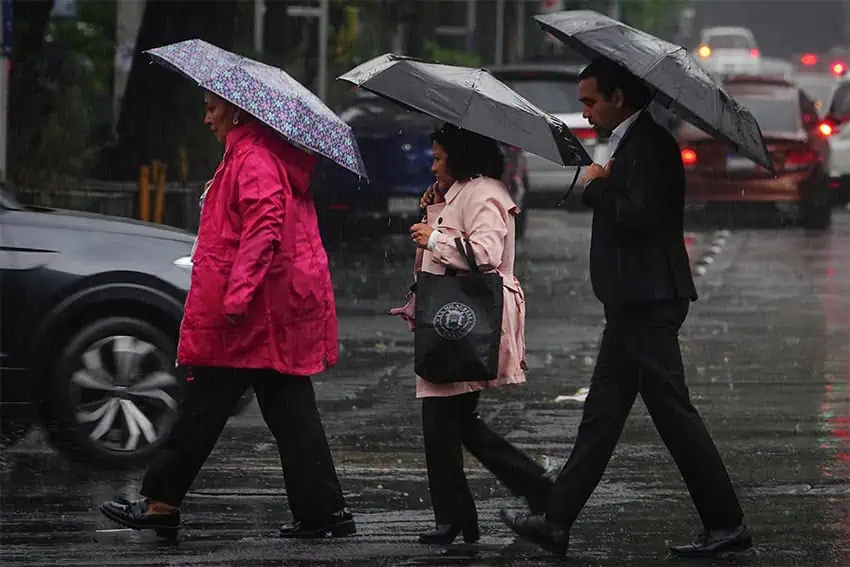
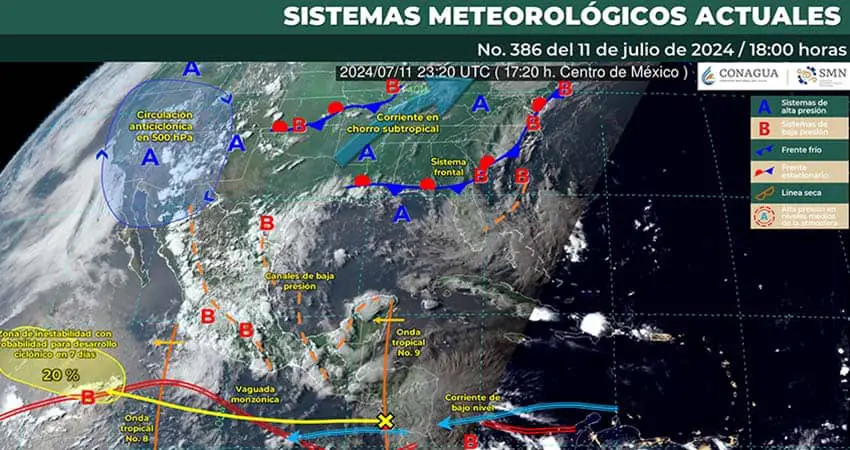
Heavy rains are expected to persist in much of Mexico throughout Thursday evening, due to the impact of tropical waves 8 and 9, according to the National Meteorological System (SMN).
Troughs over Mexico’s west, northeast, east, and center, combined with humidity coming in from the Pacific Ocean and the Gulf of Mexico, brought electrical storms, strong winds and hail to some parts of Mexico — and rain, lots of it. And will continue to do so overnight, the SMN predicted.
Here’s a look at what the SMN is predicting through 8 a.m. Friday.
Rainfall by states
Intense rainfall, expected to bring a total of 75 to 100 mm through Thursday, is forecast for parts of:
- Coahuila
- Nayarit
- Jalisco
- Colima
- Michoacán
- Guerrero
- Morelos
- Veracruz
- Oaxaca
- Chiapas
Very heavy rains (50 mm to 75 mm) are forecast for parts of the following states:
- Nuevo León
- Tamaulipas
- San Luis Potosí
- Guanajuato
- Querétaro
- Hidalgo
- México state
- Puebla
And SMN predicted between 25 and 50 mm of rain for areas of:
- Sonora
- Chihuahua
- Durango
- Sinaloa
- Zacatecas
- Aguascalientes
- Mexico City
- Tlaxcala
- Tabasco
- Campeche
- Yucatán
- Quintana Roo
Light rainfall, i.e. less than 5 mm, is expected for Baja California and Baja California Sur.

In addition, SMN is warning of brief, occasional but intense electrical storms until 9 p.m. Thursday in areas of the states of Veracruz, Oaxaca, Chiapas, Tabasco, Yucatan, Campeche Quintana Roo, Guerrero, Sonora, Sinaloa, Chihuahua, Zacatecas and Durango, with wind gusts of 40 km/h to 60 km/h and possible hailstorms in Sonora and Sinaloa.
The SMN has warned that heavy, sudden rainfall could lead to landslides, increased river and stream levels, and flooding in low-lying areas and urged residents of areas experiencing heavier levels of rain to take precautions.
Updated forecasts and alerts can be found at the SMN’s account on the social media platform X.
The national weather agency also said it is monitoring a potential low-pressure zone south of the Yucatán Peninsula, with a 20% probability of cyclonic development in the next week.
Mexico has had a rainy summer so far, with its rainiest June in more than 80 years. July is expected to continue the same trend, with some models predicting rainfall well above average in many parts of Mexico.
Mexico News Daily