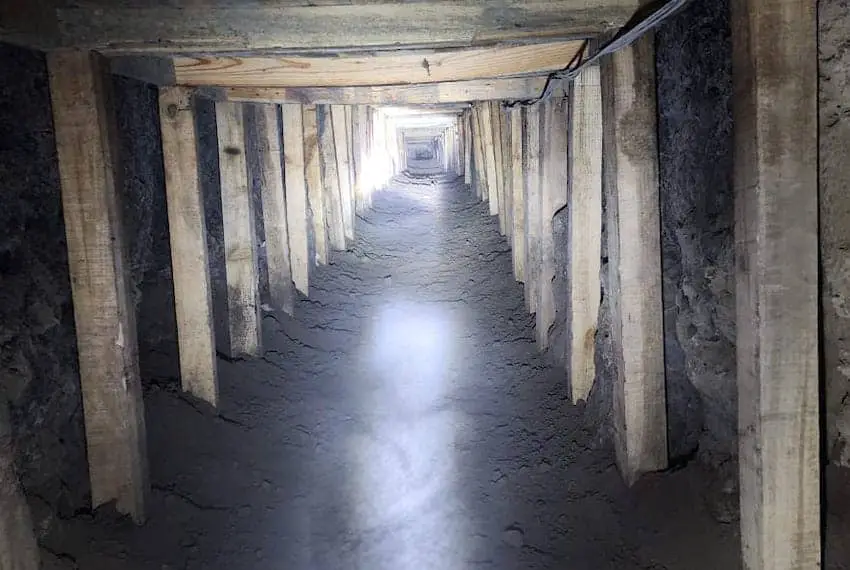
State and local authorities seized control of an 85-meter-long tunnel that was being used to steal from a Pemex gasoline duct in México state.
The “mega tunnel” was located inside a house in San Bartolo in the municipality of Acolman, a few miles south of the Teotihuacán pyramids and archaeological complex.
#Resultados. La #FiscalíaEdoméx, en conjunto con la @SS_Edomex y la Dirección de Seguridad Pública Municipal de #Acolman, ejecutaron técnica de investigación de cateo en un domicilio ubicado en el poblado de San Bartolo de esta demarcación, donde fue localizado un túnel realizado… pic.twitter.com/j9hFi27190
— Fiscalía Edoméx (@FiscaliaEdomex) July 19, 2024
The state Attorney General’s Office (FGJE) issued a statement on Thursday detailing the operation that led to the discovery of the underground passage after a warrant was issued to search the San Bartolo property.
The statement explained that the warrant was obtained after Acolman authorities notified the FGJE about suspicious excavation activities in San Bartolo.

During the inspection, the police discovered an access point to a tunnel three meters below the surface. Agents descended into the 1-meter wide tunnel and found five taps protruding from the ceiling of the passageway. The taps were connected to a fuel duct.
The FGJE did not disclose whether there was an access point at the far end of the tunnel, nor did it speculate how long the tunnel might have been used to steal fuel, popularly known as huachicoleo.
The area around the property was cordoned off and Acolman’s civil protection agency was on scene to determine if there was danger of an explosion and if the area should be evacuated.
The FGJE was preparing to turn the case over to the Federal Attorney General’s Office (FGR) as fuel theft is a federal crime. There were no arrests reported as of Friday morning.
This marks the second fuel theft tunnel located in the municipality of Acolman this year, after state and local authorities discovered evidence of huachicoleo in the Santa Catarina ejido.
The 200-meter long tunnel in Santa Catarina was far more sophisticated than the one in San Bartolo. The length of the passageway was strung with light bulbs as well as high-pressure hoses and pumping equipment. The tunnel featured a cement floor and a series of wooden support poles and ended at taps connected to a Pemex pipeline.
The Mexican government began cracking down on huachicoleo shortly after President Andrés Manuel López Obrador took office in December of 2018, but fuel thieves have since turned to building tunnels to sustain their illicit business.
In May, Mexico’s national oil company Pemex reported it was losing US $1.2 billion per day to gas thieves, and the overall losses during the first three months of this year were four times greater than net profit during Q1 2024.
Earlier this month, Pemex reported that huachicoleo in México state was primarily targeting jet fuel and illegal taps had also been discovered within Mexico City.
With reports from Infobae, La Jornada and Expansión