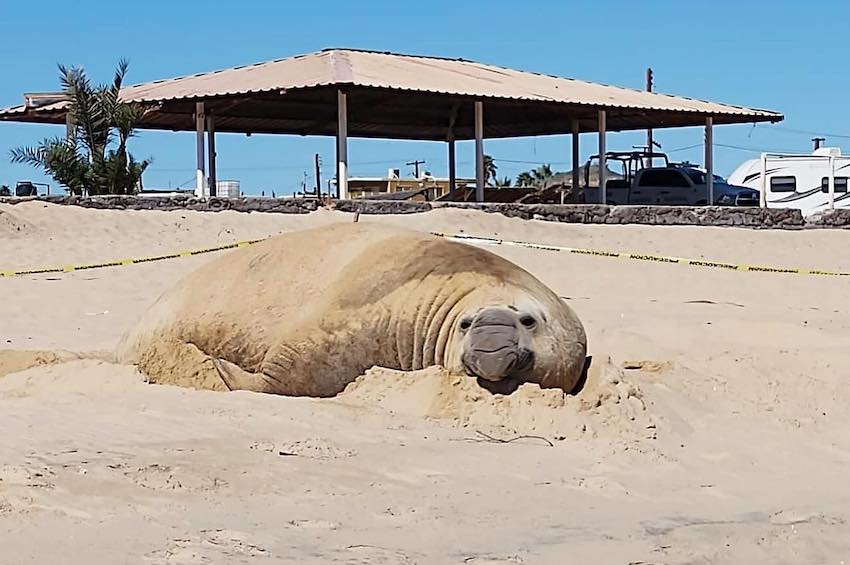
Panchito the elephant seal is back!
For the past five years, the young elephant seal from South American waters has been making the long trek north and spending his summers on Mexican beaches.
And this year is no exception.
For nearly a month, Panchito has been hanging out on a beach in the fishing town of San Felipe, Baja California — where he has become a local celebrity and the focus of a community-wide effort to protect and monitor him.
Moreover, his presence has turned San Felipe into a hub for marine conversation.
Southern elephant seals (Mirounga leonina) generally prefer the cold waters near Argentina or even as far south as Antarctica — but Panchito apparently likes to vacation in Mexico. On his first visit in 2020, he spent part of his summer on San Pancho Beach in Nayarit.
A wonderful video short documentary on Panchito, the infamous southern elephant seal who has visited San Felipe the last 2 winters & became a local conservation celebrity & ambassador
By @MaliciaTejeda & @SophiaStieglitz with music by @JuanCirerol & support from @PronaturaNoroes pic.twitter.com/Fxakxvoez8— Cetacean Action Treasury (@CetaceanAction) July 27, 2024

Upon his arrival a few weeks ago, specialists from the organization Cetaceans, Action and Transformation (CAT) quickly stepped in, establishing a perimeter around the seal to ensure his safety.
Having traveled some 8,000 km from his home waters, he was in need of a rest, so surveillance brigades were formed to protect him 24/7, with the community playing a crucial role in the initiative.
Following his 2020 visit, Panchito — whose full name is Panchito El Cortés, according to CAT — has since been spotted annually in Mexico, from La Paz near the southern tip of Baja California Sur to the Upper Gulf of California (in the Gulf of Santa Clara in Sonora, to be exact).
His repeated visits have allowed researchers to identify him by a distinctive mark on his beard.
“Panchito’s visit is an extraordinary event for Mexican waters,” marine ecologist Georgina Castro Proal told the online news outlet Animal Politico. “Seeing him here is quite rare.”
In a two-minute video, CAT’s María Tejada claims Panchito is “the first [southern] elephant seal observed in our country.” Panchito, she adds, “can be distinguished from the northern variant [of his breed] that can be seen regularly in some Baja islands and which has an attack stance similar to that of a cobra.”
Northern elephant seals (Mirounga angustirostris), found from California to Alaska, typically breed and give birth on offshore islands or remote mainland beaches, often in Baja California.
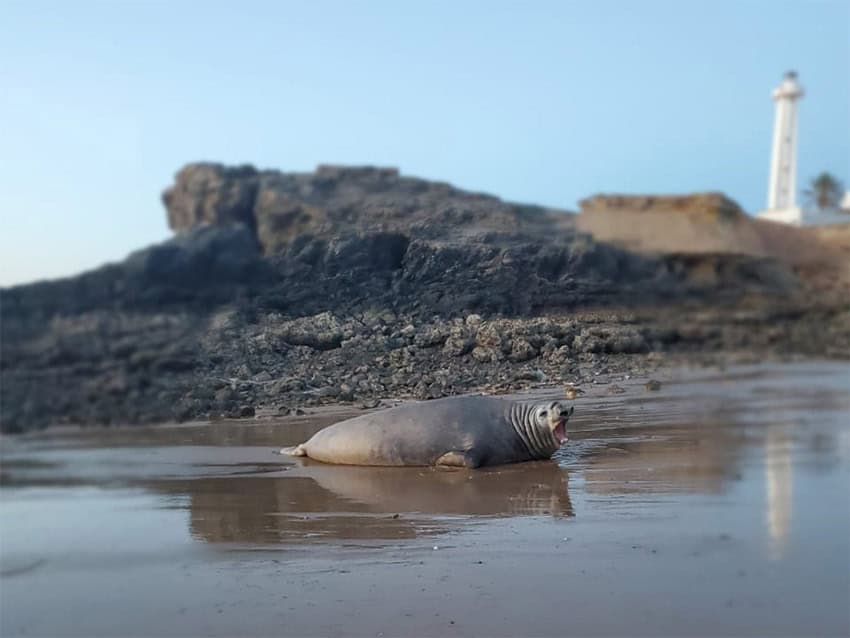
CAT has been actively educating visitors through videos, flyers and social media posts about how to safely observe Panchito without disturbing him.
They’ve emphasized the need for distance, urging people not to feed or interact with him, as these actions could be harmful. Many people are observing him from the boardwalk, others from behind the barrier.
“Everyone wants a photo, but they’ve learned to respect his space,” Tejada said.
In the video, she says he is a “sub-adult” around 10 years old who weighs almost 500 kilos (1,100 pounds). Southern elephant seals typically live between 20 and 30 years, although males tend to have shorter lifespans due to intense competition for breeding territories.
CAT has been collaborating with the Federal Attorney’s Office for Environmental Protection (Profepa) and the National Commission for Protected Natural Areas (Conanp) to ensure Panchito’s well-being.
Surveillance will be maintained until he decides to return to the colder waters of Patagonia.
“This experience has brought the community together and highlighted the importance of protecting our coastal ecosystems,” Castro Proal said.
With reports from Animal Político and La Voz de Frontera