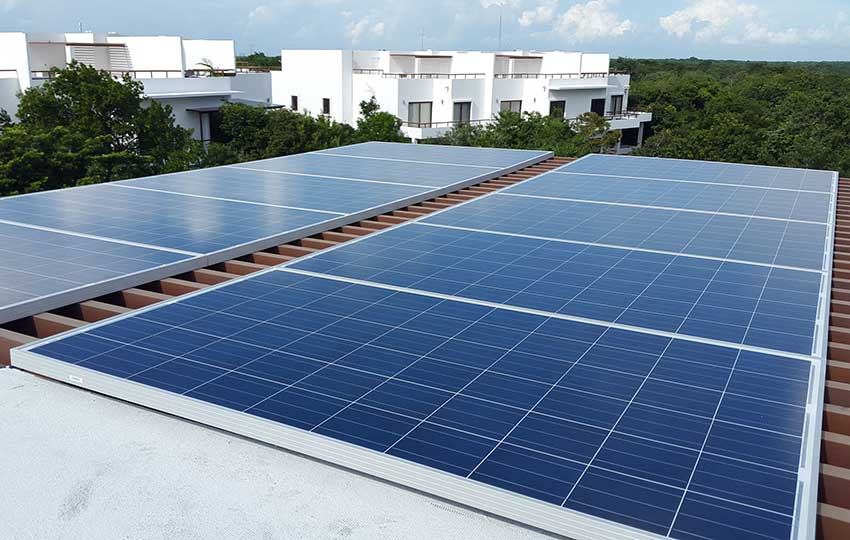
The Federal Electricity Commission (CFE) has withdrawn its legal opposition to the regulations governing the sale of solar energy up to 500 kilowatts, meaning that people with small solar systems will soon be able to sell electricity they generate back to the state-owned company.
In April last year, the CFE filed an injunction against regulations drawn up by the Energy Regulatory Commission (CRE) for the method used to calculate the rates it would pay to solar energy generators, arguing that they led to a loss of income because of high transmission costs.
The legal action effectively meant that people using small solar systems couldn’t sell the energy they produce to the CFE, a situation which the general secretary of the National Solar Energy Association (ANES) said in April was “holding back investment” in the sector.
It was also a barrier to unlocking the full capacity of the distributed generation market in Mexico, whose potential value is estimated to be more than US $500 million.
With the withdrawal of the CFE injunction, three legally established self-generation electricity schemes can now be implemented.
Under net metering, solar energy which a customer generates is measured so that any excess can subsequently be returned to the same customer to meet future energy consumption needs, likely at a time when conditions for solar generation are less favorable.
Under net billing, solar generators can sell excess electricity they produce to the CFE and receive a payment from the company in cash that is calculated according to the rate set by the CRE.

Thirdly, solar generators who don’t need any of the energy they produce can send all their electricity into the national grid and receive corresponding monetary compensation, again according to the rate set by the regulatory authority.
The ANES said the CFE’s withdrawal of its injunction is a sign of the maturity that the distributed generation market has reached, adding that achieving growth in the sector of 200% or more is now possible.
According to the CFE, it has signed 60,000 net metering contracts with power generators who have installed solar panels with less than 500 kilowatts capacity on the roofs of their homes or on those of commercial premises.
The withdrawal of the injunction will allow those people to benefit financially from the energy they produce.
The CFE also said that 420,000 high-consumption customers could now take advantage of installing solar panels on their roofs with the confidence that by selling the excess electricity they produce, they will get back their initial investment in four to seven years.
It is estimated that by the year 2030, generated distribution capacity in Mexico could reach 19,000 megawatts and that the sector could create one million jobs due to an increased demand to purchase solar systems and have them installed.
The CFE now has a period of 100 days within which it must publish details of its billing and payments for the three energy sale schemes while the CRE has until the end of the year to announce any changes to the existing rate calculation method.
Source: El Economista (sp)