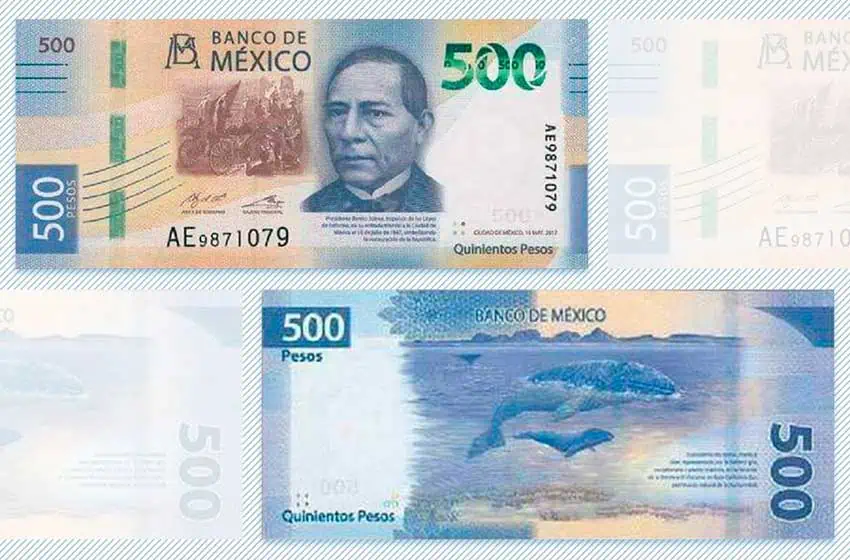
Images of former president Benito Juárez and a gray whale replace those of artists Frida Kahlo and Diego Rivera on the new 500-peso bill which entered circulation today.
The Bank of México (Banxico) officially launched the new blue-colored note at an event in Mexico City, where it was announced that it is the “first in a new family of bills that pay homage to our historical identity and natural heritage.”
The central bank said in a video that “the ecosystem of coasts, seas, islands and the gray whale” and “the historic process of La Reforma [a 19th-century liberal reform] and the restoration of the republic” feature together on the new 500-peso bill.
Juárez, a Zapotec lawyer from Oaxaca who served as president between 1858 and 1872, now appears on two bank notes as his likeness is already featured on the 20-peso bill.
Although both notes are blue and feature Juárez, Banxico pointed out that the 500-peso bill is larger than the 20 and that the former is made of cotton paper whereas the latter is plastic.
Bank of México governor Alejandro Díaz de León said the decision to change the 500-peso note was made because it is the most widely circulated and most counterfeited denomination.
The new bill features a range of security features including fluorescent ink, a dynamic thread, embossing perceptible by touch, a watermark and a multicolor denomination.

A new 200-peso bill, featuring independence heroes Miguel Costilla y Hidalgo and José María Morelos on one side and the El Pinacate desert biosphere reserve on the other, will enter into circulation next year, while a new 1,000-peso note will be issued in 2020.
The latter will pay homage to the Mexican Revolution, with images of Francisco I. Madero, Carmen Serdán and Hermila Galindo on one side. The opposite side will feature Campeche’s Calakmul Biosphere Reserve.
The 500-peso bill was first issued in 1994 and featured an image of army general Ignacio Zaragoza.
The Frida and Diego bill appeared in 2010 but will now be gradually withdrawn from circulation.
Source: El Financiero (sp)