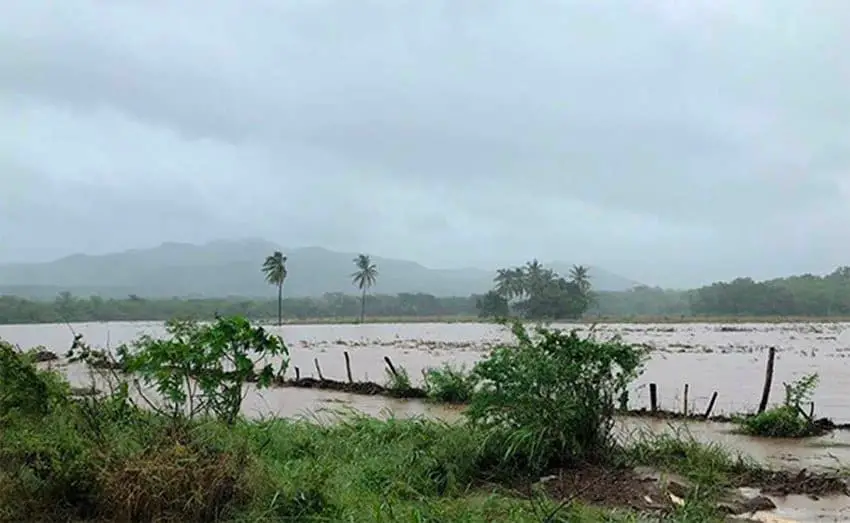
Three days of torrential rain brought by Hurricane Willa last month destroyed crops worth at least 100 million pesos (US $5 million), according to the mayor of a Jalisco municipality.
Jorge Luis Tello García said that more than 700 hectares of pineapple, papaya, chile, corn, tomatillo and sorghum crops were damaged by the heavy rain that fell between October 22 and 24 in Tomatlán, a coastal municipality south of Puerto Vallarta.
Willa slammed into the coast of southern Sinaloa on the evening of October 23.
Among the affected farmers in Tomatlán are 20 women who belong to an all-female senior citizens’ agricultural collective that grows pineapples.
Two members, Engracia and Adelina, told the newspaper El Universal that they lost their entire four-hectare crop due to the hurricane because they couldn’t access their land to save it.
“It rained and rained for three days, the rivers swelled, the roads were cut off . . . We couldn’t get there until Saturday [October 27], we cut the pineapples and took them to Guadalajara but they were no good, they’d rotted and the market returned them to us,” Engracia said.
They are among about 1,000 farming families in the region who lost their crops but have been unable to access government compensation because state Civil Protection services ruled that there wasn’t sufficient damage to declare a state of disaster.

Engracia and Adelina, accompanied by Mayor Tello García, traveled to Guadalajara to report the situation to state authorities.
The mayor said he believes that Governor Aristóteles Sandoval is not aware of the situation because following past natural disasters, such as Hurricane Patricia in 2015, assistance was provided immediately.
“What we want is for them to make insurance available for the farmers, for them to help us,” Tello explained.
Without government assistance, Adelina said, the members of the women’s collective won’t be able to plant more pineapples.
“. . . Half of what we make we share and the other half we use to produce again but now it’s over,” she said.
Adelina explained proudly that one hectare of well-tended land can yield up to 80 tonnes of pineapples.
Asked how much the collective had lost due to the loss of its crop, she responded:
“In money? Well, you do the math, they pay us five pesos per kilo.”
Source: El Universal (sp)